
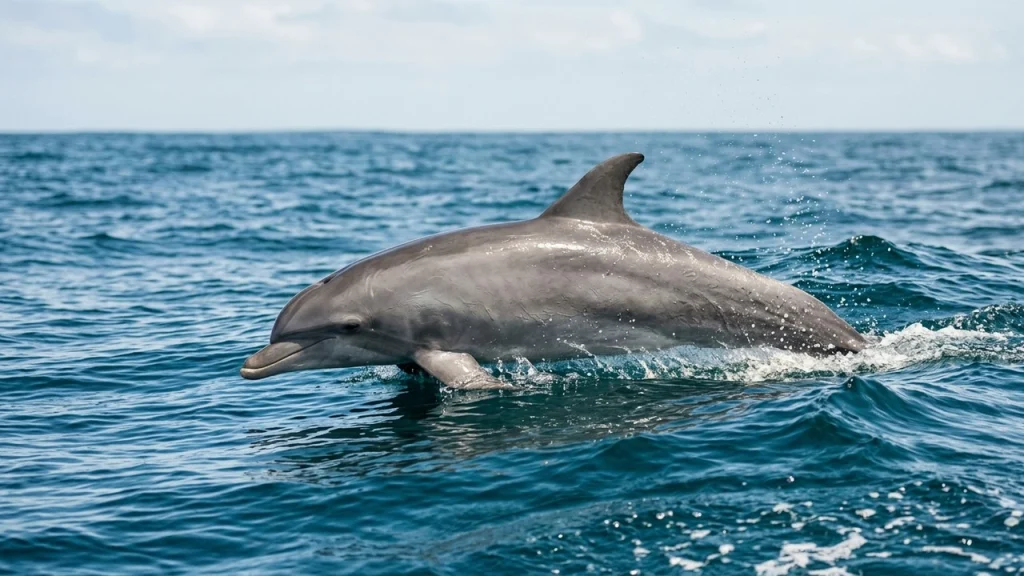
Dolphins have longer, leaner bodies than porpoises, NOAA Fisheries reports, with faces that extend into a distinct elongated beak. Their teeth come to a point in a cone form, and the back fin curves rearward in the manner of a sickle.
Porpoises, by contrast, have smaller and stockier bodies, the same fisheries guide notes. Animal Diversity Web describes short jaws without a beak and teeth shaped like spades, while the back fin forms a little triangle in certain species, shrinks to a low ridge in others, and grows very large in males of Phocoena dioptrica.
Face, teeth and back fin
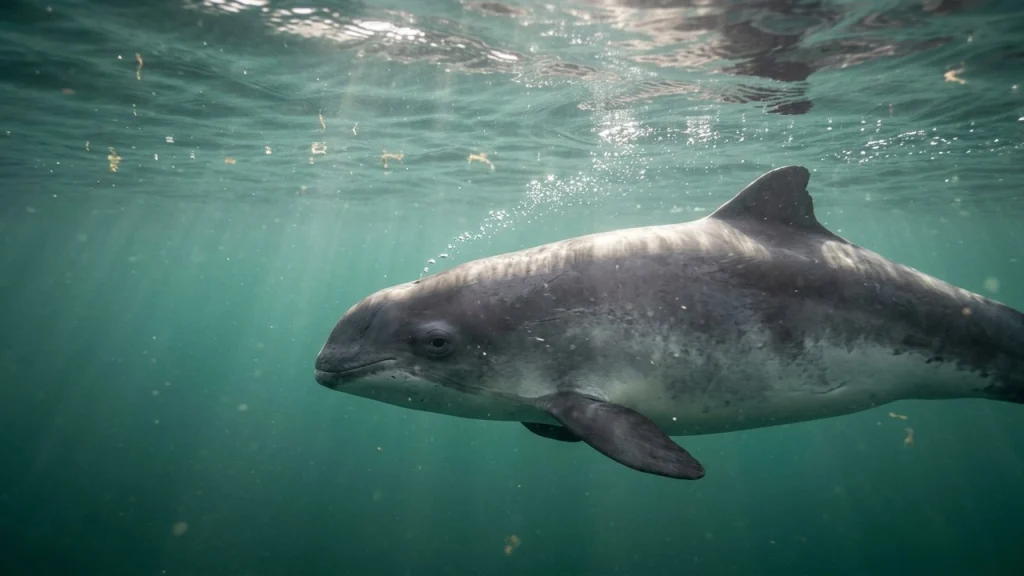
NOAA Fisheries portrays the harbor porpoise as compact and sturdy, with a stubby rounded beak and a triangular fin of middle size. Animal Diversity Web notes that orcas and Irrawaddy dolphins break the long beak pattern with briefer beaks that stop beneath the melon. Harbor coloring runs dark gray on the back, paler gray along the flanks, and white on the belly and throat with a dark chin mark toward the front, the same university account details.
Size range and wider family
Animal Diversity Web gives 1.5 to around 2 m for the length of porpoise family members. Weight in that family tops out at up to about 120 kg, the same university account adds. Dolphin family members differ greatly, the same university account reports, with orcas at almost 10 m and Hector’s dolphins at up to 1.2 m.
The same university account counts 37 species in 17 genera among oceanic dolphins and 6 species in 4 genera among porpoises. NOAA Fisheries places dolphins, porpoises and whales together as cetaceans, a marine mammal group, with dolphins and porpoises classed further as toothed whales. The two lines parted between 5.3 and 23 million years ago during the Miocene, the same university account estimates.
Group life and raising young
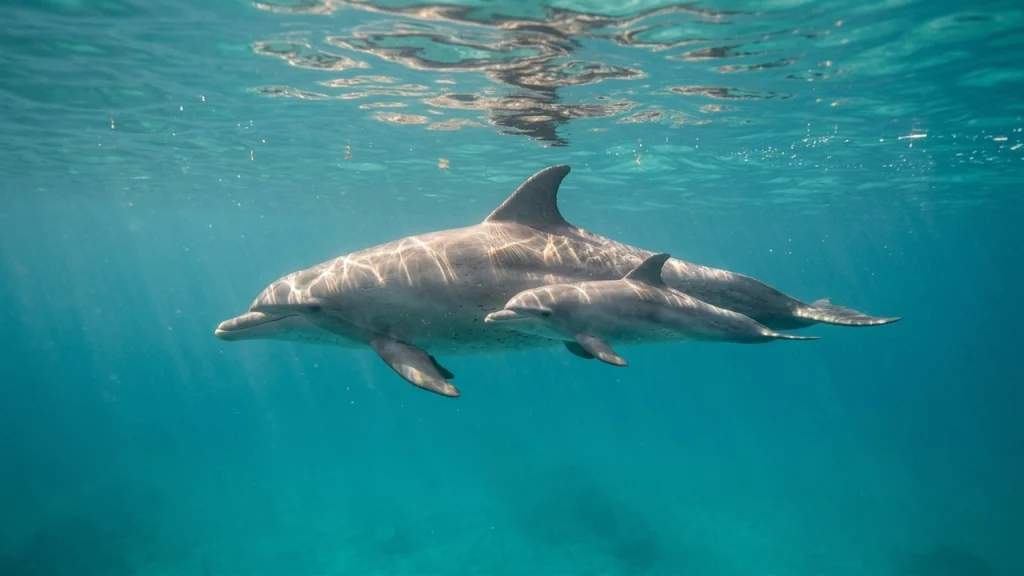
NOAA Fisheries calls dolphins strongly gregarious animals that may gather in large pods. Animal Diversity Web describes porpoises as traveling in parties of fewer than 6, at times rising to up to 20. Harbor porpoises usually appear alone, in pairs or in parties of no more than 10, though clusters of up to 200 have been reported. NOAA Fisheries states porpoises can be very shy and tend to stay away from boats.
Animal Diversity Web reports most oceanic dolphin species survive at least 10 to 20 years in the wild. Bottlenose dolphins can reach up to 60 years, the same university account adds. Depending on the species, Animal Diversity Web states calves may still be nursing at as much as 18 months old. A harbor porpoise lives about 24 years, the same fisheries guide estimates, with females maturing at 3 to 4 years, carrying young for 10 to 11 months and nursing for 8 to 12 months.
Voices, ranges and meals
NOAA Fisheries describes dolphins and porpoises as highly intelligent animals that use echolocation to find meals, keep contact and navigate. Dolphins trade clicks, squeaks, buzzes and whistles sent through the blowhole, the same fisheries guide notes. Animal Diversity Web treats the melon as a lens that focuses sound for contact and echolocation. Porpoises instead use extremely high pitched clicks beyond human hearing, the same fisheries guide reports.
The agency connects the vocal contrast to blowhole build that may have developed to evade hunters.
Oceanic dolphins occupy oceans, seas, estuaries and some rivers, the same university account notes, while porpoises keep to northern coasts, much of South America, parts of southeastern Asia and a few Asian rivers. Dolphins eat mainly fish and squid, the same university account adds, while orcas also pursue penguins, earless seals, eared seals, walruses and smaller dolphins. Porpoises take varied fish and spineless animals, the same university account continues. Harbor porpoises focus on schooling fish such as herring and mackerel and eat squid or octopus only now and then.
Sources
- NOAA Fisheries: Is It a Dolphin or Porpoise?
- NOAA Fisheries: Harbor Porpoise
- Animal Diversity Web: Delphinidae (dolphins, killer whales, pilot whales, and relatives)
- Animal Diversity Web: Phocoenidae (porpoises)
- Frontiers in Physiology: Echolocation by the harbor porpoise: life in coastal waters
- IUCN SSC Cetacean Specialist Group: Vaquita