
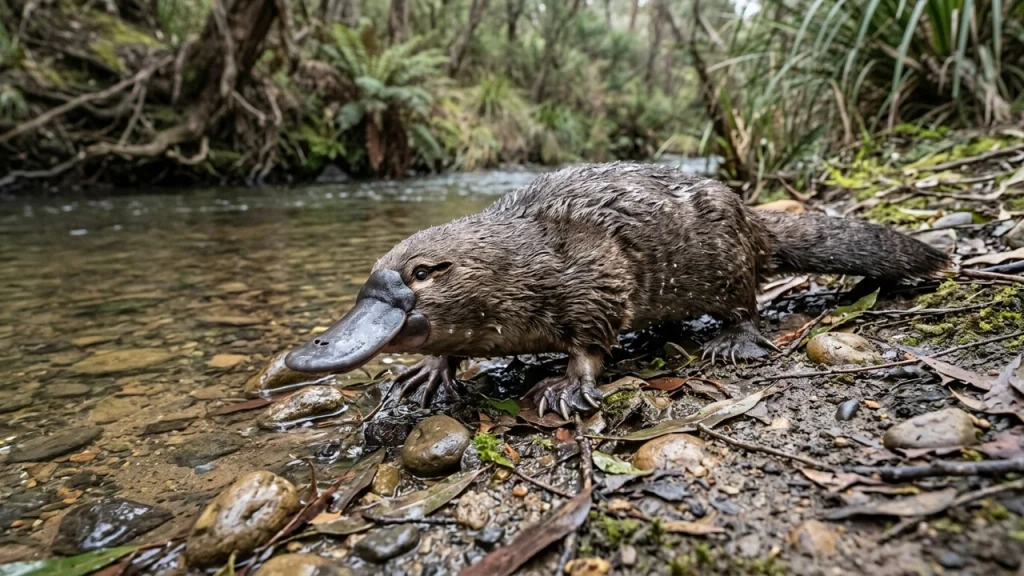
The platypus is an egg-laying mammal classified in class Mammalia and order Monotremata that produces milk to nurse its young. As observed by the San Diego Zoo Wildlife Alliance, “While most other mammals give birth to live young, platypuses (along with echidnas) lay eggs, incubate them, and nurse their young.”
Animal Diversity Web places the duck-billed platypus in subphylum Vertebrata, class Mammalia, order Monotremata, family Ornithorhynchidae, genus Ornithorhynchus, and species Ornithorhynchus anatinus. Animal Diversity Web notes that these creatures stand apart from other mammals by preserving the primitive trait of laying eggs.
Fur, milk patches, and nursing young
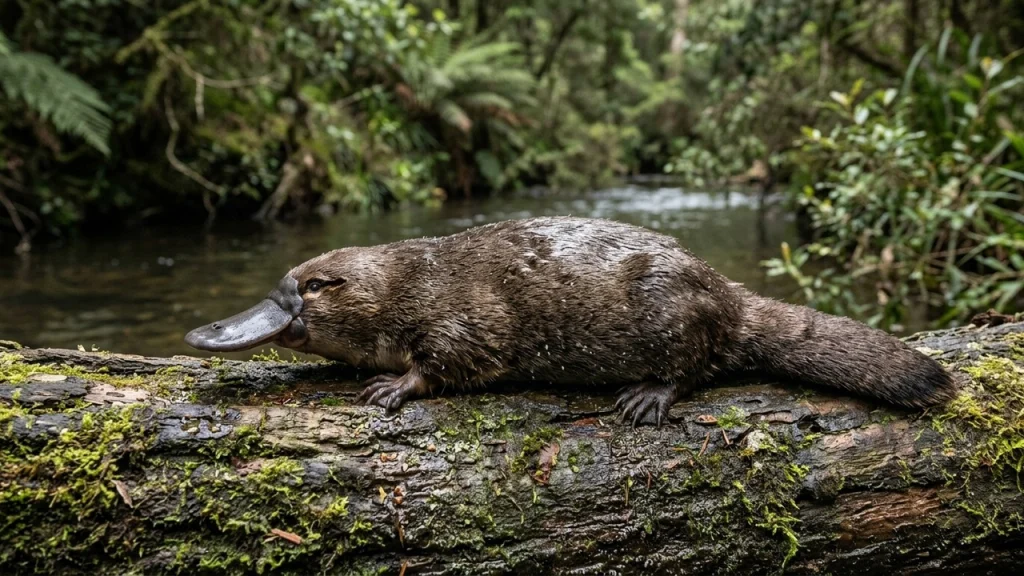
The Australian Museum states that the platypus possesses a hydrodynamic frame alongside an expansive, flattened tail shielded by thick, water-resistant fur, furnishing exceptional thermal insulation.
Animal Diversity Web indicates that maternal individuals possess milk glands without developing teats. The San Diego Zoo Wildlife Alliance highlights that abdominal skin surfaces exude secretions directly for offspring to lap up. The Australian Museum specifies that once hatching occurs, female fluid begins discharging, allowing juveniles to feed from two fur-shrouded abdominal zones.
Dentition also transforms across developmental stages. Animal Diversity Web documents that immature individuals carry juvenile dental crowns before replacing them with keratinous chewing pads in adulthood. An investigation published in Nature discovered that milk protein coding sequences remain conserved even though egg deposition persists.
Venom spurs and skeletal morphology
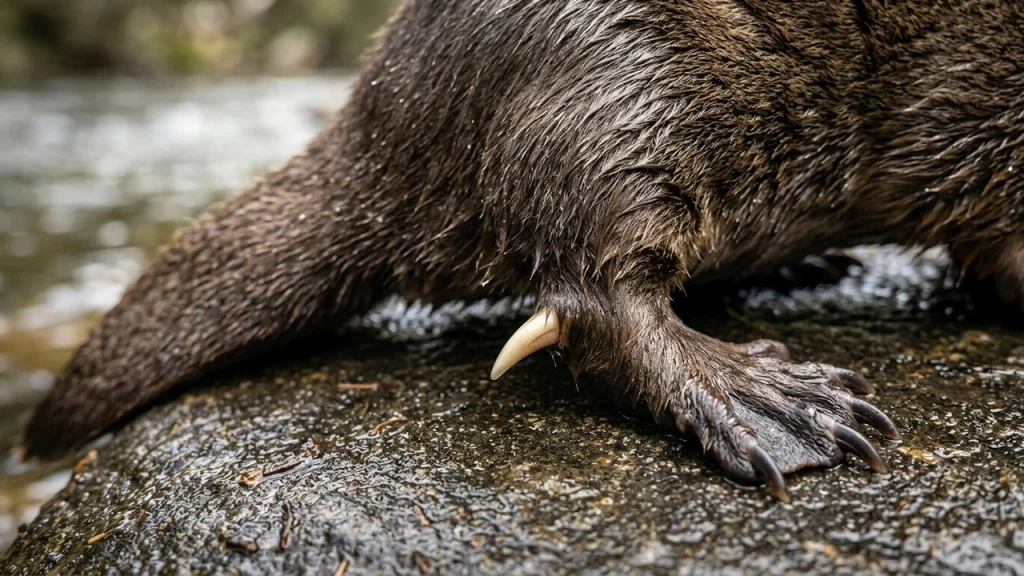
The Australian Museum documents that male specimens carry a pointed projection on each tarsal region linked to an upper-limb secretory reservoir, placing the creature among the rare venom-producing mammalian species. In Nature, researchers described the species: “This monotreme exhibits a fascinating combination of reptilian and mammalian characters.” The publication indicates that toxic peptides in both platypus secretions and reptilian lineages arose independently via equivalent molecular families.
Internal framework architecture also parallels reptilian forms. The Australian Museum explains that platypus bones present distinct structural affinities with living and prehistoric reptiles, characterized by chest supports containing five elements, laterally positioned limbs, and reduced cervical rib remnants. The San Diego Zoo Wildlife Alliance adds that supplementary elements reinforce the pectoral girdle that do not appear elsewhere in class Mammalia.
This skeletal orientation directly impacts terrestrial locomotion. The San Diego Zoo Wildlife Alliance notes that across terrain, platypuses exhibit reptile-like locomotion because limbs project from torso flanks rather than below. Animal Diversity Web notes that both reproductive clutches and metabolic byproducts exit through a singular posterior vent known as a cloaca.
Sources
- Animal Diversity Web: Ornithorhynchus anatinus (duck-billed platypus)
- San Diego Zoo Wildlife Alliance: Platypus | San Diego Zoo Animals & Plants
- Australian Museum: Platypus – The Australian Museum
- Nature: Genome analysis of the platypus reveals unique signatures of evolution
- WWF-Australia: Platypus | WWF Australia