
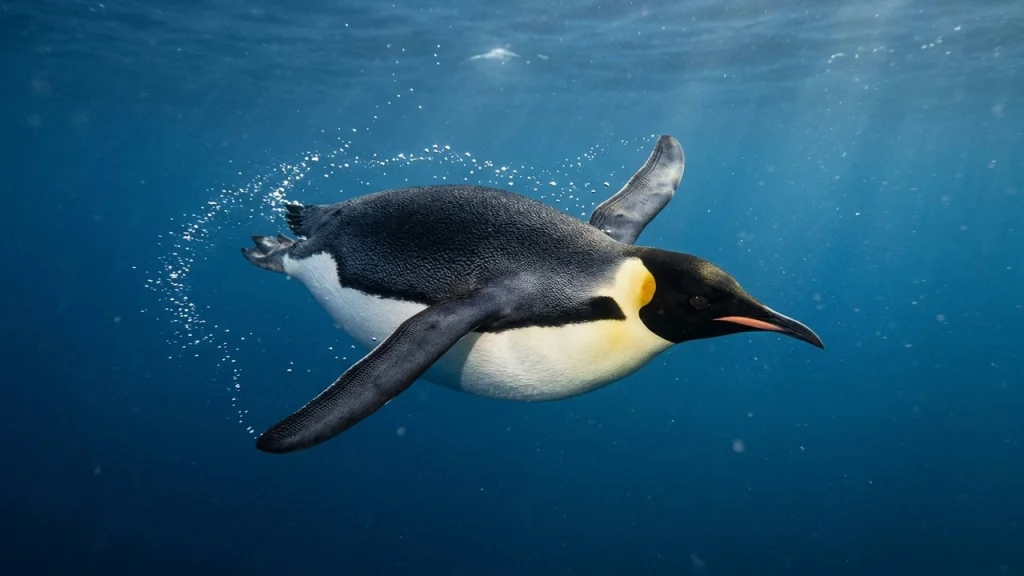
No, penguins cannot fly through the air. The San Diego Zoo Wildlife Alliance describes the African penguin (Spheniscus demersus) as having long, flat wings for moving through water and as incapable of flight through air, and Animal Diversity Web calls the little penguin (Eudyptula minor) a flightless bird.
A study in Proceedings of the National Academy of Sciences reports results that support the hypothesis that “optimizing wing shape and form for wing-propelled diving leads to such high flight costs that flying ceases to be an option in larger wing-propelled diving seabirds, including penguins.” Biomechanical models in that study suggest a wing designed for optimal diving performance should carry enormous energy costs in the air. Penguins fall within a wider seabird trend: flightlessness arose separately in at least five seabird lineages, despite the advantage of flying through the air.
Wings that push water, not air
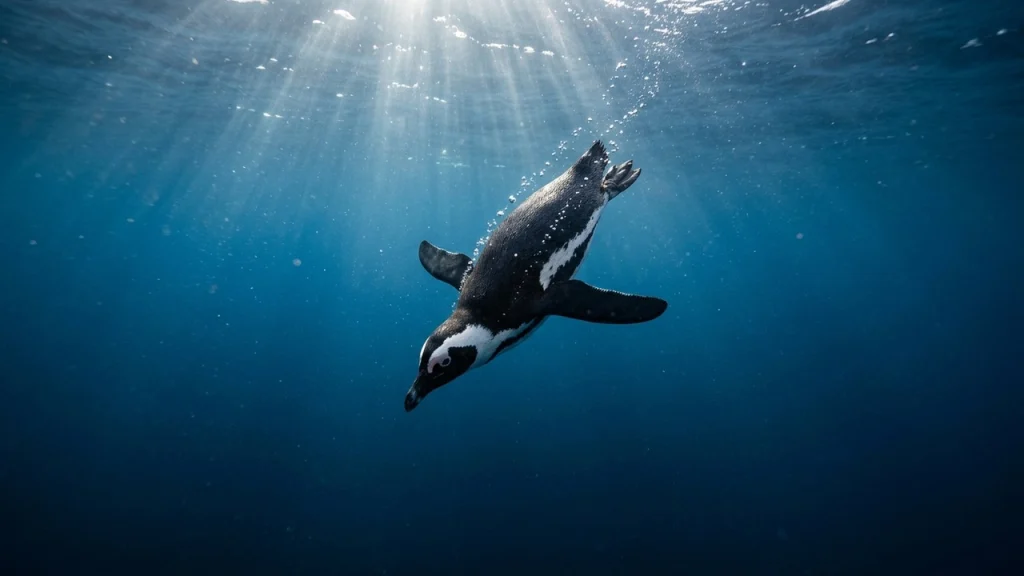
The San Diego Zoo Wildlife Alliance fact sheet says the wings beat nearly perpendicular to the long axis of the body, with the up and down strokes roughly equal in duration. On the downstroke lift points upward and forward, and on the upstroke it points downward and forward.
For the African penguin, that fact sheet gives a maximum wing speed of 3.23 m/sec and a maximum wing beat rate of 3.24 beats/sec. Directional control, the same list records, comes from the tail, the feet and the wings.
Steering and swimming speeds
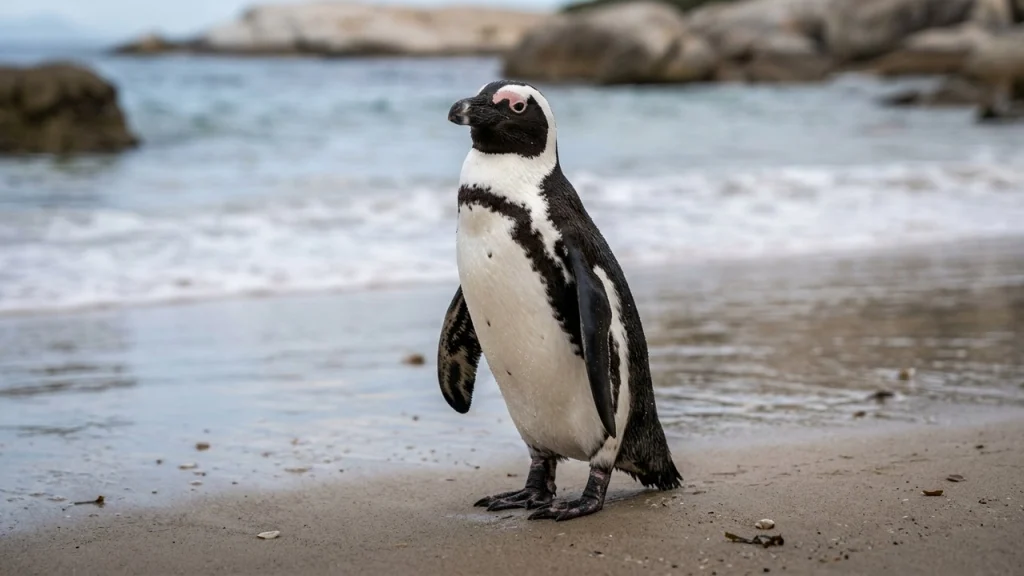
Adjustments of the feet and tail guide movement up or down along the body’s vertical axis, and the San Diego Zoo Wildlife Alliance fact sheet says a penguin turns its ventral surface toward the inside of every turn. That sheet records a swimming speed of approximately 12 km/h, and notes short dives followed by breathing leaps.
Across an entire trip, swimming speed ranges from 3.5 to 6.3 km/hr (2.2 to 3.9 mi/hr). Dive costs differ between species: a study in Proceedings of the National Academy of Sciences reports them high for cormorants and low for murres, although a murre’s dive cost stays above that of flightless wing-propelled diving birds such as penguins.
Flipper length and body shape
Animal Diversity Web gives the little penguin an average flipper length of 117.5 mm and says flipper length is similar in both genders. The San Diego Zoo Wildlife Alliance fact sheet, for the African penguin, describes a streamlined body and a short neck.
Bones that kept changing after flight was lost
A study in the Journal of Anatomy reports that the high bone density seen in penguins comes from compaction of the internal cortical tissues, and treats penguin bones as osteosclerotic rather than pachyostotic. The same study proposes two key transitions as penguin humeri moved from the hollow bones typical of birds to the dense osteosclerotic kind.
It describes two changes: a smaller medullary cavity, the result of reduced perimedullary osteoclastic activity, and a more solid cortex achieved by compaction. The oldest material in the study came from Eocene stem taxa, stages of penguin evolution that fell at least 25 million years after flight was lost, and their humeri differed clearly from those of today’s penguins.
The authors take this as evidence that flipper bone microstructure kept being modified long after the initial loss of flight in penguins.
Emperor and little penguin measurements
Animal Diversity Web lists the emperor penguin as the largest seabird of the Antarctic region, with a height of 101 to 132 cm. Its wingspans range from 76 to 89 cm, and its mass runs from 25 to 45 kg. These birds reach dive depths of up to 500 m and travel up to 20 km/hr in the water, though a more usual figure is around 10 km/hr.
For the little penguin, the same account gives an average height of 30 cm and a weight of 1.1 to 1.2 kg, and calls it the smallest penguin in the world. The same account reports that in the breeding season little penguins go no further than an average of 8 to 9 km from shore, each outing lasting about 12 to 18 hours.
Sources
- Proceedings of the National Academy of Sciences: High flight costs, but low dive costs, in auks support the biomechanical hypothesis for flightlessness in penguins
- Journal of Anatomy: Bone histology in extant and fossil penguins (Aves: Sphenisciformes)
- San Diego Zoo Wildlife Alliance: African Penguin (Spheniscus demersus) Fact Sheet: Physical Characteristics
- San Diego Zoo Wildlife Alliance: African Penguin (Spheniscus demersus) Fact Sheet: Behavior & Ecology
- Animal Diversity Web: Aptenodytes forsteri (emperor penguin)
- Animal Diversity Web: Eudyptula minor (little penguin)