
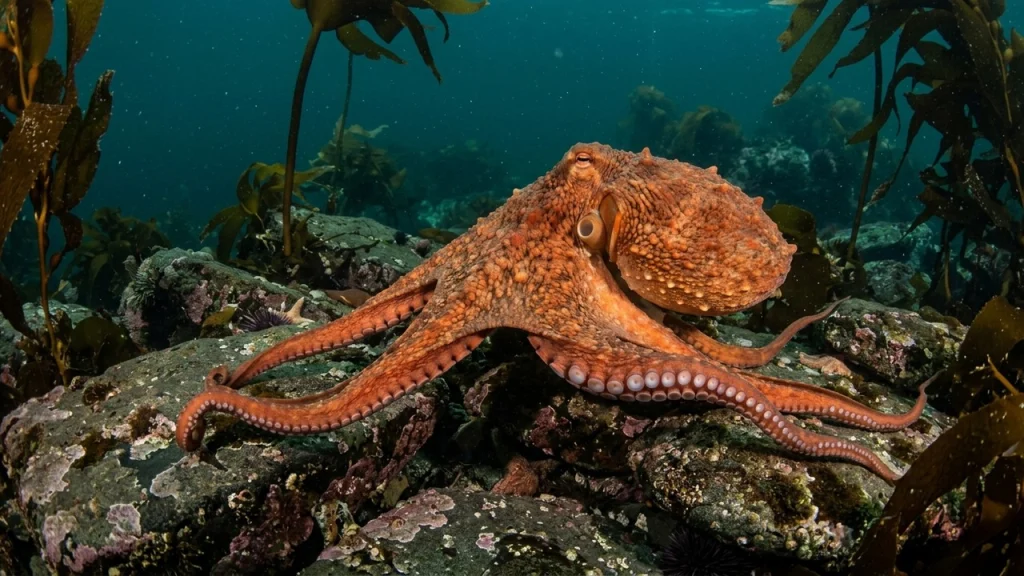
The Monterey Bay Aquarium puts the usual life span for octopuses in general at no more than a year, while National Geographic lists wild averages of 1 to 2 years for the common octopus and 3 to 5 years for the giant Pacific octopus.
Those brief spans close with reproduction. Smithsonian’s National Zoo says breeding is followed by death in males and in females.
Giant Pacific octopus sets the upper range
National Geographic presents the giant Pacific octopus as outgrowing all other octopus species and outliving them. Animal Diversity Web describes fast growth across an entire life of 4 to 5 years in giant Pacific octopuses.
In giant Pacific octopuses, that growth continues until reproduction, according to the same diversity account. Smithsonian’s National Zoo says animal care staff estimated Pandora was about 5 years old.
Mothers usually go without food while guarding eggs
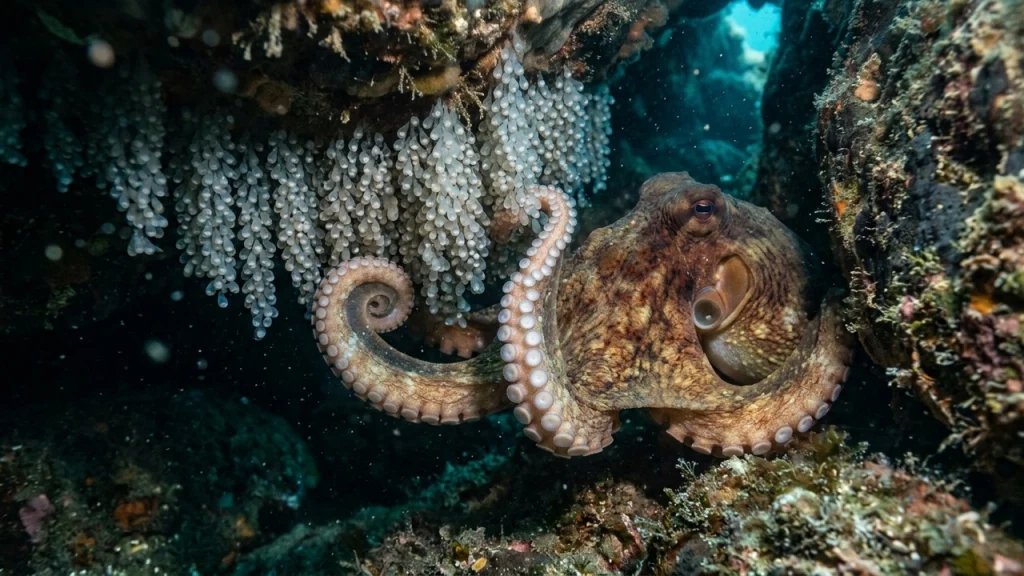
On its giant Pacific octopus page, Smithsonian’s National Zoo says females lay thousands of eggs and stay with them until hatching. The Monterey Bay Aquarium says a mother in a cave may remain there for up to six months while her curtain of eggs develops, moving water over them with arm movements and body contractions. Animal Diversity Web says female giant Pacific octopuses stay with eggs through brooding, guarding against predators and using the syphon to aerate and clean the clusters.
In the giant Pacific octopus, the same diversity account says females usually take no food during spawning and brooding, which can last 4 to 5 months at low temperatures. Common octopuses lay eggs, brood and die, the same diversity account notes.
Both sexes decline after mating
The Monterey Bay Aquarium describes a giant Pacific octopus as solitary until the close of life, when it seeks a mate, reproduces and dies soon after. Animal Diversity Web says males normally pass through senescence and die within 3 months of breeding.
Females that live through brooding go through a similar period of senescence and die within weeks after eggs hatch, according to the same diversity account. The same diversity account lists eating less, skin pulling back around the eyes, wandering and wounds that do not heal as signs of senescence in this species.
Hatching and early drift last months
Animal Diversity Web says hatching in giant Pacific octopuses can take 150 days in some cases and almost 1 year in others, with water temperature affecting timing. Giant Pacific larvae with limited swimming ability move toward the surface for a planktonic phase of 1 to 3 months, according to the same diversity account. At the close of that phase, juveniles settle to the benthos and grow quickly, the same diversity account says.
Sources
- National Geographic: Giant Pacific Octopus
- Monterey Bay Aquarium: Giant Pacific Octopus
- Smithsonian’s National Zoo: National Zoo’s Elderly Giant Pacific Octopus Dies
- National Geographic: Common Octopus
- Animal Diversity Web: Octopus vulgaris Information
- Animal Diversity Web: Enteroctopus dofleini Information