
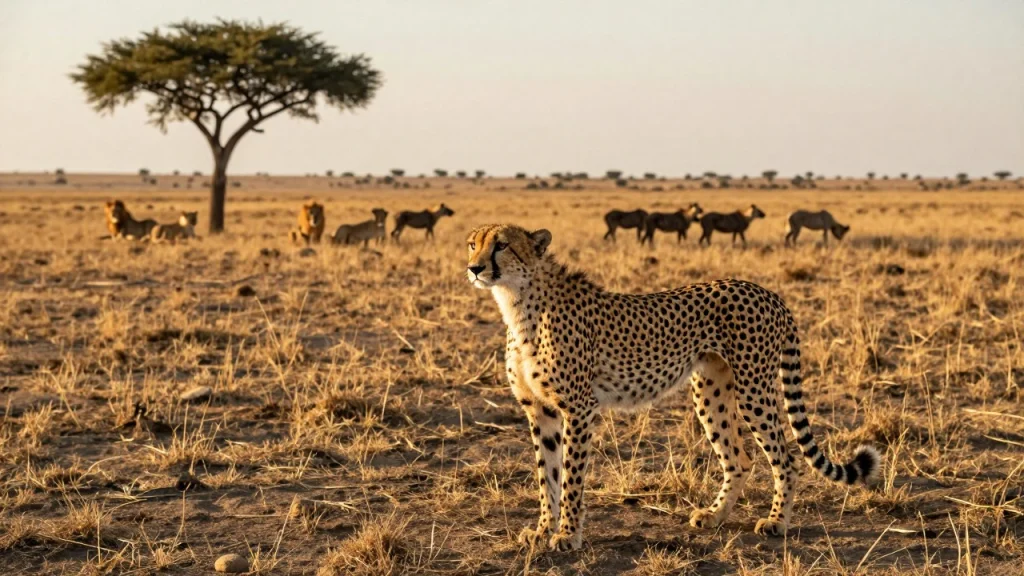
Lions first: the animal that most often eats cheetahs
Lions are the main answer, and spotted hyenas, leopards and people can all kill a cheetah too. A zoo fact sheet for the species lists its predators as lions, hyenas and humans. The qualifier that matters is how old the cheetah is, because a healthy adult is exceptionally hard to catch, which pushes almost all of the predation onto cubs.
Cubs die at higher rates than any other cat that people do not hunt, and lions, hyenas and leopards have all been recorded killing them. Even on plains thick with prey, predators rather than hunger do most of the killing, since the Red List assessment reports that 95% of cubs in the Serengeti never reached independence, mostly because of predation.
Why a grown cheetah usually gets away
The cheetah is a specialist in exactly one thing, a flat-out sprint. A cat running at its limit overheats within a few hundred meters, and the top speed it reaches, 112 kph, lasts only about 20 seconds.
Most adult cheetahs run instead of standing their ground, and a healthy adult is taken only when a predator gets the chance. That is not the same as being safe, because a kill abandoned by a cheetah becomes a free meal for whoever arrives next.
Cubs are where the losses really happen
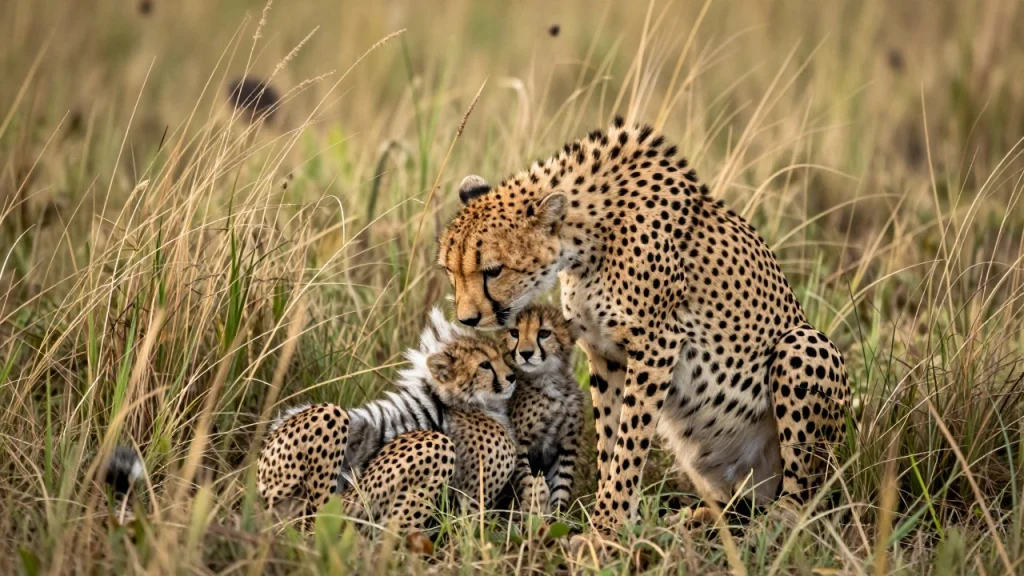
The first weeks decide a cub’s fate. Cubs arrive blind and helpless with little locomotive skill, so for an average of eight weeks the mother leaves them tucked into a marsh, a rocky outcrop or tall vegetation while she hunts, carrying them to fresh spots as she goes. Feeding cubs also forces her to land food daily, while a solitary adult can manage on a kill every 2 to 5 days, so cubs wait exactly when the family is most exposed.
A zoo fact sheet for the species puts the share taken directly by lions and hyenas at up to 70%, all before the cubs leave their mother. The list of cub hunters is longer than most people expect:
- The big three are lions, spotted hyaenas and leopards, which the Red List assessment names as the key predators of cheetah cubs.
- Smaller hunters take their share too, with honey badgers, jackals and even secretary birds recorded in the role.
- Martial eagles have been seen carrying off cheetah and leopard kittens, and are not fussy about which big cat the meal comes from.
- Other cheetahs are the unresolved case: infanticide within the species has never actually been watched happen, only suspected.
Lions are the ones that kill adults too
The Red List records Serengeti adults dying at the paws of lions, and also from attacks by the prey they were chasing. Cheetahs manage that risk rather than ignore it: they steer clear of lions and hyenas rather than risk a stand-off, and managers flag predator naivete as a real problem in reintroduction programs.
Stolen kills, the second way a cheetah is lost
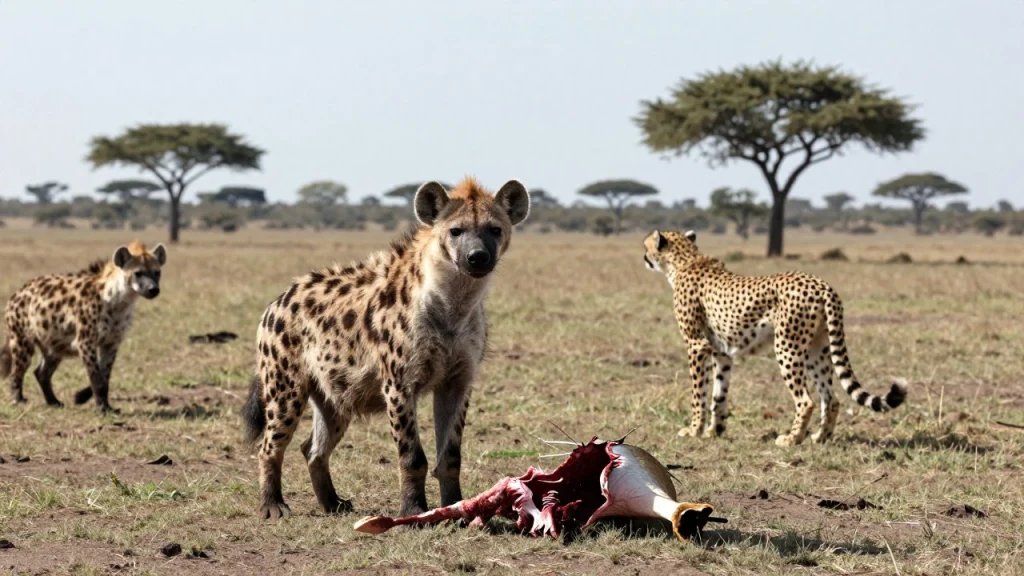
Lions and hyenas are the usual thieves, and other opportunists are known to take kills they did not make. A robbed cheetah usually cannot push the thief off, so it gives up the food rather than begin a fight it would lose.
Where large carnivores are thick on the ground, about 10% of a cheetah’s kills can go to kleptoparasites, with lions and spotted hyaenas chief among them. The answer is to eat fast and leave: cheetahs almost never scavenge, and they drop the remains as soon as they have eaten their fill.
Leopards sit lower on the list. The scientific name for the whole problem is intraguild competition, and cheetahs receive it from lions and spotted hyenas, and occasionally from leopards, which are described as a threat to the smaller-bodied cat.
Humans, the other large danger
Farmers kill cheetahs either in retaliation for attacks on their herds or to prevent livestock losses. That pressure is blunted by the animal’s own nature, since cheetah survival through this conflict is often down to how hard the cat is to kill.
Does losing cubs decide the species’ future
Not on its own. Even where there are no competitors at all, cheetahs stay scarce: on Namibian farmland and in the Sahara, where lions and hyenas are absent, densities are still only 0.25 per 100 km². In western, central and northern Africa, lions and spotted hyenas have been removed from much of the remaining cheetah range, and the species is still listed as vulnerable. Females that reach independence outlive males and typically die at an average of 6.2 years.
Where you look also changes the arithmetic. Cubs in the Kgalagadi Transfrontier Park do far better than Serengeti cubs, with survival from birth to independence reaching 35.7% there. Some subspecies are already considered endangered, a status driven mainly by habitat fragmentation and by competition with bigger carnivores over the food itself. The global population is put at around 6,517 mature individuals spread over 3,100,000 km², a total projected to fall by 37% (21–51%) over three generations.
The cheetah’s own menu shows how lopsided that bargain is. It feeds above all on gazelles, with Thomson’s gazelle the staple, and on impalas and other small and medium ungulates, while hares and birds are taken when larger prey is unavailable. Losing those kills to lions and hyenas, and losing most of its cubs to the same animals, is the price of a body built for one burst of speed: the chase wins the food, and caution keeps the mother alive to hunt again.
Sources
- Animal Diversity Web: Acinonyx jubatus (cheetah) | Information | Animal Diversity Web
- IUCN Red List of Threatened Species: Acinonyx jubatus (Cheetah) | The IUCN Red List of Threatened Species
- San Diego Zoo Wildlife Alliance: Cheetah (Acinonyx jubatus) Fact Sheet, Summary
- San Diego Zoo Wildlife Alliance: Behavior & Ecology, Cheetah (Acinonyx jubatus) Fact Sheet
- PLOS ONE, via PubMed Central: To Kill, Stay or Flee: The Effects of Lions and Landscape Factors on Habitat and Kill Site Selection of Cheetahs in South Africa
- National Geographic: In Kenya, martial eagles hunt lion cubs for lunch