
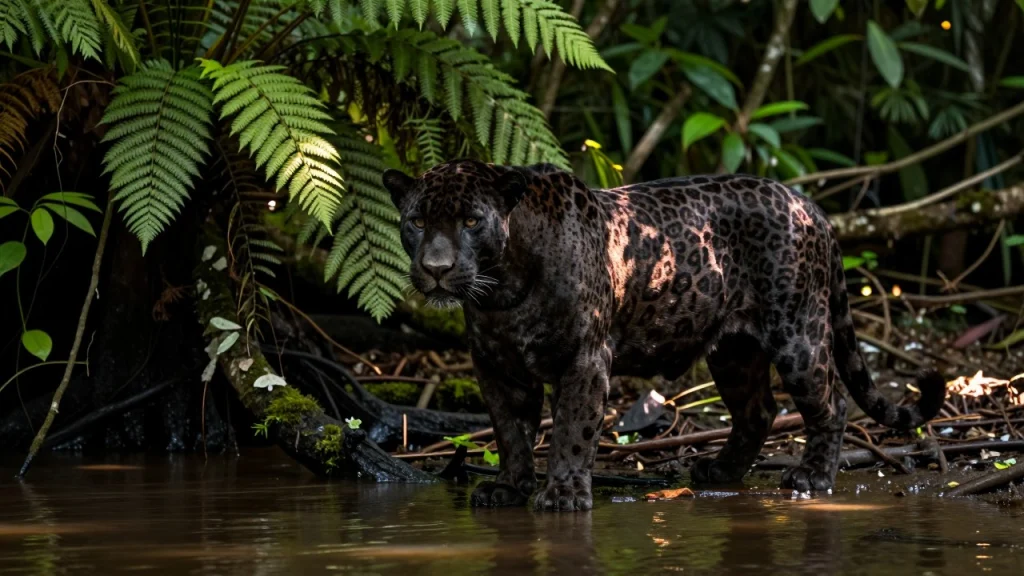
A black jaguar is a jaguar with a nearly all black coat, and nothing more than that. The condition has a name, melanism, so a dark coated cat of this kind is properly called a melanistic jaguar. It is not a separate species, and it shares the size, the hunting technique and the social habits of every other jaguar.
The naming is where the confusion starts. The same dark cats are popularly called black panthers, a catch all label rather than a species name, and the term is applied to the leopard of Africa and Asia as well. Set the label aside and a black jaguar turns out to be an ordinary member of Panthera onca wearing a genetic coat variant.
The black coat is a genetic variant, not a different animal
Jaguar coats are not uniform. The background color under the spots runs from a pale yellowish tone to a reddish brown one, with black rosette shaped spots across the neck, body and limbs, and an off white underside. In a melanistic jaguar the background turns black, and it is the pigment itself that changes: the dark coat comes from a dominant mutation in the MC1R gene, a switch that governs pigment production, and it raises output of eumelanin, the black pigment, until the animal reads as black.
Because the variant is dominant, a single melanistic parent is enough to pass it on, which is how a mostly spotted population keeps producing black individuals. Melanism is not exclusive to jaguars. Across the cat family it appears in 15 of 41 species and has arisen independently at least eight times, so the black leopard of Asia and the black jaguar of South America are separate evolutionary events rather than one shared feature.
The pattern survives underneath the pigment. A melanistic jaguar’s spots are black too, usually only dimly visible against the black background, and they stand out clearly when sunlight catches the coat at the right angle. Each rosette still encloses smaller spots inside.
Where black jaguars turn up
About 10% of jaguars are melanistic. Where they appear is not random, and geography tracks habitat: melanistic individuals are recorded more often in the Amazon, in the Atlantic Forest and in the Cerrado, while almost none are reported from the Llanos or the Pantanal. The species itself favors humid lowland forest, and although that kind of dense tropical cover is its first choice it also manages in scrub, reed beds, coastal woods and swamps.
That distribution fits what ecologists call Gloger’s rule, which links darker pigmentation to humid climates where a dark coat can pay off in camouflage and in temperature control. Healthy jaguar populations need three things from a landscape: a water supply, dense cover and sufficient prey.
What the dark coat gains and what it costs
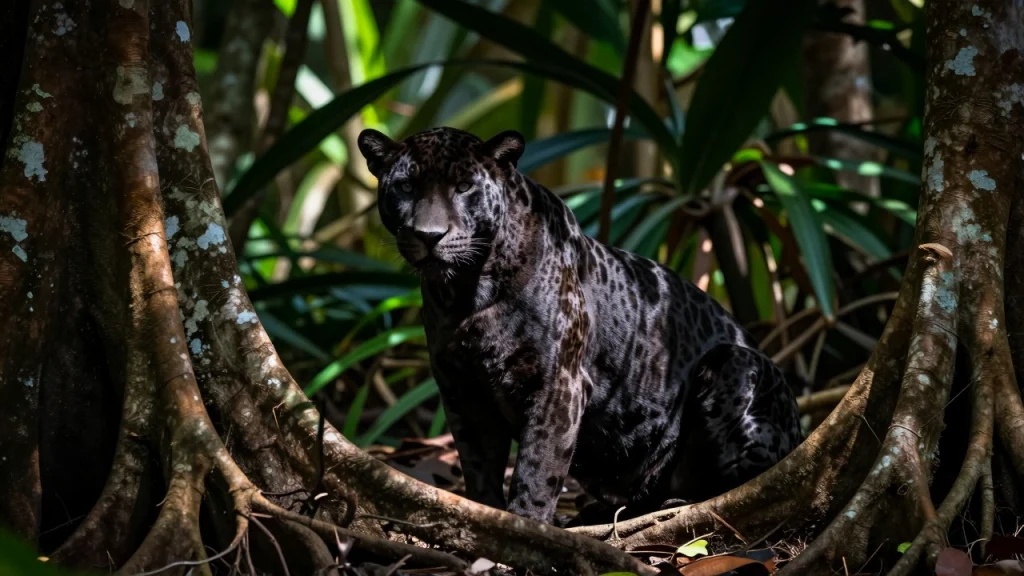
The clearest reported gain shows up in the daily schedule. Black jaguars have been reported to spend more of their time active by day, and hunting in brighter conditions can suit a cat that dissolves into shadow rather than one whose rosettes break up its outline.
The cost is communication. Many wildcat species carry white marks behind the ears and on the tail tips so they can pass signals to other individuals, and melanistic cats have none of those markings. In jaguars specifically, those white ear markings catch low light and are believed to matter for communication within the species, so their absence in melanistic individuals may make visual signalling harder, a handicap that could offset the camouflage advantage.
Hunting and daily life
Color aside, a black jaguar eats like any other jaguar. More than 85 prey species have been recorded in the jaguar diet, and the preferred targets are large animals:
- peccaries, tapirs and deer
- caimans, turtles and snakes
- porcupines and capybaras
- fish and large birds
Ambush, not pursuit, is the method. A jaguar pounces on prey from a concealed position, and a kill comes either from a bite to the neck that suffocates the victim or from canines driven through the back of the skull. Jaws and canines powerful enough to pierce thick reptilian skin and turtle shells explain why armoured animals such as turtles and caimans appear on the list at all.
Water matters as much as cover. Jaguars swim well and are generally found near rivers, slow moving streams, lagoons and swamps. Dry season water matters most to them, because wading and bathing are how jaguars deal with heat. They also climb trees for safety or for hunting.
Outside the breeding season a black jaguar is as solitary as any other, with females working roughly 25 to 38 square km of range and males covering as much as twice that. Hunting is mostly a night activity, though the timing shifts from place to place.
Family life
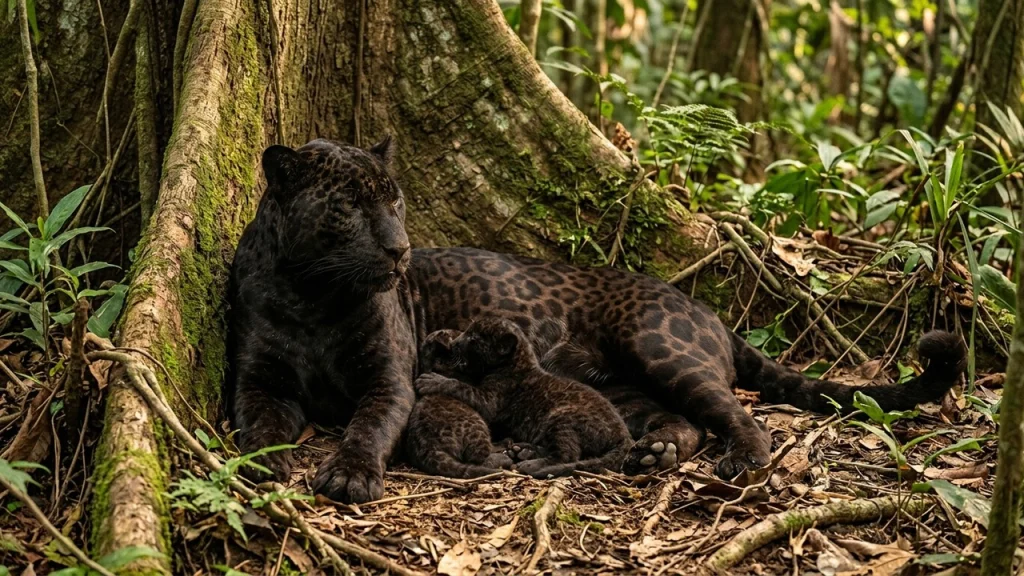
Gestation runs about 100 days, and the most common litter is two cubs, with as many as four. Cubs arrive weighing about 800 g and are weaned at 5 to 6 months. Males reach sexual maturity at 3 to 4 years and females at 2 to 3 years, and a wild jaguar averages a lifespan of about 13 to 14 years.
Where jaguars stand now
The IUCN Red List classes the jaguar as Near Threatened, a category assigned in the 2016 assessment, and the species sits on Appendix I of CITES, the strictest tier of controls on international trade. United States law lists it as Endangered.
Estimates put the wild population at about 173,000 individuals, most of them in Brazil and Peru, and the trend is downward. Range mapping recorded a 20.0% decline between 2002 and 2015, from 8.77 million km2 to 7.02 million km2, and the assessment team expects breeding adults to be down by at least 20-25% across the past 21 years.
Recognizing one in the field
Identifying a black jaguar is mostly a matter of scale and setting. An adult weighs 57 to 113 kg, and jaguars have lean bodies with muscular limbs, built for power rather than speed. In the Americas the jaguar tops every other cat, and no other living member of the Panthera genus ranges in the New World. A large black cat with faint rosettes, seen near dark water in dense tropical forest, is a melanistic jaguar and not a mystery species.
Sources
- IUCN Red List: Panthera onca (Jaguar) | The IUCN Red List of Threatened Species
- Animal Diversity Web: Panthera onca (Jaguar) | Animal Diversity Web
- San Diego Zoo Wildlife Alliance: Jaguar (Panthera onca) Fact Sheet
- National Geographic: A Black Panther May Not Be What You Think
- Ecology and Evolution, via PubMed Central: First Record of Mating Involving a Melanistic Jaguar (Panthera onca) in the Wild: Novel Behavioural Insights Into Colour Morphs and Captive-Wild Comparisons
- National Geographic: Is being a black panther beneficial? It depends.