
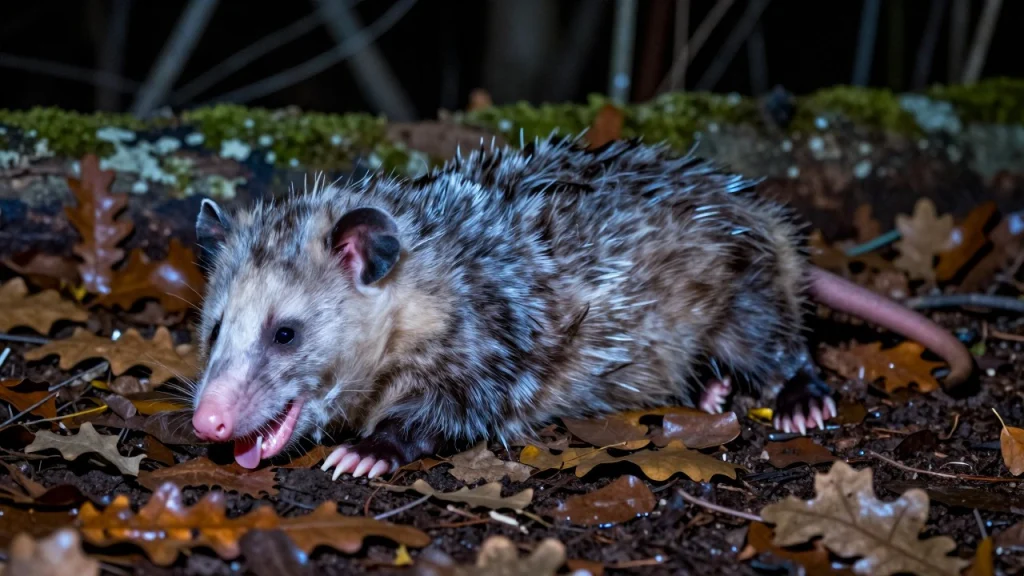
The Virginia opossum (Didelphis virginiana) relies on a remarkable behavioral adaptation to survive life-threatening encounters. As nocturnal creatures that raise numerous young, Virginia opossums hold the distinction of being the sole marsupial species indigenous to North America. When facing predatory danger, they often display an extraordinary survival routine known colloquially as playing possum.
The widespread survival habit commonly referred to as playing possum operates as a specialized defense mechanism. Biologists define this phenomenon as tonic immobility or thanatosis, recognizing it as an instinctive, terminal protective tactic against dangerous hunters. Far from being an intentional theatrical bluff, this physical collapse occurs as an unbidden bodily reaction comparable to fainting from terror. The catatonic swoon creates a convincing simulation of death, causing many carnivores to lose predatory motivation and abandon their quarry unharmed.
The involuntary mechanics of tonic immobility
During a thanatosis event, profound physiological shifts overwhelm the creature’s nervous system. The animal does not choose to fall over; extreme stress triggers an autonomic reflex that completely immobilizes skeletal muscles. Internal circulation decreases as cardiac pacing slows down.
The physical appearance of the motionless marsupial mimics decay with startling precision:
- Once overcome, the creature topples onto its flank, falls flaccid, closes its eyelids, and permits its tongue to dangle through parted lips.
- Field researchers noted that subjects often settle into a semirigid physical posture throughout the motionless episode.
- During catatonia, their caudal appendages curve inward along the belly while glassy eyes remain unblinking and extended tongues protrude between teeth.
- The body turns rigid with a vacant gaze, exposed teeth, frothing saliva around the jaws, and discharge of pungent fluid.
This multi-sensory presentation deters hunters through sight, posture, and scent. Both male and female subjects evacuate their intestinal tracts and discharge odorous green slime from paracloacal chambers during full immobility.
Defensive escalation before immobility occurs
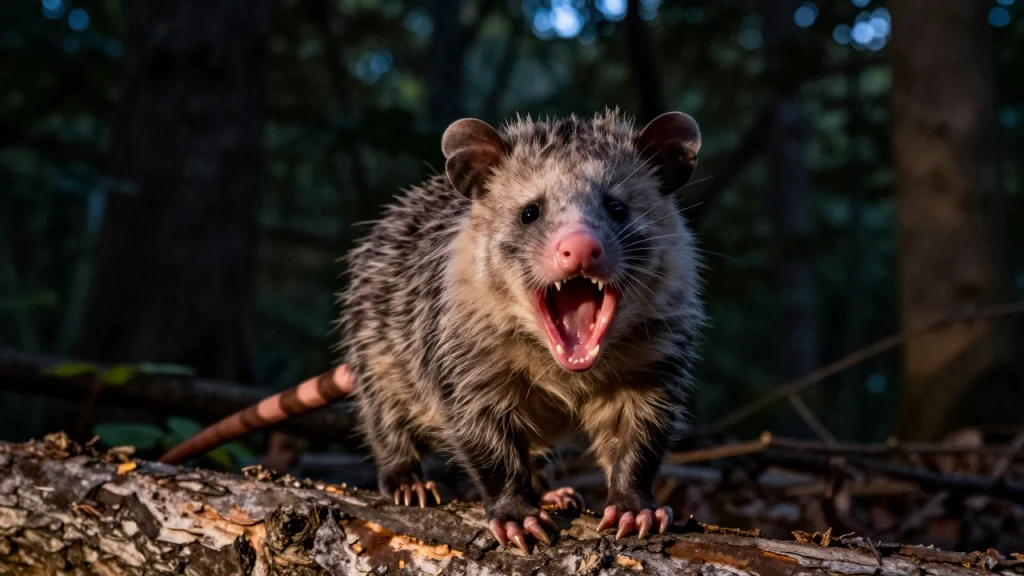
Entering a coma-like swoon represents an extreme measure rather than an opening move. These animals display non-aggressive temperaments when navigating their wild surroundings. Before collapsing, an individual moves through several progressive stages of threat mitigation designed to avoid physical violence altogether.
When an incoming hunter closes the distance to roughly 5 m, the animal typically attempts an initial retreat. While often regarded as sluggish wanderers, their flat-footed four-legged posture lets them sprint between 7.1 and 7.4 km per hour while weaving sideways to evade pursuit. If running along the forest floor proves inadequate, individuals may also ascend trunks or plunge into waterways to evade threatening encounters.
Confrontation at close quarters
When flight fails and distance vanishes, the marsupial shifts to active intimidation. Should an assailant press inward within 2 m, the cornered creature pivots directly toward the aggressor while snarling with wide jaws and exposed fangs. Their open maw reveals 50 teeth, exceeding the tooth count of every other terrestrial mammal across North America.
To maintain defensive positioning, the animal tracks every step of the hunter. If the carnivore prowls in circles, the marsupial rotates its position to keep the threat under direct observation. Throughout this initial confrontation, the animal expels gas, empties its bowels, and secretes a foul, green fluid of mucus-like consistency from its paired paracloacal glands.
When defensive displays cannot deter an attack, the creature feigns death as an ultimate refuge. The severity of the danger dictates whether the animal collapses into thanatosis. Controlled studies reveal that animals entered tonic immobility in 67% of human captures, whereas seizure by canines triggered the state in 100% of encounters.
Why predators abandon an unresponsive target
In the wild, immobility functions as an exceptionally effective survival tool. Wild opossums face predation from multiple hunters, including:
- Domestic dogs
- Coyotes
- Red foxes
- Raccoons
- Bobcats
- Large snakes
- Owls
Attackers such as canines consistently put down or release the stiffened animals upon the onset of tonic immobility.
Researchers observed that hunting dogs exhibited no desire to continue mauling an unresponsive subject even when handlers urged them forward.
Duration and awakening
The protective catatonia does not resolve instantly once the carnivore walks away:
- This paralyzing state can persist for up to four hours, successfully discouraging carnivores that hunt only warm, animated targets.
- The completely frozen posture might endure for merely a minute or extend across up to 6 hours.
- Following what functions like brief nervous shock, the creature regains alertness promptly and flees at the earliest opening.
Age strongly influences how frequently this behavior appears in nature. Complete feigning of death occurs infrequently in the wild and appears most commonly among youthful individuals. Mature adults far more frequently hold their ground with exposed dentition or make a rapid getaway rather than collapsing.
Specialized survival adaptations of North America’s marsupial
Beyond playing dead, the Virginia opossum relies on several remarkable physiological traits that bolster its survival in competitive ecosystems. Their distinct physiology grants them remarkable resistance against contracting the rabies virus.
Their biochemical defenses extend to venomous predators as well. They carry natural biochemical resistance against Viperidae snake venoms, neutralizing toxins from cottonmouth moccasins, eastern and western diamondback rattlesnakes, Korean mamusi, and copperheads.
Opossums also provide vital ecological sanitation by eliminating destructive parasites. One individual can consume about 5,000 ticks per year, curbing tick-borne afflictions such as Lyme disease across the surrounding ecosystem.
High reproductive output and population resilience
The reproductive cycle features a rapid gestation period spanning just shy of two weeks. Breeding females, termed jills, deliver litters containing up to about 20 tiny living neonates.
Within the maternal pouch, nursing space is constrained because mothers possess exactly 13 nipples.
The animal holds an official ranking of least concern under the IUCN Red List.
Sources
- Animal Diversity Web: Didelphis virginiana (Virginia opossum)
- San Diego Zoo Wildlife Alliance: Virginia Opossum | San Diego Zoo Animals & Plants
- National Park Service: Mammals – Great Smoky Mountains National Park (U.S. National Park Service)
- Frontiers in Psychology: Tonic immobility and phenomenal consciousness in animals: a review
- Missouri Department of Conservation: Virginia Opossum | MDC Discover Nature