
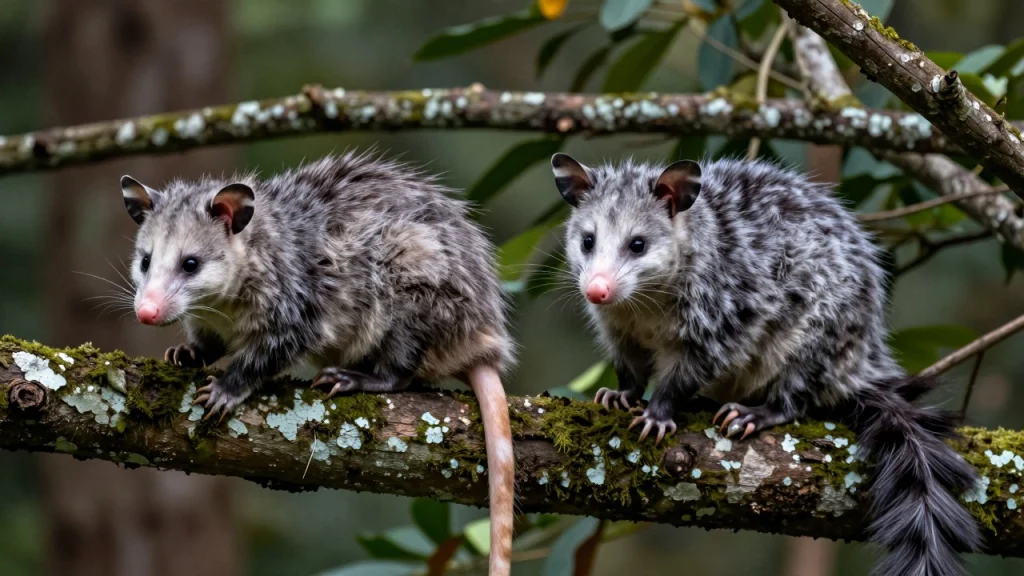
If you have heard both words used for the same scruffy animal nosing around a deck, it is easy to assume a possum and an opossum are simply two names for one creature. They are not. An opossum is an American marsupial of the family Didelphidae, while a true possum sits in a different order entirely, the one found in Australia and New Guinea. The muddle has a traceable cause: naturalists who reached Australia in the late 1700s decided the furry, tree-dwelling animals they saw belonged to the same tribe as opossums, and the shorter spelling stuck.
Two lineages that parted company long ago
The gap between these animals is not a matter of degree. More than 300 kinds of marsupial exist today, about 100 of them American and a little over 200 living in Australasia, and the two continental lineages have not shared an ancestor for roughly 80 million years. That is why the difference runs far deeper than fur colour or tail shape: these are separate evolutionary histories measured in tens of millions of years.
Opossums are a single family of over 60 species, running in size from a pocket-sized pygmy form to a cat-sized Virginia opossum. Just one of them reaches North America, and that animal is the sole native marsupial of the continent. It suits life around people remarkably well, turning up in sheds, barns and beneath homes with the same comfort it shows in forests and swamps.
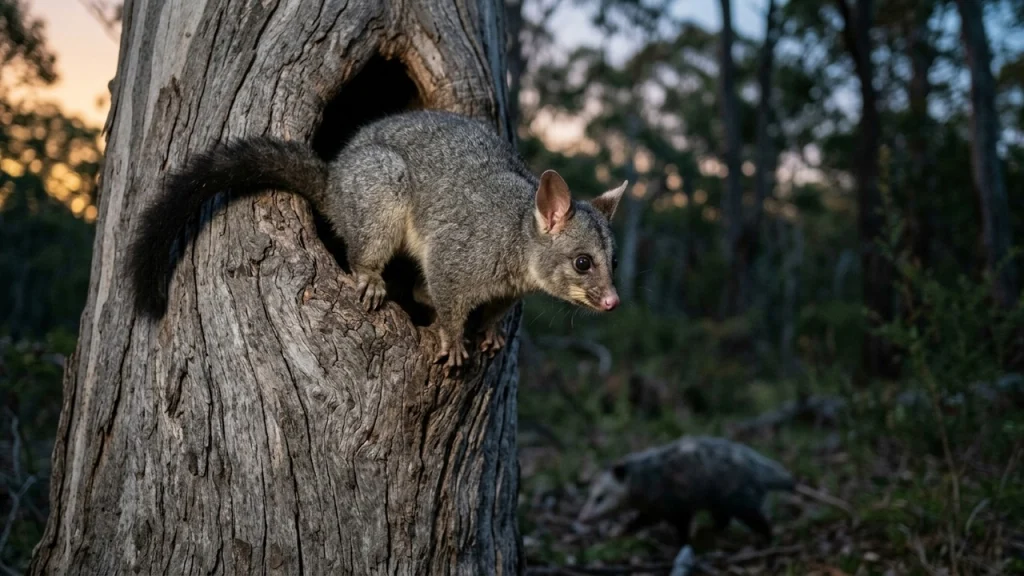
Possums belong to a family numbering roughly 18 species in 6 genera, living in Australia, New Guinea or a scattering of smaller islands. Of them, the common brushtail is spread more widely than any other Australian mammal, across most of the mainland and Tasmania. It has also established itself far beyond that range and does well in New Zealand, which is why the word possum carries a second, very different meaning outside the Americas.
Tails and feet built for different jobs
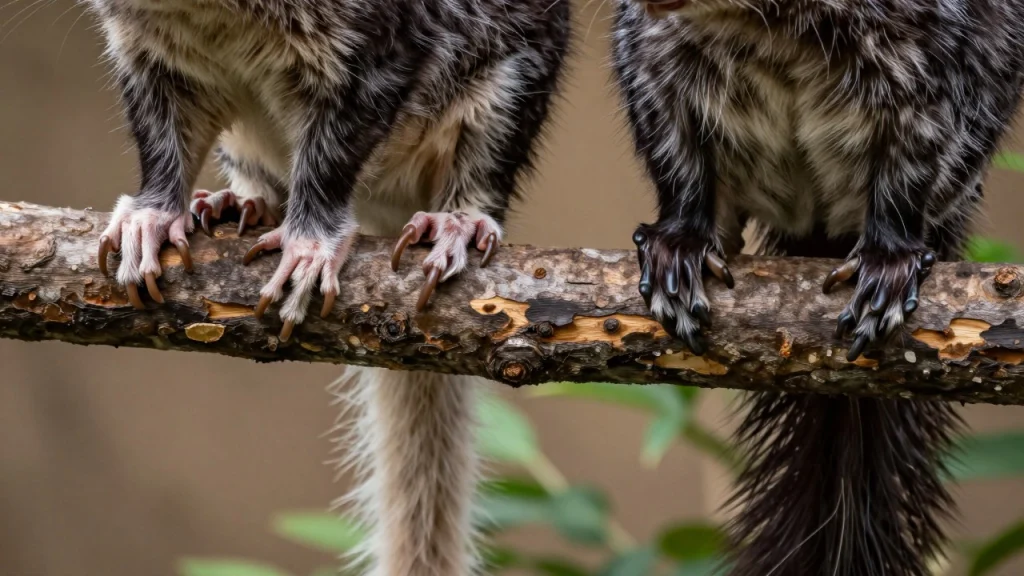
The tail is the quickest field mark. Opossum tails are long, scaly and prehensile, and in the Virginia opossum the appendage measures nearly as much as the head and body put together, close to 93% of that length, gripping branches like a fifth hand. A possum tail is comparatively furry: in the brushtail it is long and cloaked in long bushy fur, and across the family many species carry thickly furred tails, with a prehensile one in most.
The feet differ just as clearly. Opossums are not syndactylous, all toes except the hallux carry claws, and the hallux itself has a nail, which produces a clawless, partly opposable thumb on the hind foot. Possums sit in the order Diprotodontia alongside kangaroos, possums and wallabies, and they are diprotodont with hind feet that are syndactylous, meaning two of the toes are joined together.
Teeth make the difference easy to count. The Virginia opossum shows 50 of them, a tally no other land mammal on the continent matches. The possum family runs lower, at 34 to 36 teeth, a reduction that fits a diet built largely on vegetation rather than on seizing prey.
Pouches built for very different loads
An opossum female carries her young for barely 12 to 13 days before giving birth to between 4 and 25 altricial newborns, each about the size of a honey bee. Only 13 teats are available to them, and not every teat works, so a pouch that looks crowded usually holds more claimants than it can feed. Once latched on, a young opossum stays attached for 50 to 70 days, and a female averages roughly eight in the pouch at a time.
Possums put the effort into a single joey. A brushtail female is pregnant for around 18 days, and the one young appears in the pouch some four months later. Weaning follows at about six months, and the animal leaves for good somewhere between 8 and 18 months of age. A well developed pouch opening toward the front is typical of the family, and one baby per litter is the rule rather than the exception. One infant against a possible litter of more than twenty is the sharpest practical contrast between the two animals.
Lifespan, speed and daily habits
Virginia opossums are short-lived in the wild, where individuals make it only a year and a half to two. The losses fall hardest on the young, and a brushtail possum in the wild averages 13.0 years.
Both animals are nocturnal, solitary and good climbers, and the resemblance stops there. The opossum is terrestrial by inclination though it den in trees, and on a plantigrade stance, walking on the soles of its feet much as we do, its top speed sits between 7.1 and 7.4 km per hour. The brushtail is primarily arboreal, sleeping through daylight hours inside hollowed out logs and taking shelter in attics where cities supply them. Possums also signal. A brushtail announces its territory and calls to mates with deep, guttural vocalizations.
The opossum adds a signature defence. A threatened individual falls into a defensive catatonic state, popularly called going opossum, holding perfectly still for anything from a minute to six hours. The reflex is rare and shows up most often in young animals, while a cornered adult more often bares its teeth or runs.
Diets and the work each animal does
The two feeding strategies explain the two lifestyles. Opossums are opportunistic feeders, eating anything from vertebrates and invertebrates to plant material and carrion. They also work as important seed dispersers, carrying intact fruit seeds such as those of Asimina and Diospyros away from the parent plant. Their scavenging earns them a kind of pest control credit, since one animal can consume some 5,000 ticks a year, which helps hold down diseases such as Lyme in wildlife and people alike.
Possums lean hard on vegetation. The brushtail feeds mostly on leaves, shoots and flowers, favouring eucalypt blooms in most of its range and adding clovers, grasses, garden fruit and turnips. It copes with highly toxic foliage that few other animals can eat. Where possums grow numerous the consequences are serious: across its range the species counts as a major agricultural pest, and it has badly damaged eucalyptus and pine forest.
Reading the names in context
In North America the two words get blurred constantly. Opossum numbers hold steady in most places, and these animals do more than put up with human settlement, since their survival rate is higher near people, which is why so many of us meet one in a garage. Their present-day range stretches from Costa Rica north to southern Ontario in Canada, and it keeps expanding.
Elsewhere the same word travels with a different animal attached. The common brushtail is also doing very well in New Zealand following introduction there in 1840, far from its Australian home. A newspaper headline about possums in that country is not about the North American animal at all, while a sighting report from Ohio or Ontario concerns a marsupial with no living Australasian counterpart. The two share a body plan inherited from a distant common ancestor, not a family tree.
Sources
- Animal Diversity Web, University of Michigan Museum of Zoology: Didelphimorphia (American marsupials) | INFORMATION | Animal Diversity Web
- Animal Diversity Web, University of Michigan Museum of Zoology: Phalangeridae (brushtail possums and cuscuses) | INFORMATION | Animal Diversity Web
- Animal Diversity Web, University of Michigan Museum of Zoology: Didelphis virginiana (Virginia opossum) | INFORMATION | Animal Diversity Web
- Animal Diversity Web, University of Michigan Museum of Zoology: Trichosurus vulpecula (silver-gray brushtail possum) | INFORMATION | Animal Diversity Web
- San Diego Zoo Wildlife Alliance: Opossum | San Diego Zoo Animals & Plants
- Genes (peer-reviewed journal), PubMed Central: Chromosome Evolution in Marsupials