
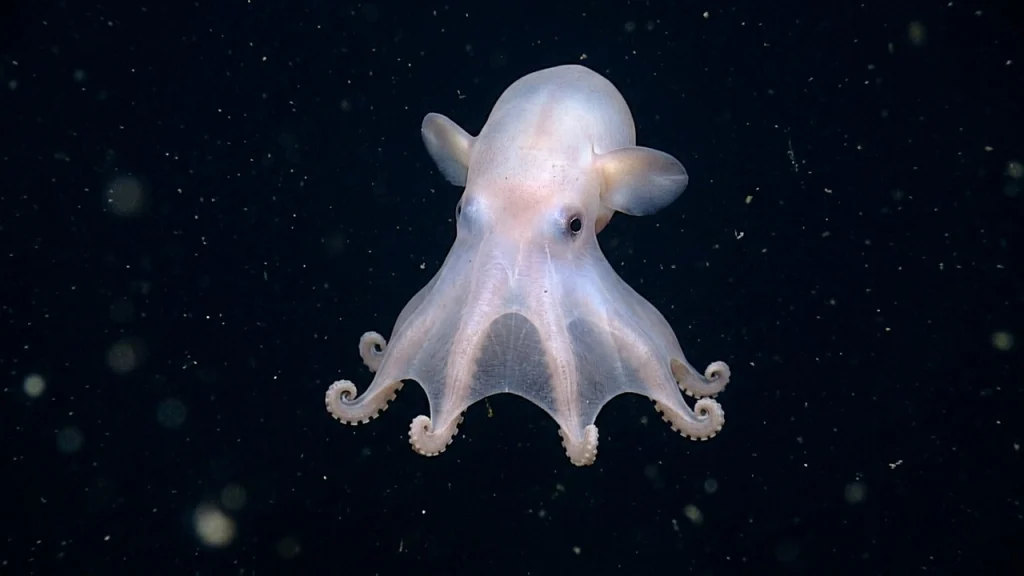
National Geographic explains that Dumbo octopuses are cirrate octopuses, a group of deep-sea octopuses, and the Aquarium of the Pacific records that Grimpoteuthis species are recognized as the deepest living of all octopus species. The aquarium notes that most species measure 20 to 30 cm (7.9 to 12 in) in length and feature prominent ear-like fins projecting from the mantle right above their almost sightless eyes.
According to the Aquarium of the Pacific, roughly 17 species of Dumbo octopus exist within the umbrella octopus category. According to the Aquarium of the Pacific, they possess eight webbed tentacles.
Deep-sea habitat and swimming fins
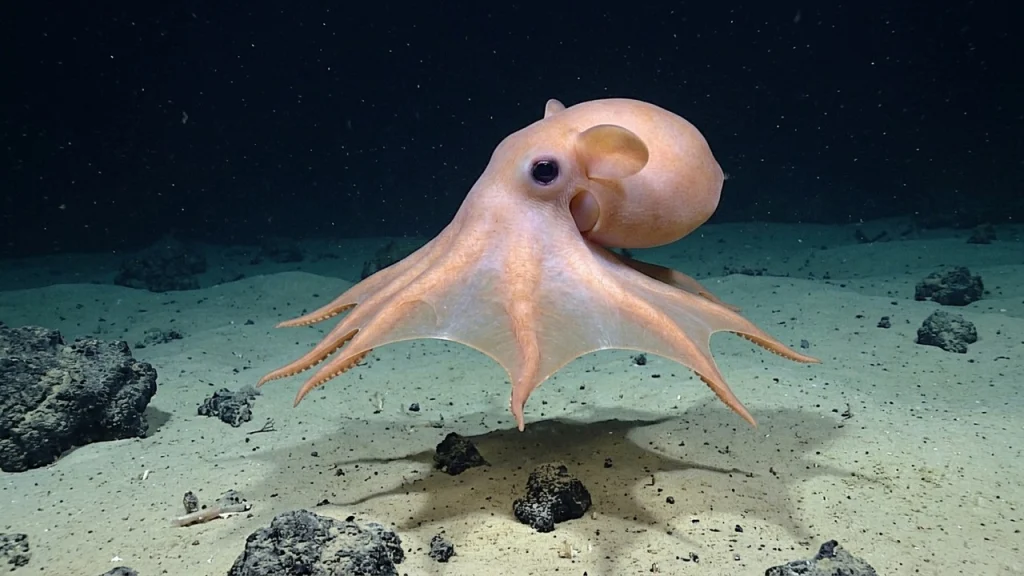
In the wild, Dumbo octopuses typically inhabit the seafloor or hover slightly above it at depths between 3000 and 4000 m (9800 to 13000 ft). The Aquarium of the Pacific notes that some live as deep as 7,000 m (23000 ft) beneath the ocean surface. Across the globe, specimens have been found in New Zealand, Australia, Monterey Bay in California, Oregon, the Philippines, and Papua New Guinea.
NOAA Ocean Exploration states that cirrate octopods have all but abandoned swimming via jet propulsion, relying instead on fins as their primary means of locomotion. The Aquarium of the Pacific observes that Grimpoteuthis appear to have adapted to intense pressure and cold temperatures by forgoing propulsion and growing mantle fins. A sudden thrust remains possible by shooting water through their funnel or expanding and contracting the webbing between their arms, and they can also crawl along the seafloor on their tentacles.
Diet and seafloor feeding
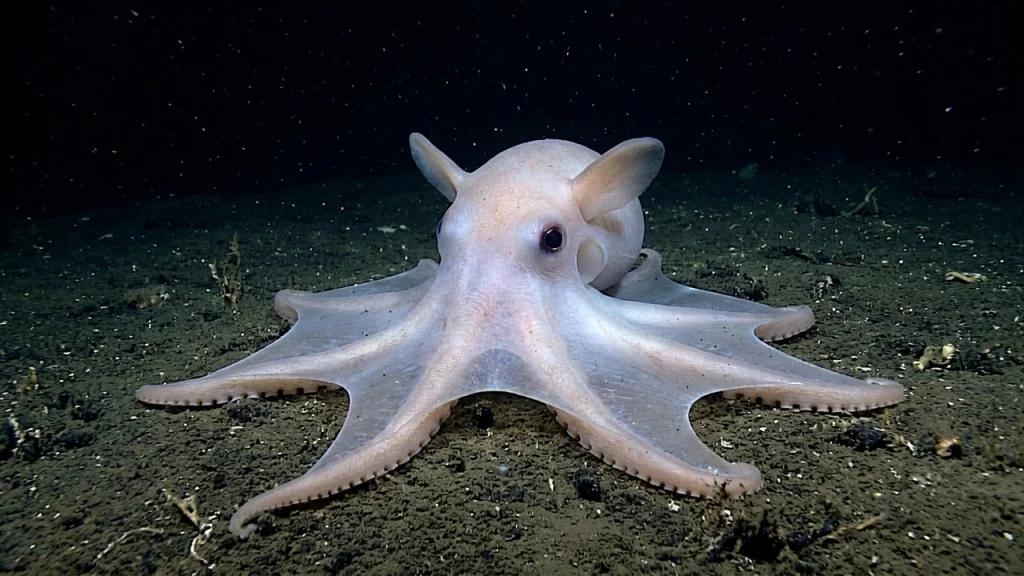
Dumbo octopuses seek out prey on the seabed, moving slowly across the bottom according to the University of Texas at Austin to find snails, worms, and other small organisms. The Aquarium of the Pacific adds that their diet includes copepods, isopods, amphipods, and bristle worms.
When securing a meal, these animals pounce on prey and swallow it whole. The aquarium explains that a degenerated radula-type opening permits them to ingest prey complete, without tearing or grinding the food.
Physical features and dimensions
The University of Texas at Austin notes that large, rounded fins on the body resemble the ears of Walt Disney’s animated elephant Dumbo. Its bell-shaped body and webbed arms give the creature the outline of an umbrella when spread out. The Aquarium of the Pacific observes that they possess a semi-translucent body supported by an internal cartilaginous shell or mantle shaped like a U or V.
The aquarium reports that the largest Dumbo octopus measured 1.8 m (6 ft 32in) in length and weighed 5.9 kg (13 lb). NOAA Ocean Exploration records that the rare dumbo octopus Cirrothauma murrayi lacks a lens and has a reduced retina, leaving its eyes able to detect light without forming images.
Reproduction and conservation status
Necropsies of females by the Aquarium of the Pacific show eggs at varying stages of maturity, indicating that the animals lack a distinct breeding season. The Aquarium of the Pacific reports that females deposit eggs continuously beneath small stones or deep-sea shells, and their reproductive timetable seems ongoing, surpassing shallow-water octopus species. Males utilize a specialized protuberance on one arm to deposit an encapsulated sperm packet inside the female’s mantle.
The aquarium lists the conservation status of the Dumbo octopus as Data deficient. According to the Aquarium of the Pacific, little is known about Dumbo octopuses, and their population status has not been evaluated.