
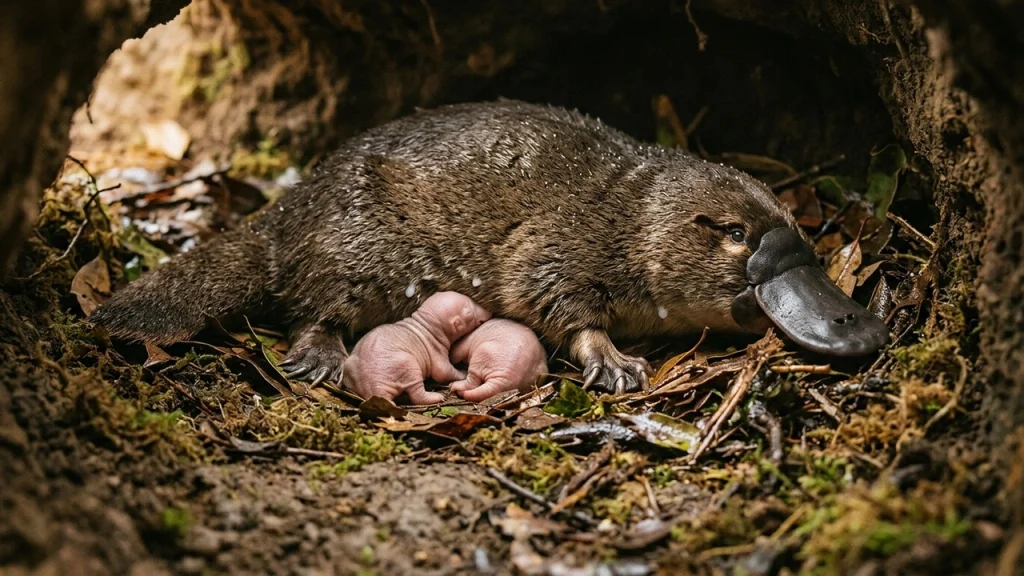
A female platypus possesses functional mammary glands despite having no teats, and the San Diego Zoo Wildlife Alliance notes that a mother features specialized abdominal skin areas that discharge milk for her offspring to lap up.
Together with echidnas, platypuses represent the sole surviving mammals that produce eggs, a lineage termed monotremes. The alveoli and duct system resemble those of placental mammals, but the areolae, the spots where milk emerges, are hidden under fur. A genome investigation published in Nature reports that “the young depend on milk sucked directly from the abdominal skin, as females lack nipples.”
How platypus mothers nurse without nipples
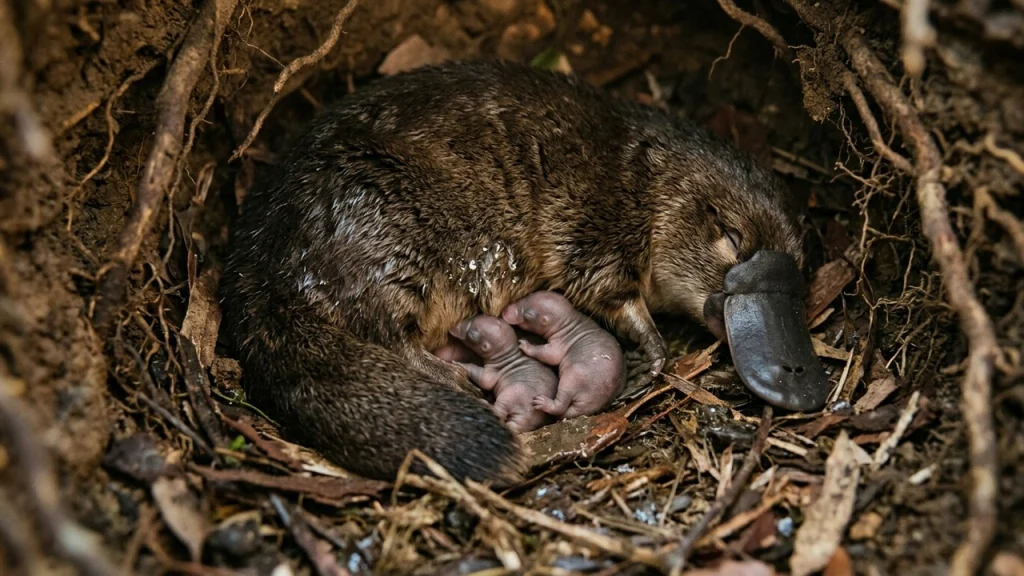
Once her young hatch, she starts secreting milk and the puggles suckle from the two fur-covered patches on her abdomen. A review in PeerJ records that juvenile monotremes, known as puggles, suckle nourishment from pores located across these glandular zones. Rather than latching onto defined teats, developing monotremes take nourishment directly from abdominal areolae without staying attached, according to Genome Biology and Evolution.
The same journal notes that monotreme mammary architecture is broadly similar across both the amphibious platypus and the terrestrial short-beaked echidna. In addition, the paper characterizes nipples as a more specialized method of fluid delivery that developed during the transition toward live birth, a milestone estimated at about 166 to 220 Ma in mammals.
Composition and protective proteins in the milk
Research in Genome Biology and Evolution emphasizes that maternal milk serves as the solitary origin of nourishment and immune defense for young until weaning takes place. A review in PeerJ notes that monotreme milk seems more dilute during early lactation, recording 8% solids for the platypus. The same review reports platypus milk at 39.1% w/w, alongside 48.9% w/w for the short-beaked echidna.
The same review explains that marsupials and monotremes depend heavily on iron provided through milk to generate cytochromes, hemoglobin and myoglobin, reflecting their undeveloped state at birth. Furthermore, difucosyl-lactose forms the predominant carbohydrate within platypus milk, in contrast to human milk where it occurs only as a minor constituent. Investigators hypothesize that fucose probably delivers the bulk of metabolic energy gathered by young monotremes from nursing.
Because a mother platypus has no pouch, her young remain directly inside a burrow likely to harbor pathogens. MLP represents 4.1% of the transcripts in platypus milk cells and is produced from early to late lactation. This substance exhibits antibacterial activity against both Enterococcus faecalis and Staphylococcus aureus, acting as an ancient facet of milk-based innate immunity absent in other mammalian groups. The authors suggest that incorporating MLP into milk may have evolved to facilitate milk delivery without teats.
Egg incubation, burrows and nursing duration
The protein makeup of the milk also shifts as lactation proceeds. Scientists have suggested that nursing originally arose as a fluid supply to shield porous, parchment-shelled eggs against drying out during incubation, or to guard clutches against microbial infections. Egg-laying monotremes with parchment shells still display an ancestral mammary patch lacking teats, which may continue to serve defensive roles for unhatched clutches.
According to the Australian Museum, following a 21-day gestation period, a mother typically lays 1 to 3 eggs, with 2 being usual. The San Diego Zoo Wildlife Alliance states that she cushions the nesting chamber with damp leaves, vegetation and twigs, holding her eggs between tail and rump for warmth. These soft, pliant eggs measure about 1.7 centimeters across, and the burrow entrance is blocked at intervals with plugs that can regulate humidity, stabilize temperature, or deter predators and flooding. A study in Genome Biology and Evolution reports that platypus eggs are incubated externally for 10 to 12 days.
After about 10 days, tiny hairless young hatch and begin nursing. The young possess molar-like milk teeth at hatching that drop out before they leave the burrow. Animal Diversity Web notes that lactation continues for three to four months. Separately, a study in Genome Biology and Evolution reports that lactation is prolonged in the platypus, extending to 114 to 145 days. According to the zoo, young platypuses develop fur and can swim independently once they leave the nesting burrow and are fully weaned.
Sources
- Genome Biology and Evolution: Monotreme Lactation Protein Is Highly Expressed in Monotreme Milk and Provides Antimicrobial Protection
- PeerJ: Marsupial and monotreme milk, a review of its nutrient and immune properties
- San Diego Zoo Wildlife Alliance: Platypus
- Australian Museum: Platypus
- Animal Diversity Web: Ornithorhynchus anatinus (duck-billed platypus)
- Nature: Genome analysis of the platypus reveals unique signatures of evolution