

Rhinoceroses have excellent hearing, which they rely on heavily because of their poor eyesight.
Because black rhinos have poor vision, with the ability to see only 25 to 30 m away, they use their keen sense of hearing and smell to detect predators. Their auditory system acts as an early warning network, keeping these massive mammals aware of their surroundings long before potential danger comes into visual focus.
How Far Away Can a Rhinoceros Hear?
No published measurement shows exactly how far a rhinoceros can hear. The range of about 1 to 2 miles (1.6 to 3.2 km) often quoted online is an approximate, unverified figure; field researchers note that a white rhino’s snarl may be audible 1 km (0.6 miles) or more away, yet rhinos were never seen responding to such sounds at a distance. Environmental conditions like wind direction, humidity, and terrain density significantly influence sound transmission across wild habitats.
In quiet environments, such as early morning savannah plains, sound waves travel with minimal acoustic interference. This allows rhinos to pick up subtle noises that human ears would completely miss over identical distances.
- Dense bush or forest: Vegetation absorbs higher audio frequencies, slightly narrowing their effective range, though low vibrations still penetrate dense foliage.
Their hearing range is finely tuned to both airborne sounds and low-frequency vibrations, giving them a comprehensive acoustic map of their territory.
Anatomical Features of the Rhino Ear
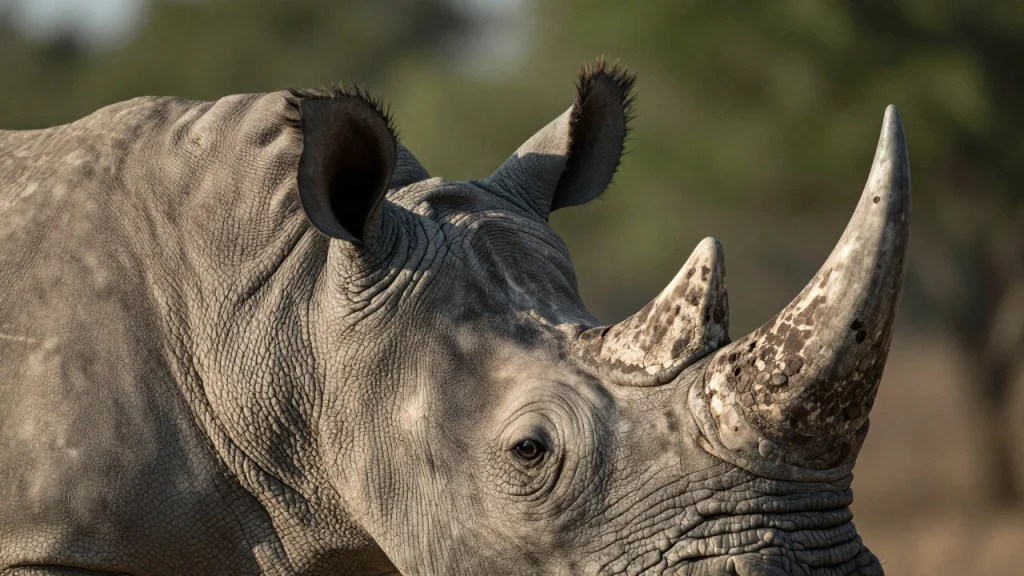
The shape and movement of a rhino’s ears play a pivotal role in their ability to capture far-off sounds. Rhinoceroses possess large, tubular outer ears (known as pinnae) situated on top of their skulls.
These pinnae function much like directional microphones. Each ear can move independently of the other, and one may be cocked forward while the other is directed backward, allowing the animal to pinpoint sounds without moving its head.
       [ Sound Waves ]
             │
             ▼
    ┌────────────────┐
    │ Tubular Pinna  │ ── Captures acoustic signals independently
    └────────┬───────┘
             │
             ▼
    ┌────────────────┐
    │ Middle/Inner   │ ── Processes high and infrasonic frequencies
    │ Ear Channels   │
    └────────┬───────┘
             │
             ▼
    ┌────────────────┐
    │ Auditory Cortex│ ── Alerts rhino to direction and danger
    └────────────────┘
When a rhino hears an unfamiliar noise, it will instantly stop, raise its head, and swivel both ears toward the source. If the two ears point in different directions, the animal is simultaneously monitoring two distinct acoustic fields in its environment.
Sound Frequencies and Vocal Communication
Some rhinoceros calls reach the infrasound range, below the lower limit of human hearing, although there is no evidence that rhinos use them to communicate over long distances.
Infrasonic sound waves travel exceptional distances because high-frequency atmospheric absorption does not easily attenuate them. This frequency sensitivity allows rhinos to maintain social structure and communicate across broad landscapes.
Infrasonic Rumbles
Rhinos produce low-pitched, subterranean rumbles and grunts. These low frequencies travel long distances across savannahs, permitting individuals to monitor territory boundaries, identify receptive mates, or announce group presence without needing visual contact.
High-Pitched Signals
Calves produce higher-frequency squeaks, whines, and pant-panting noises when calling their mothers. A female rhino’s ears can isolate these soft, high-frequency vocalizations over long distances, ensuring calves stay protected in thick vegetation.
The Evolutionary Importance of Acute Hearing

For rhinoceroses, acute hearing is an evolutionary necessity driven by physical limitations and habitat conditions. Across all five extant species (white, black, Indian, Javan, and Sumatran rhinos), eyesight is severely limited.
A rhino’s small eyes are located on the sides of its head, providing a limited field of binocular vision and poor depth perception. They struggle to identify motionless objects short distances away, making audio cues their primary tool for threat detection.
Rhino Sensing Reliance:
┌───────────────────────────────┐
│ Auditory (Hearing)   - HIGH   │ ── Long-range threat detection
├───────────────────────────────┤
│ Olfactory (Smell)    - HIGH   │ ── Windward identification & tracking
├───────────────────────────────┤
│ Visual (Eyesight)    - LOW    │ ── Near-sighted, limited depth perception
└───────────────────────────────┘
By combining swivel-action ears with a highly sensitive sense of smell, rhinos compensate entirely for their weak vision. Any strange rustle, snapped branch, or distant footsteps will prompt a rhino to turn into the wind, orienting its ears and nostrils toward the source to evaluate potential danger.
How Environmental Factors Impact Hearing Distance
While a rhino’s ears are built for long-distance sensing, several atmospheric and environmental factors alter how far sound travels in the wild.
- Wind direction and velocity: Strong head-winds can block high-frequency acoustic waves, while tail-winds help carry signals farther across open ground.
- Ambient noise levels: Heavy rain, thunder, or rushing rivers create acoustic masking, reducing effective hearing distances.
- Topography: Ridges, hills, and thick riverine forests reflect or dampen sound waves, whereas flat plains allow clean acoustic propagation.
- Time of day: Inversion layers during cool mornings and evenings allow sound waves to bend back toward the ground, extending audible ranges.
Despite these variables, rhinoceroses rely on their excellent hearing to stay aware of their surroundings.
Sources
- Bioacoustics (Policht et al. 2008): The vocal repertoire in northern white rhinoceros Ceratotherium simum cottoni
- San Diego Zoo Wildlife Alliance: Rhinoceros | San Diego Zoo Animals & Plants
- Animal Diversity Web, University of Michigan: Diceros bicornis (black rhinoceros) | INFORMATION | Animal Diversity Web
- Oregon Zoo: Black rhinoceros | Oregon Zoo
- National Geographic: Indian Rhinoceros | National Geographic
- Animal Diversity Web, University of Michigan: Rhinocerotidae (rhinoceroses) | INFORMATION | Animal Diversity Web