
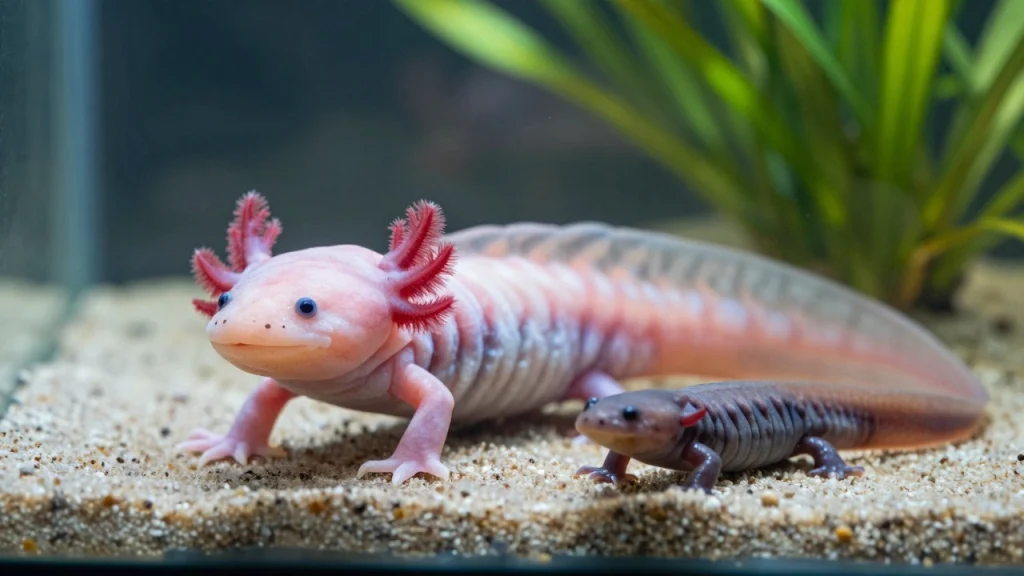
When an axolotl goes through metamorphosis, its gills, tail fins and dorsal ridge are completely resorbed, and its body mass and growth rate drop. In nature this change almost never happens, and in laboratories it appears only when scientists trigger it with thyroid hormone.
The transformation also carries a price. Most laboratory animals die shortly after it, and limb regeneration, the axolotl’s famous talent, becomes much weaker.
Why axolotls normally never transform
Most salamanders leave the water as adults, but the axolotl is neotenic, so it keeps juvenile traits after reaching adulthood. Biologists also call this state paedomorphosis: a sexually mature adult that still carries larval features. Axolotls descend from tiger salamanders, which makes their arrested development all the more striking.
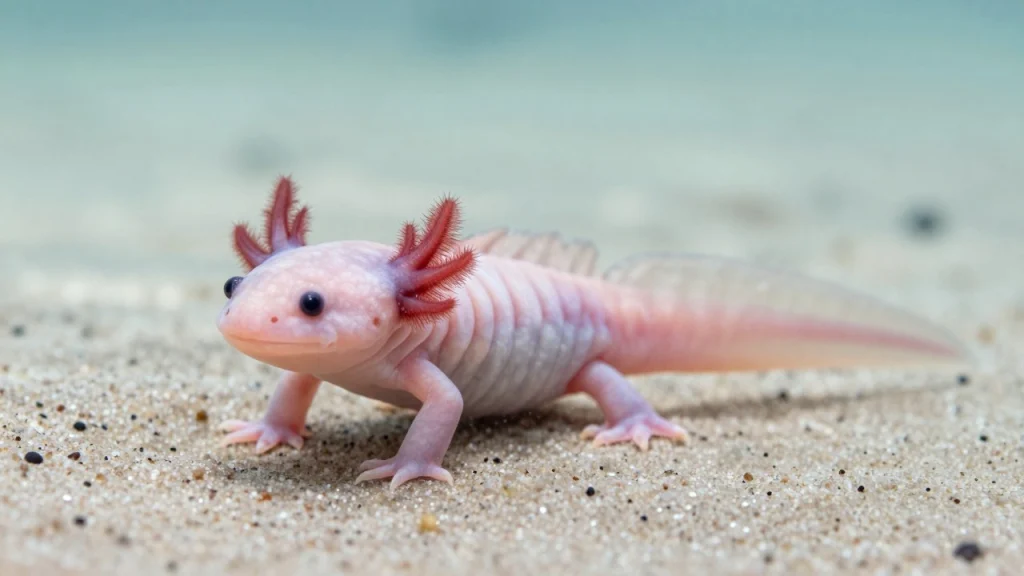
The larval features are easy to spot. Axolotls keep feathery external gills and a finned tail built for swimming, and they stay aquatic all their lives. They also lack movable eyelids.
Even though adults develop functional lungs, they still rely on their gills to breathe underwater. Neoteny lasts for life in wild animals and in captive-bred colonies alike.
The hormone brake
The cause is hormonal. In the axolotl, the pituitary appears to make too little thyroid-stimulating hormone, so circulating thyroid hormone stays chronically low.
The ability to change is still there, though. Researchers can trigger metamorphosis by giving the animals thyroid hormones, and injecting the hormone is one route. In the wild, axolotls rarely, if ever, take this step.
What changes on the outside
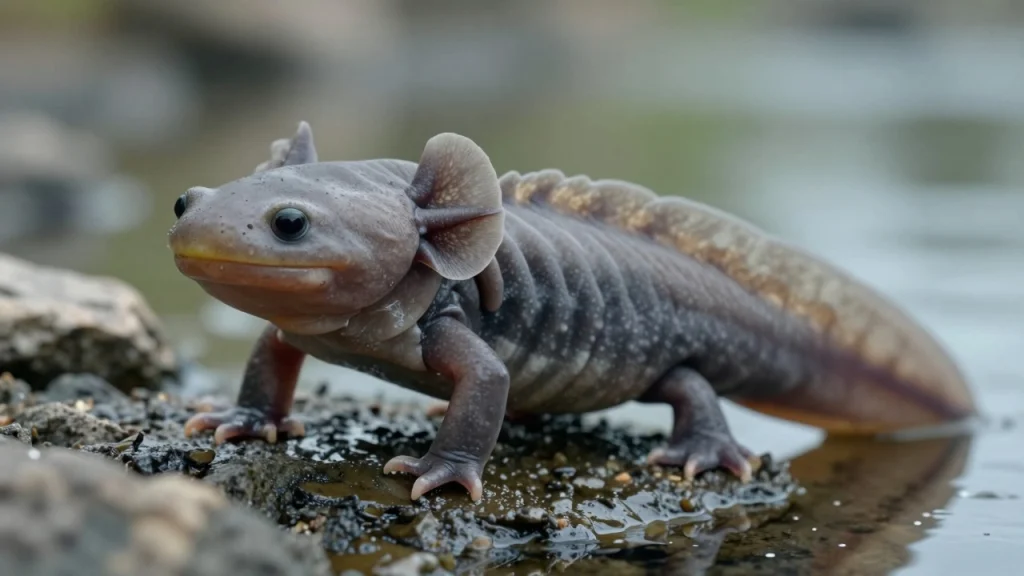
Once metamorphosis is under way, the animal loses mass and its growth slows. Three structures vanish completely: the tail fins, the dorsal ridge and the gills.
Nothing shows right after the hormone is given. A latency period comes first, during which growth continues at a normal pace and weight loss and tissue resorption are not yet visible. Once the delay ends, visible changes start appearing in one trait after another.
A quick summary of the changes
- Lost completely: tail fins, dorsal ridge and gills.
- Reduced: body mass and growth rate.
- Delayed: the first visible signs, which follow a latency period.
Hidden changes: the microbes on the body
Metamorphosis also reshapes the bacteria that live on and in the animal. Researchers proposed that reorganizing the tissues would restructure the bacterial community, and their comparison of neotenic and metamorphosed axolotls supported that idea.
Skin shows the shift clearly. Proteobacteria expanded sharply on metamorphosed skin compared with neotenic skin, while bacterial diversity fell steeply in skin and fecal samples. The skin of metamorphosed animals was also dominated by Pseudonocardia, a genus known as an antifungal commensal.
The cost to regeneration and lifespan
Axolotls can regrow limbs and even parts of the brain, which is why laboratories value them. Metamorphosis blunts that ability.
In one experiment, all 15 neotenic axolotls regrew a limb by day 64, in miniature form with four digits. Metamorphosed animals regrew more slowly, and by day 150 only 2 of 15 had regrown a four-digit limb.
Lifespan suffers too. Laboratory axolotls are expected to live 5 to 6 years, and some reach 10 to 15 years, yet most laboratory animals die shortly after metamorphosis.
Why wild axolotls matter
The axolotl is a critically endangered salamander. Wild populations occur in only two lakes, Mexico’s Lake Xochimilco and Lake Chalco, where pollution, habitat degradation and non-native species all add pressure.
Because the species lives its whole life in water, protecting clean, still lakes is what keeps the neotenic lifestyle going. Metamorphosis remains a laboratory tool rather than a wild behavior.
Sources
- Animal Diversity Web: Ambystoma mexicanum (axolotl)
- San Diego Zoo Wildlife Alliance: Axolotl | San Diego Zoo Animals & Plants
- Scientific Reports (PMC): Experimentally induced metamorphosis in highly regenerative axolotl (ambystoma mexicanum) under constant diet restructures microbiota
- PMC: A model of transcriptional and morphological changes during thyroid hormone-induced metamorphosis of the axolotl
- PMC: Neoteny and Evolutionary Strategy: Reconsidering Developmental Arrest in the Axolotl and the Olm