
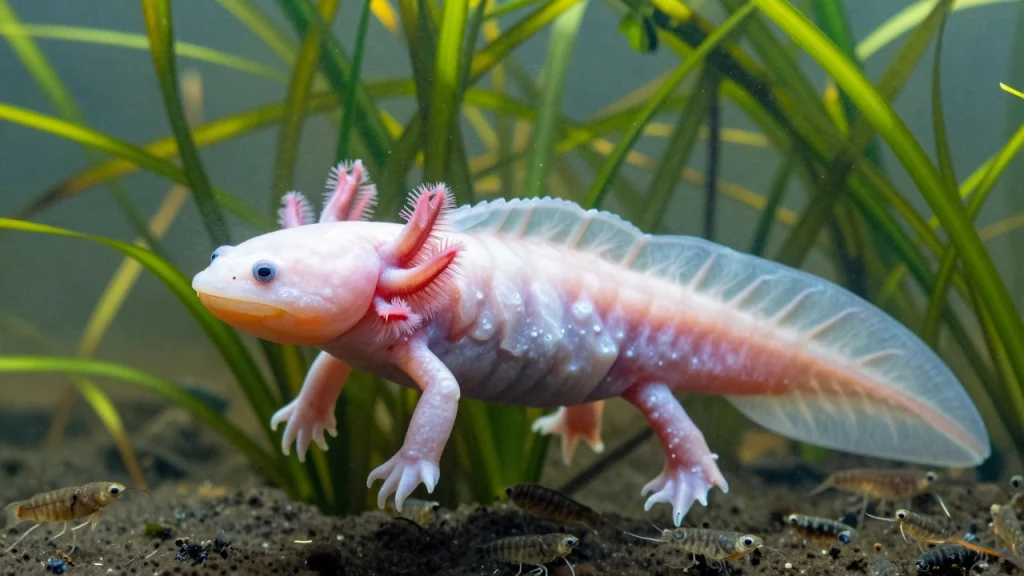
Axolotls eat almost any small animal they can catch, including worms, insect larvae, crustaceans, mollusks, small fish and even other axolotls. According to the San Diego Zoo, they feed by sucking their prey in.
Wild axolotls are strict carnivores that seize almost any small animal they can overpower in calm water.
The short answer to what these predators swallow is worms, insect young, little fish, soft bodied mollusks and tiny crustaceans, all taken whole rather than chewed.
This salamander keeps a fully aquatic body for life, so every meal must be found, caught and swallowed underwater.
Scientists place it in the genus Ambystoma as Ambystoma mexicanum.
Still lakes shape a sit and wait hunter
These amphibians live mainly in quiet, still waters where patient ambush beats long chases.
Their historic range centered on the Valley of Mexico near Mexico City, including Lakes Chalco and Xochimilco.
Today the strongest wild presence remains in slow moving wetland channels around Lake Xochimilco, where dense plants and soft sediment create hiding places.
That setting favors ambush over pursuit, because prey drifts close before the axolotl strikes.
Researchers describe adults as routine ambush hunters, a style that saves energy between strikes.
Another assessment calls them obligate ambush predators that depend on a broad mix of spineless prey, which means waiting is not optional but central to survival.
How suction replaces chewing
Small and poorly developed teeth cannot cut or grind, yet these animals remain highly successful feeders.
They inhale prey with a sudden gulp that pulls the victim straight into the mouth, a method that works well at close range.
Documented meals taken this way include worms, tadpoles, insects and little fish, showing how flexible one strike can be.
Vacuum feeding also explains why tiny stones sometimes enter the mouth along with food.
Swallowed grit can lodge in the belly and help crush soft tissue, acting much like the grinding stones birds carry.
Because suction is imprecise, the diet naturally widens to whatever small and soft bodied creature fits through the gape.
A wild menu that changes with age
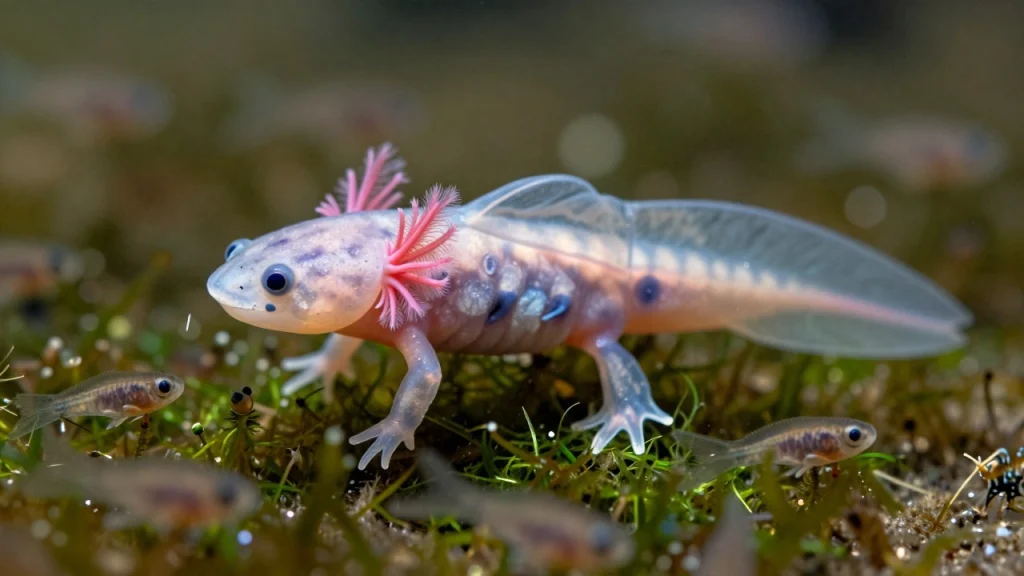
Adult diets look broad, but several prey groups appear again and again in field studies:
- worms, little fish and insects picked from plants, mud or open water
- small crustaceans that drift or crawl near the bottom
- larger crayfish that offer a rich package of muscle
- semiaquatic flies plus algae recorded alongside animal prey
That combination shows protein first feeding, with plant material present only as a minor part of the recorded catch.
Young larvae live a different feeding life because their mouths and bodies are much smaller.
They rely heavily on drifting zooplankton and small worms, foods that can be taken without overpowering large prey.
Larvae stay close to the substrate and seldom rise high to chase food, so early hunting is a low, careful search.
Cannibalism also occurs, since axolotls sometimes prey on other members of their own species.
That habit matters in crowded canals, where crowding can turn neighbors into meals.
Senses that find food in muddy water
Axolotls hunt largely by sight, locking onto movement before lunging.
They also detect weak electrical fields and combine visual with chemical information to locate hidden prey.
This multisense approach helps in cloudy water where eyes alone would miss buried worms or still crustaceans.
Polluted water makes feeding harder, likely because contaminants weaken the odor trails axolotls follow.
Faint or distorted scent may force longer searches, raising energy costs for the same meal.
Clear water is therefore hunting habitat, not only a comfort factor.
Night shift on the lake floor
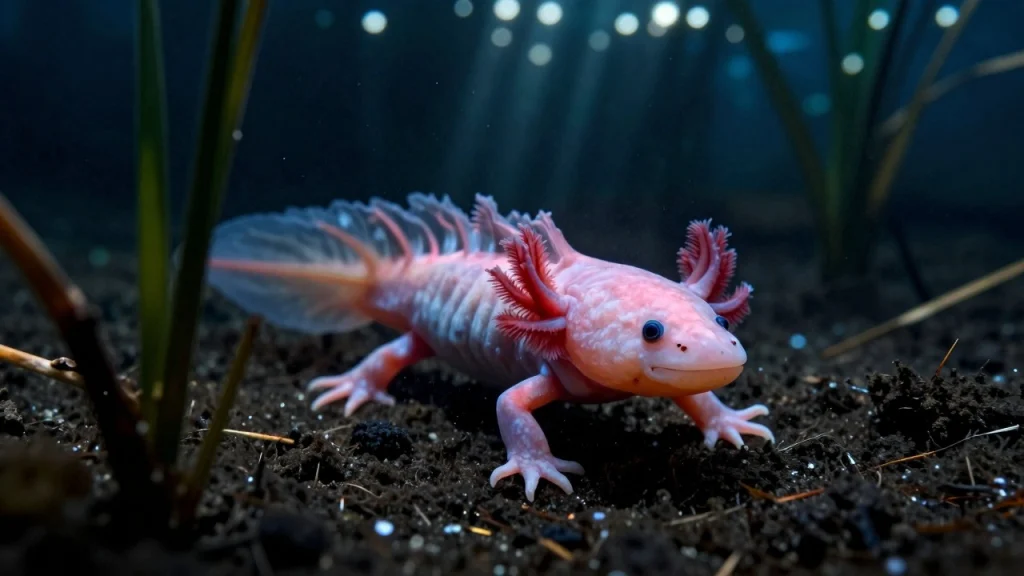
Individual animals are solitary and their activity can occur at varied times, which suits an ambush lifestyle.
Many hunts peak after dark, when they leave cover hungry and alert.
By day they shelter in plants and mud on the bottom, avoiding larger hunters while digesting.
That rhythm links diet to safety: feed when small fish and insects are exposed, hide when large fish patrol.
Newly introduced large fish have compounded the problem, contributing directly to the decline of axolotl populations.
Axolotls can in turn fall victim to large fish and to other axolotls, so every size class faces a different menu of risks.
Rivals for the same tiny prey
Larval axolotls appear to compete with young fish for drifting zooplankton, placing native salamanders against fast breeding newcomers.
Carp and tilapia, both introduced to the lakes, prey on axolotls from time to time as well.
Conservationists therefore treat food supply as inseparable from water quality and control of non native species.
The species is listed as critically endangered across its native range, with habitat loss and pollution identified as leading pressures.
Protecting feeding grounds means protecting the remaining wetland habitat at the same time.
Size, appetite and zoo lessons
Most wild sized animals reach no more than 9 inches, although exceptional individuals have stretched to 18 inches.
That body size sets the upper limit of prey: anything too wide or too strong cannot be inhaled.
Zoo keepers use that principle when they offer captive axolotls a rotating mix of worms and insects.
Such kept diets mirror field records rather than inventing new foods, keeping protein high and form familiar.
The broader lesson is simple: feed the hunter, not just the body, by matching prey size, movement and water conditions to wild ambush.
What this means for a disappearing lake predator
A top position in the local food web once let axolotls structure their community by thinning worms, insects, crustaceans and small fish.
That role survives only where quiet water, cover and clean scents remain.
Safeguarding hunting habitat in Xochimilco is thus the most direct way to keep wild jaws snapping.
What is the best food for pet axolotls?
In a husbandry guide, the University of Kentucky notes earthworms as a favorite feeding option. The guide also suggests salmon pellets, trout pellets, water fleas, mosquito larvae, feeder goldfish or guppies, and beef liver or heart. Standard laboratory care combines meals of salmon pellets with California blackworms and live brine shrimp.
How often should you feed an axolotl?
Newly hatched larvae in laboratory care receive live brine shrimp each day. Larvae receive brine shrimp daily until reaching near 4 cm long, then switch to crushed fish pellets offered three times per week. Once captive adults reach about one year old, keepers typically reduce feeding to three or four days each week, limiting each meal to a maximum of five pellets.
Which foods are bad for axolotls?
Bait shop freshwater minnows are unsuitable food because those fish frequently carry heavy parasite loads.
Sources
- San Diego Zoo: Axolotl | San Diego Zoo Animals & Plants
- San Diego Zoo Wildlife Alliance Library: Diet & Feeding – Axolotl (Ambystoma mexicanum) Fact Sheet
- Animal Diversity Web: Ambystoma mexicanum (Salamandra ajolote)
- U.S. Geological Survey: Axolotl (Ambystoma mexicanum) – Species Profile
- San Diego Zoo Wildlife Alliance: axolotl | San Diego Zoo Wildlife Explorers
- University of Kentucky: Guide to Axolotl Husbandry
- University of Kentucky: What do axolotls eat?
- Acta Biologica Colombiana via SciELO: Ambystoma mexicanum, A MODEL ORGANISM IN DEVELOPMENTAL BIOLOGY AND REGENERATION: A COLOMBIAN EXPERIENCE