
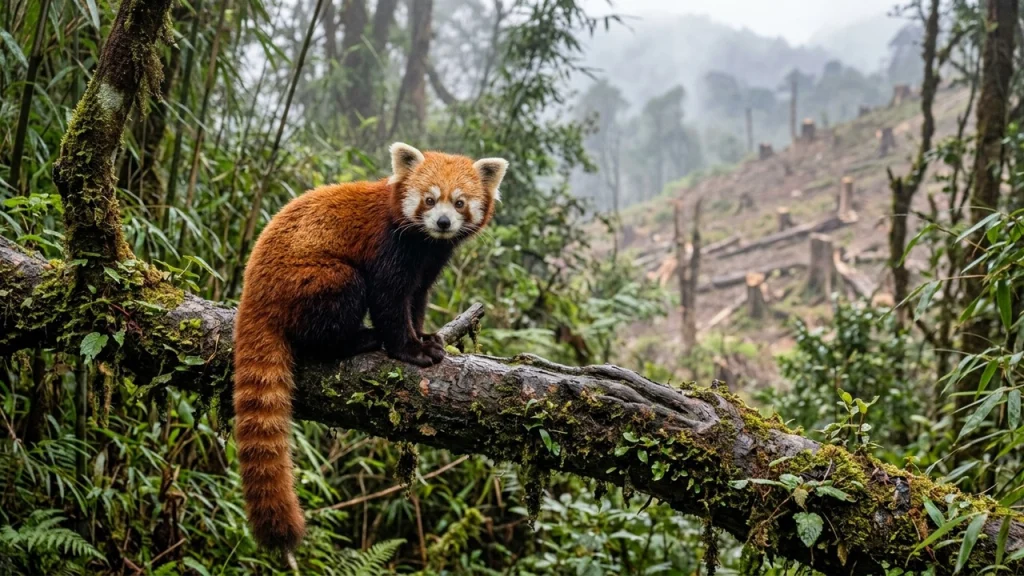
Habitat loss and degradation, human interference and poaching are the primary threats to red pandas, according to the Smithsonian’s National Zoo. The zoo attributes habitat loss mainly to farming, logging, grazing livestock, demand for firewood and human encroachment. A paper in Ecology and Evolution gives the red panda’s conservation status as Endangered on the IUCN red list and says it is included in Appendix 1 of CITES.
The San Diego Zoo Wildlife Alliance puts the adult population at probably around 10,000. Researchers believe the overall red panda population has shrunk by 40 percent over the past two decades, the Smithsonian’s National Zoo says.
Habitat loss and the habitat red pandas need
Clearing land for crops reduces the food and shelter that is available, the Smithsonian’s National Zoo says. Animal Diversity Web adds that deforestation removes nesting sites and food sources and leaves populations isolated in small fragments, cut off from each other by inhospitable habitats.
Animal Diversity Web says the species lives in deciduous and coniferous forests in temperate climates. The Ecology and Evolution paper describes it as a typical high-altitude animal found at elevations between 2,200 and 4,800 m. According to the Smithsonian’s National Zoo, red pandas need a specific set of circumstances to optimize survival, among them water close by, appropriate forest cover and altitude, and sufficient bamboo.
About 95% of the red panda’s diet is bamboo, according to the Smithsonian’s National Zoo. It also notes that in degraded habitats bamboo grows unreliably, and that this adds stress to the situation.
Fragmentation, roads and inbreeding
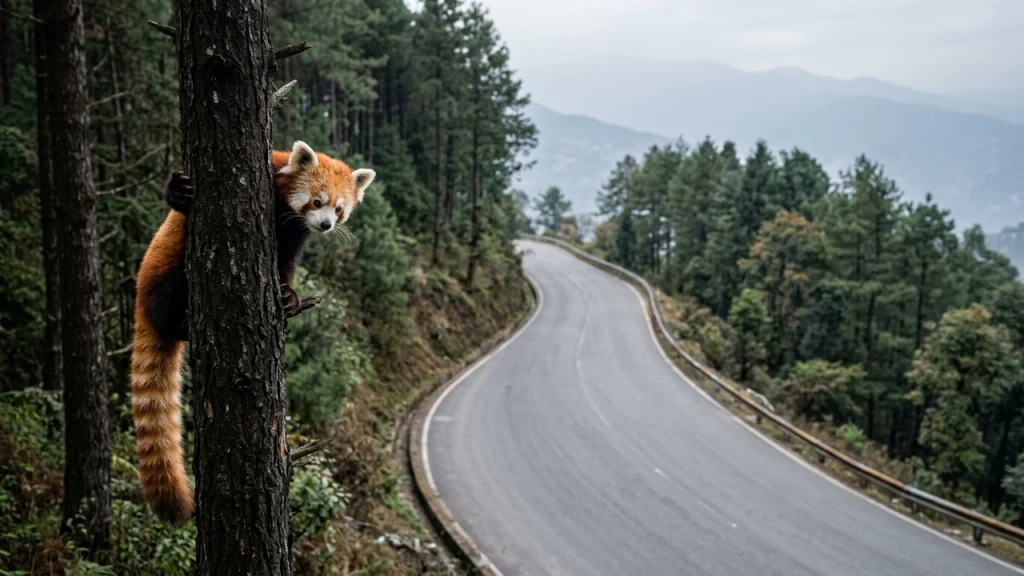
Fragmentation that follows habitat loss has led to inbreeding, the Smithsonian’s National Zoo says, as red panda populations become more isolated. The Landscape Ecology paper points to examples of habitat abandonment and local extirpation of red pandas in some areas of China and Nepal.
The same paper makes a general statement about roads: a rise in road density and traffic load can break up the habitat, deter movement across such linear features, and also interfere in conspecific interactions, resulting in population isolation.
Livestock, herders and dogs
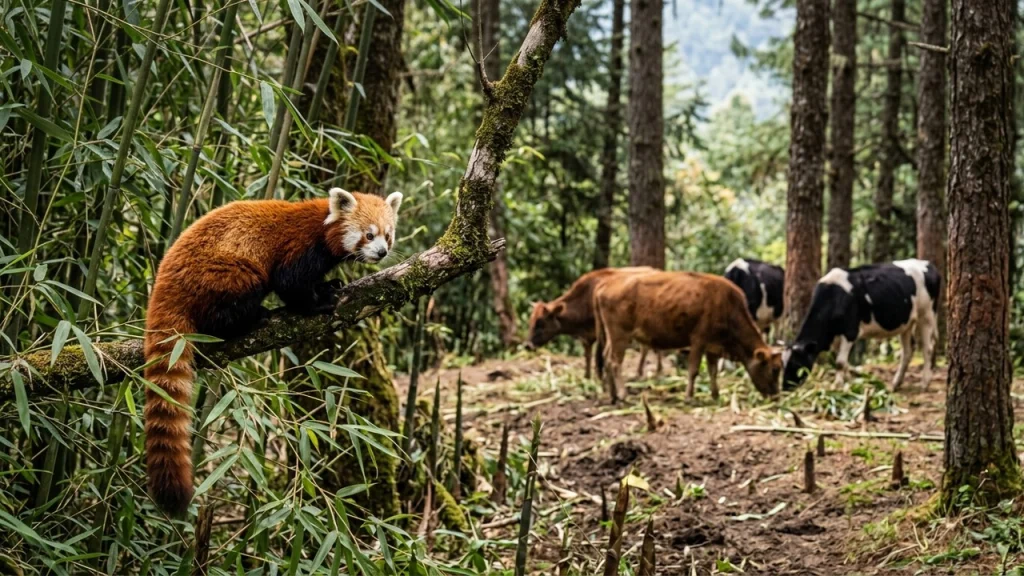
Animal Diversity Web says local livestock outcompete red pandas for food. The Ecology and Evolution paper adds that many cattle, herders and their guard dogs have been responsible for disturbing red pandas and their habitats.
According to the Smithsonian’s National Zoo, domestic dogs can hunt red pandas, or transmit disease to them, such as canine distemper.
Of the four top predictor variables in the Ecology and Evolution paper’s habitat suitability results, three are anthropogenic factors: livestock density, human population density and distance to paths. The paper reports that all three have a negative impact on red panda habitat suitability.
Hunting, snares and the pet trade
Red pandas are hunted for their pelts, the San Diego Zoo Wildlife Alliance says, and the pelts are made into fur capes and hats. Snares set out for takins, deer and wild pigs sometimes catch red pandas, the same source says.
Animal Diversity Web describes the red panda as an occasional target of game hunting and says it is often found in musk deer traps. In its discussion of red panda threats, the Smithsonian’s National Zoo describes the illegal pet trade as reportedly growing across Asia.
Other pressures and legal protection
The Smithsonian’s National Zoo says the threats to red pandas it describes are compounded by climate change and natural disasters, along with limited investment by local governments in red panda conservation and inadequate enforcement of laws and regulations. Legal protection covers red pandas in Myanmar, Nepal, China, Bhutan and India, the zoo says.
Sources
- Smithsonian’s National Zoo and Conservation Biology Institute: Red Panda
- San Diego Zoo Wildlife Alliance: Red Panda
- Animal Diversity Web: Ailurus fulgens (red panda)
- Landscape Ecology: Effect of disturbances and habitat fragmentation on an arboreal habitat specialist mammal using GPS telemetry: a case of the red panda
- Ecology and Evolution: An assessment of human impacts on endangered red pandas (Ailurus fulgens) living in the Himalaya