
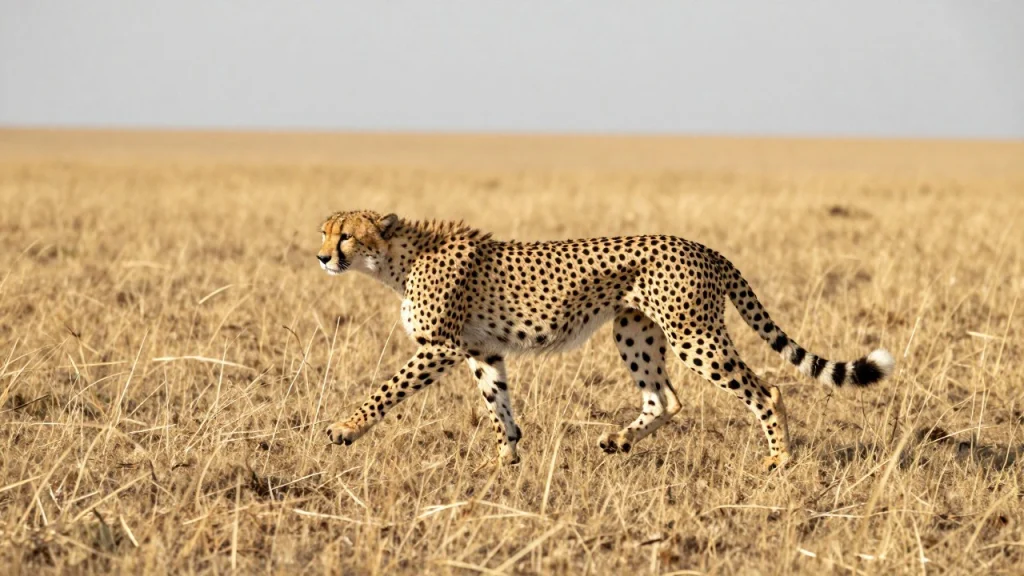
A cheetah’s top speed averages 60 to 70 miles per hour (96 to 112 kilometers per hour). The cheetah ranks as the swiftest land mammal. The San Diego Zoo Wildlife Alliance reports speeds up to 70 miles per hour (or 112 kilometers per hour).
The cheetah holds the title of quickest mammal on land. A full sprint typically sits in the 60 to 70 miles per hour band. That pace leaves a top racehorse at 43 miles per hour well behind. Such an edge shapes where the cat lives and how it feeds, because only open terrain lets extreme pace pay off.
It launches from a standstill to 45 miles per hour within only 2.5 seconds. Another timing puts the burst from rest to 60 miles an hour at only three seconds. Researchers think free living animals can approach nearly 70 miles an hour. Even then, the effort can continue for about 30 seconds. Its top speed, which averages 60 to 70 miles per hour, can be held for only about 300 yards before the cat must slow.
What full stride looks like in motion
At full pace each bound covers 23 feet, with four bounds completed every second. Above half of each fast run happens with no feet touching earth, which gives the floating look seen in slow motion footage. Long bounds let the animal close gaps quickly without wasting steps, while rhythm stays stable even as direction changes. The point is not endurance but rapid closure, followed by a quick stop or turn.
Why takeoff beats cruising
A frame tuned for sudden bursts
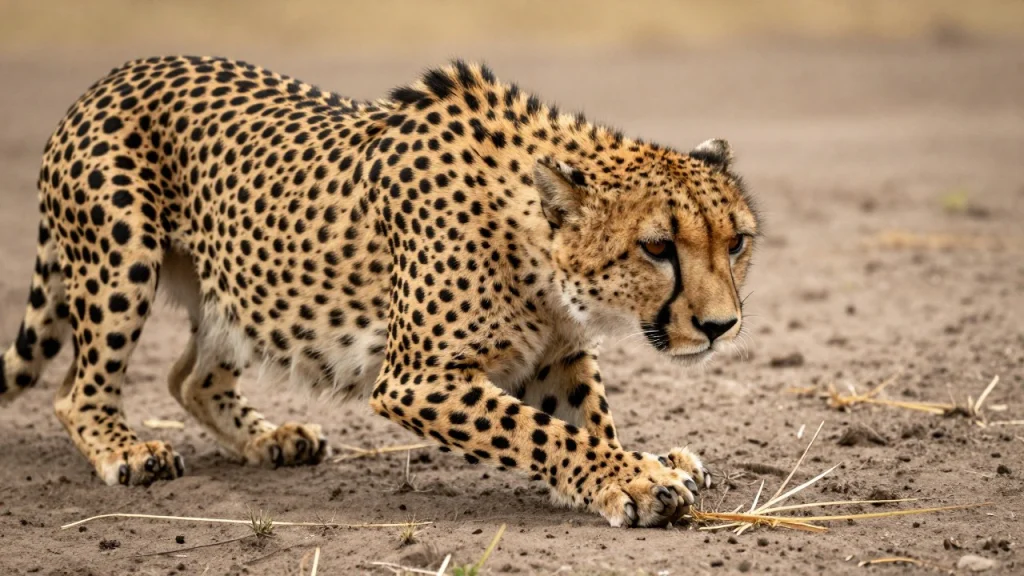
Flexible backbone gives the stride its length. A supple backbone lets the front limbs extend far ahead during every bound, so the body stretches and folds like a spring. This spring action adds distance that muscular legs alone could not supply. It also lets shoulders and hips swing widely, which lengthens each cycle without extra steps.
Grip and steering keep that length under control:
- Textured foot pads plus partly retractable nails add grip on dusty ground.
- Protective sheaths found in most felines are missing around its nails, so grip stays rough rather than razor sharp.
- The lengthy tail works as a steering aid during sharp turns, countering shifts in body mass.
- Oversized breathing organs and heart supply short explosions of power.
Such parts work as a system. Legs supply thrust, nails hold the surface, tail corrects the line, and chest organs repay the oxygen debt. The result feels less like distance running and more like a leap repeated at high frequency. Because the skeleton and muscles absorb large braking forces, the cat can slow sharply, pivot and go again.
How breathing supports the dash
Hard effort floods muscles with demand for air. Wide nasal passages, large lungs and a strong heart move oxygen quickly and clear heat through panting after the stop. Recovery is therefore part of speed, not an afterthought, since a cat that cannot cool cannot hunt again soon.
Daylight hunting built around vision
Hunts concentrate in early morning and late afternoon, when keen vision matters more than scent. Cats often survey open country from a raised kopje or termite mound before moving. Elevated posts widen the view and help the hunter pick an animal that has drifted from cover or lags behind companions. Patience at this stage saves energy for the few seconds when pace counts.
From stalk to trip
A stalk typically closes to within 100 yards before the final burst. The actual dash often starts from about 165 feet away, after a low crouch and freeze sequence that uses coat pattern for concealment. A dappled coat melts into tall pale grass during quiet approach. Movement stays low and steady until the last moment, then power takes over.
All out running generally lasts about 20 seconds. Roughly one half of chases end with a catch, which shows how often agility and timing decide the outcome rather than raw pace alone. Failed attempts still cost dearly, so choice of the moment matters as much as leg power. The hunter often walks away, rests and tries again rather than pushing a lost cause.
Why dashes must stay brief
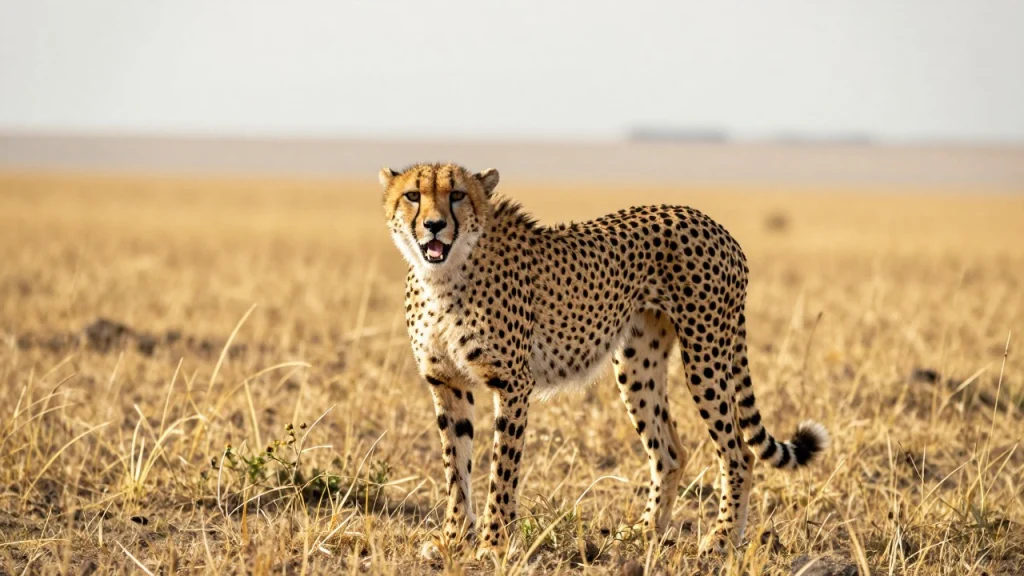
If the dash goes too far, the body risks overheating. Long pursuits rarely stretch past 500 m, even when prey remains in sight. Because such rushes demand huge energy, pursuits usually finish in less than a minute. Heat builds faster than panting can release it, so restraint protects brain and muscle. Stopping early is a survival skill, not a failure.
After a chase, heat can climb as high as 105 degrees Fahrenheit. Breathing and heat need about 20 minutes to settle back to normal. Once the prey stops moving, the cat must feed fast before lions or hyenas push it aside. Larger rivals watch for hunts and move in quickly, which forces the winner to eat rapidly or hunt again sooner. Speed wins the animal, but haste keeps the meal.
More than pace: size, range and survival
The cheetah stands alone as the living member of genus Acinonyx. Scientists list it as Acinonyx jubatus. Adults commonly weigh 75 to 140 pounds and stand about 30 inches at the shoulder, giving a light frame that favors quick starts over wrestling strength. Slim build reduces load on limbs during turns and helps shed heat after effort.
Wild populations live across parts of Africa, with a smaller group in Iran. Open grassland and plains suit them, offering cover plus room to run. Good visibility lets them spot movement early, while scattered bushes break their outline during the approach.
A low density future
Globally the species ranks as Vulnerable in IUCN Red List assessments. Specialists tentatively count 6,517 mature animals in 33 subgroups, with most groups small and scattered.
Speed therefore works as one part of a wider survival plan. Short and violent acceleration secures food, efficient cooling and quick feeding protect the gain, and broad habitat lets low density groups persist. Guarding that habitat keeps the fastest sprint in nature worth running.
How fast can a cheetah run in km/h?
Published maximum speeds for the cheetah range from 80 to 112 kilometers per hour according to Animal Diversity Web. According to the San Diego Zoo, a running cheetah can reach 112 kilometers per hour.
During a chase, sprint speed can climb up to 103 km/hr as recorded by the Cat Specialist Group. In a measured test reported by National Geographic, zoo officials clocked an 11-year-old individual on radar at up to 98 kilometers an hour.
What is the fastest land animal?
The San Diego Zoo ranks the cat first among terrestrial mammals for swiftness over brief sprints. A Notre Dame biomechanics page calls the cheetah the speed leader among land animals.
Sources
- Smithsonian’s National Zoo: Cheetah | Smithsonian’s National Zoo and Conservation Biology Institute
- San Diego Zoo Wildlife Alliance: Cheetah | San Diego Zoo Animals & Plants
- National Geographic: Cheetah, facts and photos | National Geographic
- Animal Diversity Web: Acinonyx jubatus (cheetah) | INFORMATION | Animal Diversity Web
- IUCN SSC Cat Specialist Group: Living Species – Cheetah | IUCN CatSG
- National Geographic: Cheetah Breaks Speed Record Beats Usain Bolt by Seconds
- University of Notre Dame: The Biomechanical Blueprint: How Cheetahs Bodies Are Engineered for Speed