
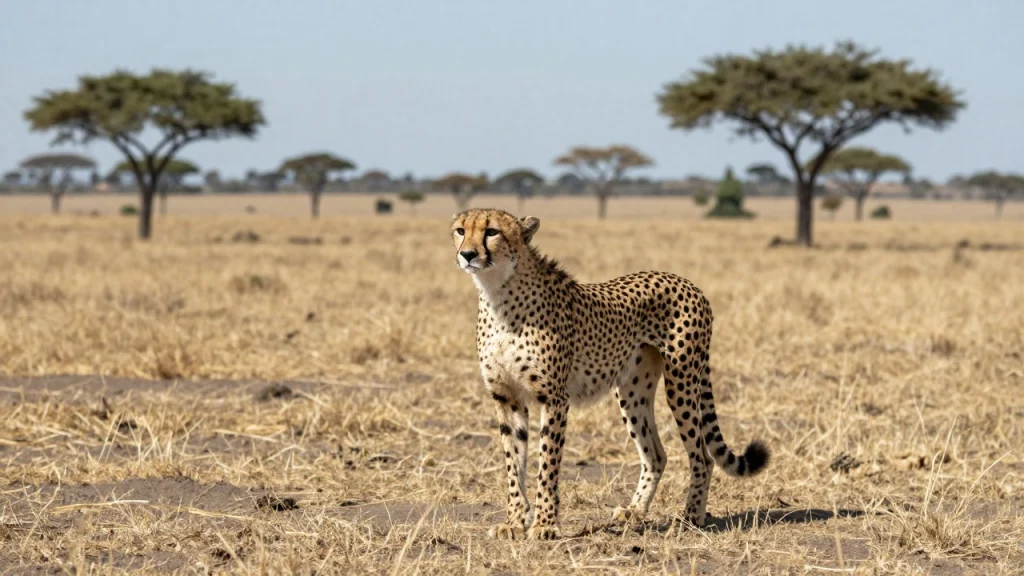
Wild cheetahs today occupy wide portions of Africa, reaching northern districts, the Sahelian belt and both eastern and southern zones.
Most live in eastern and southern ranges below the Sahara, while tiny groups persist in North Africa and Iran. That geography gives a short answer to the search question: check the east and south of the continent first, then note a small Asian remnant still holds on in Iran. The cats favor dry, open country over closed forest, and they need very large connected landscapes with enough prey to support wide-ranging lives.
Present range centers on two African strongholds
The modern core lies through the drier portions of sub-Saharan Africa, where the species remains fairly widespread in the south and east. Researchers describe two remaining anchor areas, one joining Namibia with Botswana and another joining Kenya with Tanzania.
Within that broad footprint, field workers report the highest abundance in Kenya plus Tanzania in the east together with Namibia plus Botswana in the south. Continent-wide surveys finished before 2005 logged the animal in 25 nations, which shows how scattered distribution has become. During the prior half century it disappeared from at least 13 countries, so current maps show patches rather than one continuous belt.
The current picture can be summarized as:
- Eastern anchor: Kenya plus Tanzania hold the best known eastern concentration
- Southern anchor: Namibia plus Botswana hold the best known southern concentration
- Northern fringe: small groups remain in North Africa
- Asian outlier: a small population remains in Iran
Open country specialists, not forest cats
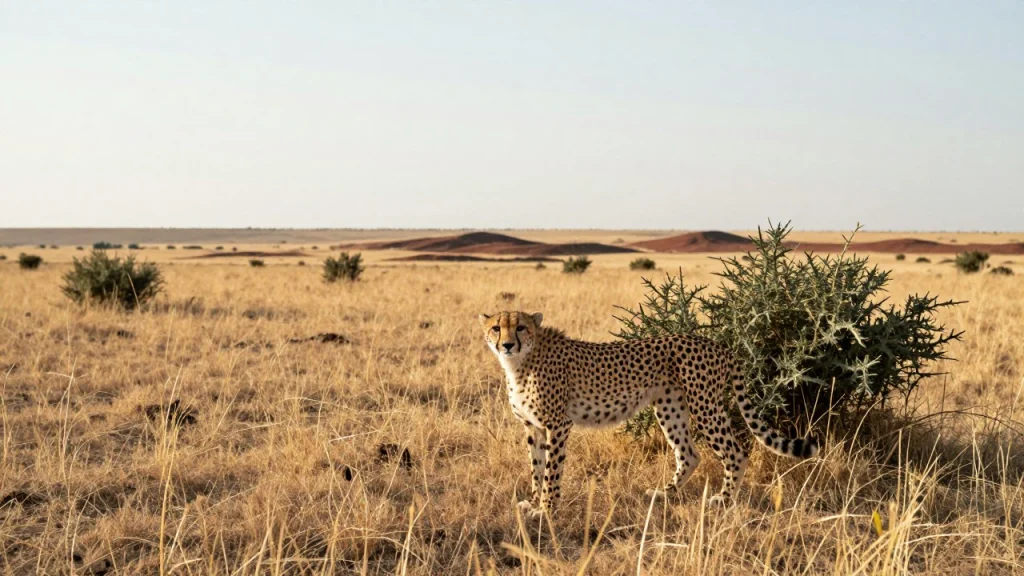
Cheetahs select for open terrain where speed and vision pay off. Favored ground covers grasslands plus deserts, and more broadly open grassland with savannah. That choice shapes hunting style. Animals also occupy a wider set of eastern and southern habitats beyond pure plains.
The menu of occupied vegetation is wider than many visitors expect:
- Grasslands and savannahs form the classic stronghold
- Dry forest plus semi-desert plus open woodlands plus shrubland also support residents
- Thick plant cover and high rocky ground are used in places such as Namibia
- Tropical rainforest does not support them, and they stay out of that closed biome
Namibia illustrates flexibility well, because animals there use grasslands and also savannahs, plus dense plant cover or high rocky terrain within one country. In the central Sahara some individuals even use elevated rocky habitat that gets a bit more rain than nearby desert lowlands. Enough concealment for stalking and resting appears to decide many local choices, since cats need a bush, rise or grass clump to approach prey and shade to rest after a chase.
Iran shows the dry extreme of this pattern. The Asiatic form mainly uses desert plus semi-desert plus open dry ground, including flat salt areas, worn foothills and dry hill chains. Yearly rain in those Iranian ranges drops under 100 mm per year,
Open plains provide two linked benefits. Spotted coats merge with dry grass, and long sight lines allow space to chase prey to exhaustion. Animals therefore do best where land stretches unbroken and prey stays plentiful. When grasslands disappear under settlements or farms, home ranges shrink and contacts with people rise.
A shrunken remnant of a vast former range
The historic footprint was very wide for Acinonyx jubatus. Early accounts trace it from Palestine plus Arabia toward Tajikistan and into central India, and across most of Africa outside rainforest and the central desert. Other summaries extend that old belt from the Cape of Good Hope toward the Mediterranean, through Arabia and the Middle East. Such breadth shows an animal built for dry savannas and arid plains rather than for one narrow niche.
Specialists describe the species as well suited to arid climates, formerly present in savannas and parched landscapes across much of the continent. That tolerance helps explain survival on dry grassland fringes, in the Sahel and in Iranian deserts alike.
Loss has been severe. Around 1900 roughly 100,000 cheetahs occupied lands across the west of Asia plus Africa. Today the animal keeps only a fraction of that old extent, with 11% left in the east, 22% in the south and 9% in the northwest. Current world estimates put 7,500 to 10,000 wild individuals alive, with the biggest single national total of 2,500 in Namibia and a wider southern African stronghold of roughly 4,500 grown animals.
Lineage and legal status help explain why each fragment counts. The cheetah forms the lone living member of the genus Acinonyx. Worldwide it carries the label Vulnerable on the IUCN Red List. The Asian form, termed A. j. venaticus, persists in Iran but faces critical danger, and Iran alone still shelters an extremely small remnant believed to number in the low hundreds.
Sharing land with people and livestock
Wild cats increasingly live outside strict reserves. As human expansion pushes into favored ground, animals now turn up regularly on commercial farms.
Space demand makes this overlap hard to manage. Because individuals range widely, biologists calculate they require broad linked terrain, probably more than 3,800 square miles, in order to locate mates and persist long term. Most reserves by themselves cannot maintain resident groups for decades, since borders rarely contain a full lifetime of movement. Expanding towns and fields have thus cut former corridors into islands.
Conservation here means keeping open landscapes linked and productive. Wide grass plains with cover, wild prey and tolerance from landowners support more cats than isolated parks alone. Where those three elements meet, in parts of Kenya, Tanzania, Namibia and Botswana as well as remnant pockets farther north and in Iran, cheetahs still course, rest under shade and raise young in the wild.