
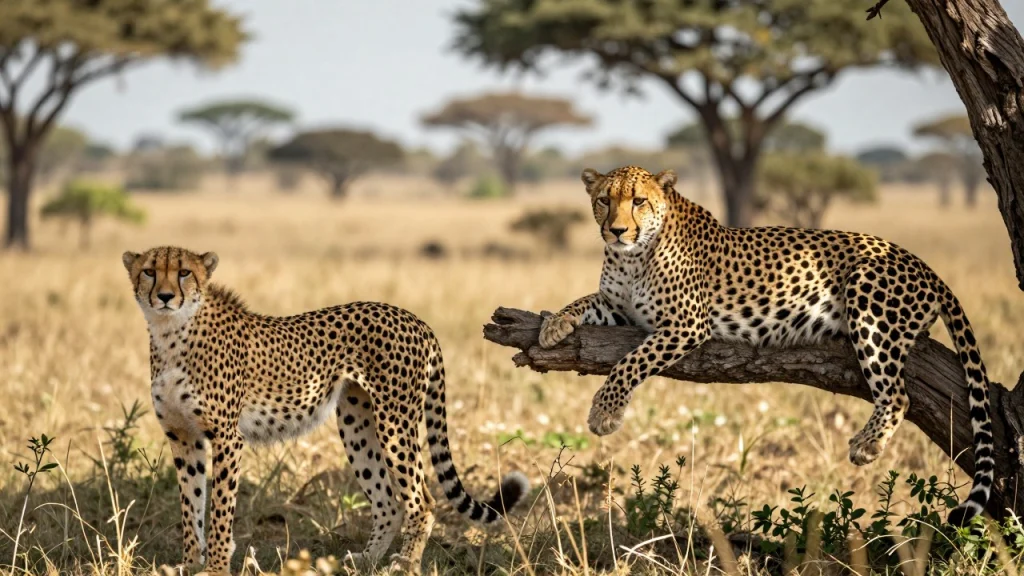
Observers often confuse cheetahs with leopards, but the leopard is a much heavier feline characterized by rosette-shaped spots and an absence of facial tear stripes. Cheetahs display a sleek silhouette with elongated legs and blunt claws that retract only partially. Leopards share an anatomical build reminiscent of jaguars and carry flower-shaped clusters known as rosettes across their coats with no central dot, unlike the jaguar which features an inner spot inside each rosette. These two spotted cats occupy distinct ecological roles across their overlapping African ranges.
A distinctive dark tear line extends from the inside corner of each eye straight to the feline’s mouth. These deep facial markings assist diurnal hunts by deflecting blinding solar glare. Engineered for aerodynamic velocity, the cheetah ranks as the quickest mammal on land. Leopards lead a nocturnal existence, resting throughout daylight hours and seeking quarry after dusk. Examining their coat markings, physical frameworks, hunting mechanics, and social behaviors reveals two very different evolutionary paths.
Coat Patterns and Facial Markings
The most reliable visual field mark begins with the spots. A cheetah exhibits solid, independent black spots distributed evenly across its body, set against a tawny background. These markings remain distinct circles from the neck down to the extremities, creating a clean pattern that disrupts the predator’s outline across open savannas.
In contrast, a leopard displays intricate floral markings termed rosettes. These patterns consist of darkened irregular rings that encircle a warmer golden center, breaking up the cat’s contour against dense shadows and dappled foliage. While jaguars display similar groupings with centered dots, the leopard keeps the middle of each ring completely vacant. This cryptic patterning affords the leopard exceptional concealment within brush, rocky kopjes, and woodland thickets.
Facial architecture reinforces this distinction immediately:
- The cheetah features pronounced facial tear lines running from the anterior ocular corners down toward the lips.
- These facial lines serve a critical functional purpose under harsh midday light, reducing solar reflection much like grease under an athlete’s eyes.
- Leopards lack facial tear marks entirely, presenting a spotless facial expanse surrounding their whiskers.
This clean facial presentation allows observers to identify either cat within seconds, even when vegetation partially obscures the rest of the body.
Skeletal Frame, Body Mass, and Paw Anatomy
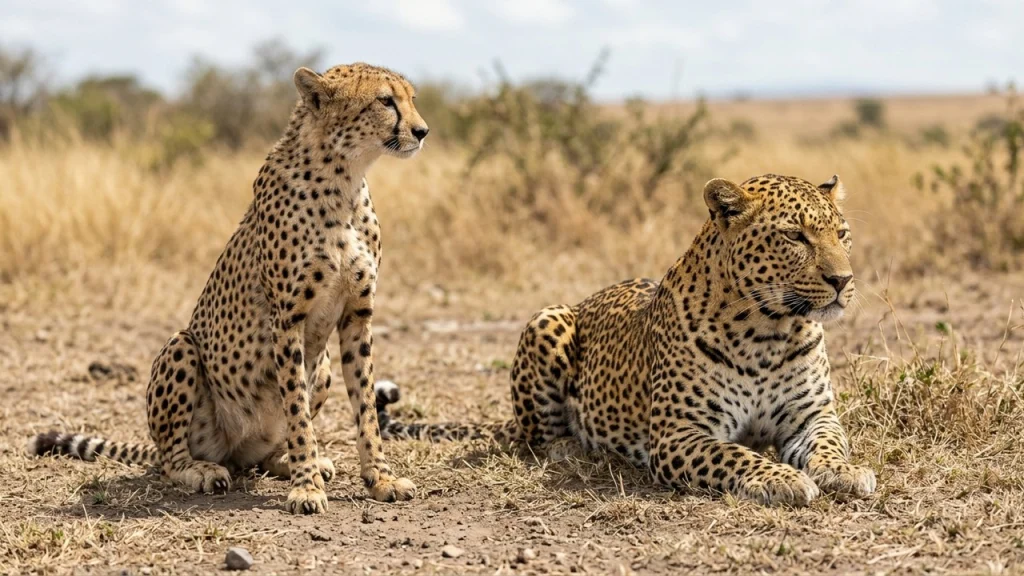
A close look at their silhouettes reveals radically diverging athletic designs. The cheetah represents a lightweight sprinter, whereas the leopard functions as a dense, muscular brawler.
An adult cheetah weighs 34 to 64 kilograms, standing about 77 centimeters tall at the shoulder with a body length of 112 to 142 centimeters and another 66 to 84 centimeters of tail length. This creates an elongated, deep-chested frame with a narrow waist that flexes dramatically during locomotion. Female leopards weigh between 21 to 60 kilograms, whereas adult males reach 36 to 75 kilograms. This heavier mass rests upon shorter, thicker limbs designed for leverage and explosive grappling.
Cranial and Dental Adaptations
Skull geometry reflects how each predator dispatches its food:
- Leopards possess a wide cranial architecture, and their massive skull provides anchor points for formidable jaw musculature.
- Spacious nasal cavities inside a cheetah leave minimal internal room to seat the elongated roots needed for substantial canine teeth.
- Owing to these compact teeth, cheetahs dispatch their captured targets through respiratory suffocation.
The leopard’s robust jaws generate crushing force capable of snapping mammalian bones and piercing heavy hides. Cheetahs trade bite force for oxygen intake during high-speed exertion. Their enlarged nasal airways allow rapid ventilation during maximum cardiovascular output.
Paw Structure and Traction
Paw morphology highlights their opposite locomotive priorities:
- Cheetah forepaws carry four primary digits plus an elevated dewclaw, whereas their back paws possess four toes.
- A cheetah can withdraw its claws slightly, yet the protective skin sheaths typical of felines remain absent.
- Rigid, pointed claws function like athletic cleats, supplying superior surface grip during rapid acceleration.
The cheetah’s blunted, semi-retractable claws stay permanently exposed to provide immediate ground purchase.
Sprinting Velocity Versus Arboreal Strength
Locomotion represents the greatest behavioral divide between these two predators. One commands the open plains through blistering straight-line acceleration, while the other dominates the vertical realm through supreme upper-body power.
During a chase, an accelerating cheetah can surge to 45 miles per hour from zero in just 2.5 seconds. Their top speed averages between 96 and 112 kilometer per hour, a blistering sprint sustainable for only about 274 meters. At top speed, cheetahs advance 7 meters in a single bound while completing four strides per second. A cheetah utilizes its elongated tail like a directional rudder, while oversized air passages, lungs, and cardiac chambers empower brief bursts of explosive power. The flexible spine bends and straightens like a spring, extending reach with every step.
Leopards trade high-velocity pursuit for tremendous climbing prowess. Among the larger felids, leopards prove to be the most arboreal, employing lengthy tails to maintain poise upon slender branches. The shoulder blade of a leopard contains specialized anatomical zones that anchor robust vertical climbing muscles. Thanks to immense muscular power, a leopard can ascend 50 feet (15 meters) into a tree canopy clutching a fresh kill that weighs more than the cat itself.
This climbing ability provides vital protection on the ground. By hoisting carcasses high into the fork of a tree, leopards place their meals far beyond the reach of heavy scavengers that dominate ground level.
Hunting Techniques and Diel Activity
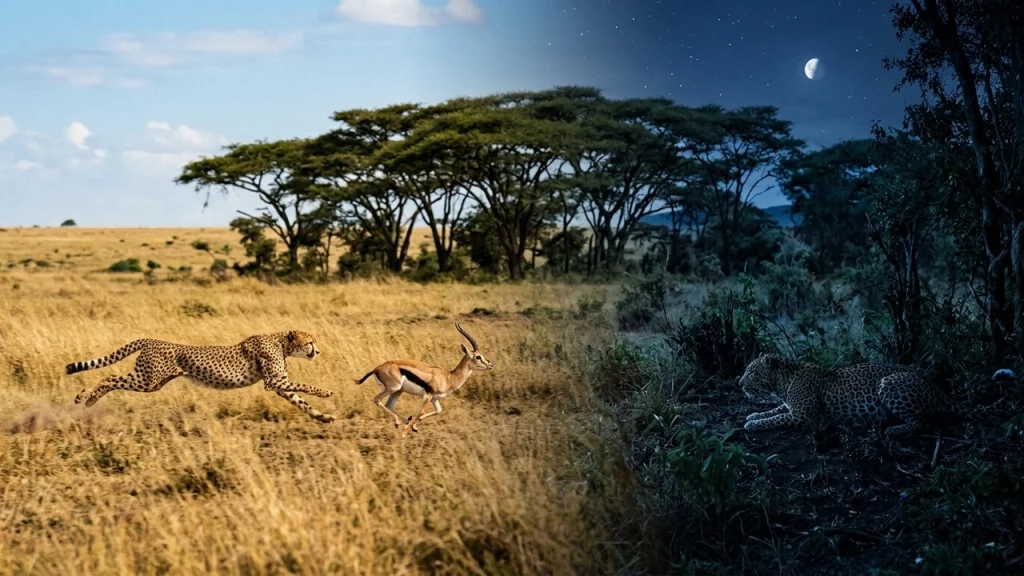
Hunting schedules reflect their divergent physical strengths.
Cheetahs typically pursue prey during early daylight hours and once again at twilight. Hunting during cooler daylight phases enables cheetahs to spot potential quarry across flat expanses while larger competing carnivores sleep. They survey herds from termite mounds, select an isolated target, and initiate a lightning-fast pursuit.
A leopard relies on careful stealth and pouncing strikes instead of running down targets across vast distances. Crouching close to the ground, a leopard creeps within striking range under cover of darkness before launching a decisive ambush. Following a neck snap, leopards asphyxiate quarry and haul the carcass into secluded arboreal roosts. This ambush approach requires dense cover, patience, and silent footing.
Social Systems, Communication, and Interspecific Dynamics
Social organization also sets these species apart across the African landscape.
Female cheetahs live solitary lives once their litters disperse. Young female siblings depart their natal litter around two years of age to live independently, whereas young males band together permanently in a coalition. These male coalitions defend common hunting territories against rivals, collaborating throughout their lives.
Communication reveals stark acoustic differences between the two animals:
- Cheetahs cannot roar, expressing themselves instead through high chirps, growls, hiss sounds, barking noises, and purrs.
- Leopards can roar.
The lack of a roaring larynx aligns the cheetah with smaller felid lineages rather than the pantherines.
Competitive interactions between the two cats heavily favor the stronger species. Leopards frequently pirate kills from Acinonyx jubatus, solitary foragers belonging to Hyaenidae, and other smaller predators. Cheetah young remain under maternal protection for about 18 months, often falling prey to lions, leopards, and hyenas. Because cheetahs lack heavy dental weaponry and muscular mass, they generally surrender contested kills rather than risk injury. Official global assessments classify the cheetah under vulnerable species status. Recognizing these distinct evolutionary specializations ensures a deeper appreciation for how Africa’s iconic spotted cats thrive within their respective ecological niches.
Sources
- Smithsonian’s National Zoo: Cheetah | Smithsonian’s National Zoo and Conservation Biology Institute
- San Diego Zoo Wildlife Alliance: Cheetah | San Diego Zoo Animals & Plants
- San Diego Zoo Wildlife Alliance: Leopard | San Diego Zoo Animals & Plants
- Animal Diversity Web: Acinonyx jubatus (cheetah) | INFORMATION | Animal Diversity Web
- Animal Diversity Web: Panthera pardus (leopard) | INFORMATION | Animal Diversity Web