
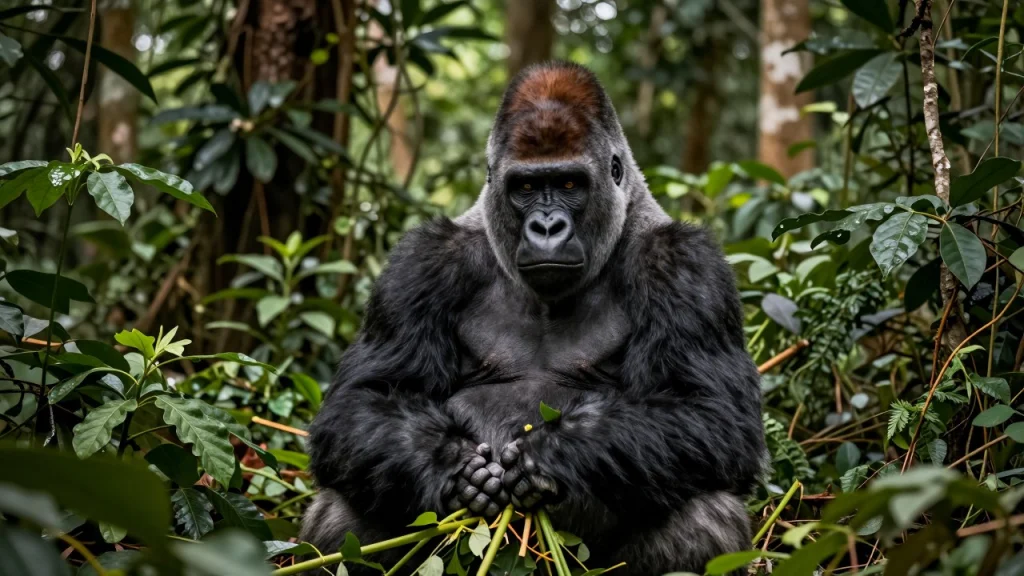
Gorillas hold the top size slot among great apes, yet the western lowland form ranks as the most compact of its group, which frames the whole puzzle of bulk without hunting. A bulky plant-centered routine plus a fermentation-adapted bowel lets them add and keep that mass without chasing prey, so green abundance rather than meat explains their power.
Adult males in zoo records span 300 to 400 pounds, while adult females span 159 to 216 pounds, a large gap between the sexes. Males can stand up to 6 feet tall, which shows how much bone and muscle a forest diet can support when intake stays high and digestion stays efficient.
Why huge meals replace meat
Wild individuals live chiefly on soft, water-rich stalk plants, a staple that makes up most of what they eat. That abundance lets troops feed steadily without defending kills, so more daily energy flows into growth, movement and social life instead of pursuit.
Their core fare centers on foliage and tender stalks gathered from woodland herbs, shrubs and climbers, and that steady base carries them through weeks when sweet produce disappears. They also take juicy tree produce from close to a hundred seasonal kinds, so fruit sugar boosts calories in ripe months.
Beyond that core, they use foliage, small fleshy produce, fern fronds and stringy bark, a backup set that keeps the gut full when preferred fruits fail. This variety matters because young animals learn to handle many textures and plant defenses, and groups can stay in familiar ranges rather than wander far.
What a day of foraging looks like
Broader menu records describe them as combined leaf and fruit feeders using up to 230 items from 180 plant kinds, a very broad menu. One field team logged 132 food items from 98 plant and insect kinds across 237 observation days, a tally that highlights both flexibility and detailed knowledge of local flora.
A silverback-class male takes in about 45 pounds of feed each day, a load that demands hours of picking, stripping, chewing and handling. Females take in about two-thirds of that male amount, a difference that tracks their smaller frames while still requiring near-constant gathering by mothers and juveniles.
Such bulk matters because foliage and other green parts supply only modest nourishment per bite, so volume compensates for low density and keeps daily fuel stable. Feeding peaks occur in the morning and again in the afternoon, a twice-daily rhythm.
A gut built for tough fiber

Swamp and water-edge greens favored in bais digest readily and bring protein plus salt and minerals, acting like natural supplement patches inside the forest. Troops that reach these wet clearings gain richer bites without crossing large stretches of poor ground, which helps growing youngsters and nursing mothers most.
When choosing, animals favor greens rich in protein and modest in fiber, a preference that lifts growth while easing the work of digestion. Lab work found both mature and young foliage held more protein than fruit pulp, so leaves function as the protein anchor while fruit functions mainly as quick fuel for travel and play.
Foods taken in fruit-rich months carried greater digestible energy, though other major nutrients did not rise, which means seasons change calorie supply more than mineral supply. Gorillas therefore ride fruit booms for energy and fall back on leaves for steady protein, a two-part strategy that smooths nutrition across the year.
Microbes unlock leaves and bark
When produce grows scarce, animals likely cover most daily fuel by digesting extra protein, fat and fiber from foliage and bark, a feat tied to great bulk and hind-bowel fermentation. Big chambers hold feed longer, microbes release useful acids from walls that small stomachs cannot crack, and steady intake keeps body fuel stable through lean weeks.
- A roomy lower bowel linked to fermentation in the cecum and colon works like an internal compost line for fiber.
- A cecum stocked with abundant microbes that split cellulose turns stiff cell walls into usable fragments.
- An extended hold inside the tract raises uptake of nutrients and lets slow microbes finish their work.
- Powerful chewing muscles plus wide and sturdy teeth shear and grind tough fare before microbes take over.
Small animal extras and smart bodies
To reach choice foods, western animals ascend trunks up to 15 meters high, which opens fruit crowns and young foliage that ground rivals cannot strip. Climbing skill thus widens the menu without tools or teamwork, and it lets heavy adults harvest efficiently before descending to rest and digest.
A little extra protein arrives with tiny spineless animals picked off foliage and produce, a bonus that adds amino acids and minerals without active hunting. Free-living troops keep a strict plant routine, although animals under human care readily accept flesh when offered, proof that wild habits reflect ecology rather than inability to process animal tissue.
Why giant frames suit this menu
Almost everything they consume counts as plant matter, so the forest itself acts as a permanent canteen rather than a hunting ground. Great bulk lowers the cost of digesting fiber because a bigger vat holds more feed, keeps it longer and houses more microbes, which turns low-grade greens into steady growth.
Western animals now face a precarious future as a critically endangered form, so protecting fruit trees, herb patches and swamp clearings protects the very foods that build giants. Secure forests let troops feed long, ferment well and raise young slowly, keeping these forest gardeners on the landscape for decades.
Sources
- Smithsonian’s National Zoo: Western lowland gorilla | Smithsonian’s National Zoo and Conservation Biology Institute
- San Diego Zoo Wildlife Alliance: Gorilla | San Diego Zoo Animals & Plants
- San Diego Zoo Wildlife Alliance Library: Diet & Feeding – Western Lowland Gorilla (Gorilla gorilla gorilla) Fact Sheet
- Animal Diversity Web: Gorilla gorilla (western gorilla) INFORMATION
- PLOS ONE: The Influence of Seasonal Frugivory on Nutrient and Energy Intake in Wild Western Gorillas