
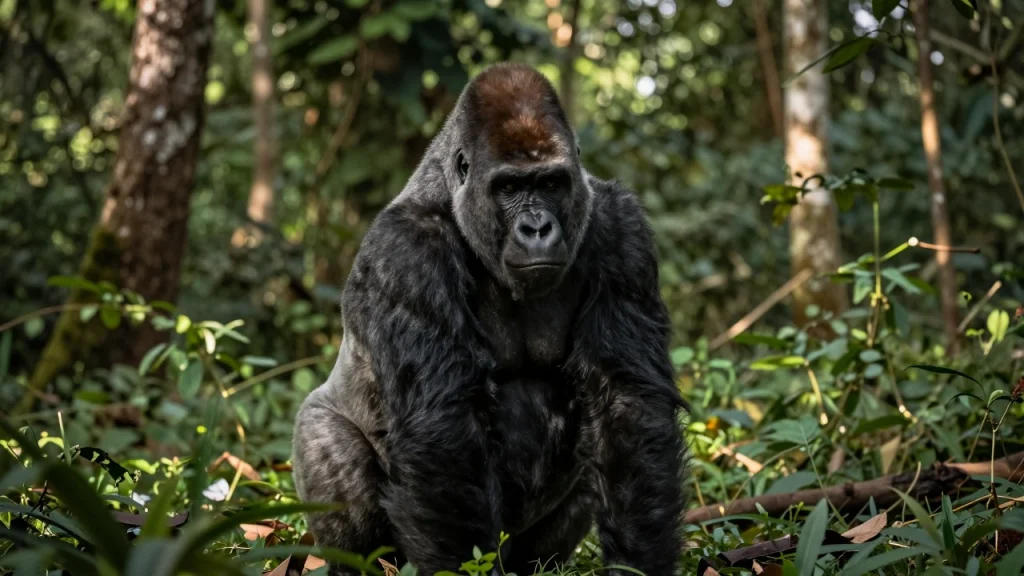
Gorillas do not have a higher IQ than humans, and no study has placed a gorilla above a person on a general measure of intelligence. What the research does show is an animal that comes remarkably close in a few narrow areas, such as symbolic communication and stubborn, patient problem solving, and that falls behind in the brain tissue supporting abstract thought.
The comparison is awkward anyway, because nobody has handed a gorilla an IQ test built for human children. Scientists instead compare specific skills: how long an ape works at a puzzle, whether it picks up a stick, whether it recognizes its own reflection. Most researchers describe the gorilla mind as unfinished business, and the result changes depending on which skill you measure.
The brain comparison is not close
Gorillas and orangutans are human-sized in body, yet the brain of each is only one third the size of a human brain. That gap is often used against our own species, cited as proof that the human brain is roughly 3 times oversize for a primate that large.
The raw numbers still favor people. A human male brain averages 1.5 kg, and counting its cells gives 86 billion neurons along with 85 billion non-neuronal cells. Even the much-hyped human cortex, long described as overdeveloped, accounts for only 19% of all brain neurons.
Why should neurons settle an intelligence contest? Because this line of research concludes that cognitive ability centers on absolute numbers of neurons rather than on brain size relative to the body, and among primate brains built on the same economical rules, the human brain is the largest and therefore holds the most neurons of all. A gorilla working with a much smaller budget simply has less material for the flexible thinking that human daily life runs on.
Talking with hands and the Koko legacy
Gorillas made their reputation in the language lab. In the mid-1970s, after sign work with chimpanzees had paid off, researchers turned to gorillas, and the western gorilla Koko went on to master more than 1000 signs. That is genuine evidence of symbolic communication, since the ape linked hand gestures to names, requests and feelings over years of teaching.
It is also easy to overread. Signing is a human convention handed to an animal, so it measures how well a gorilla learns from people, not whether it thinks more broadly than a person does. Out in the forest the toolkit is smaller: gorillas lean on sound, posture and smell, and field researchers have distinguished 22 separate vocalizations, each with a different meaning. They are generally quiet animals that will also scream, bark and roar.
Tools: rare outdoors, routine in captivity
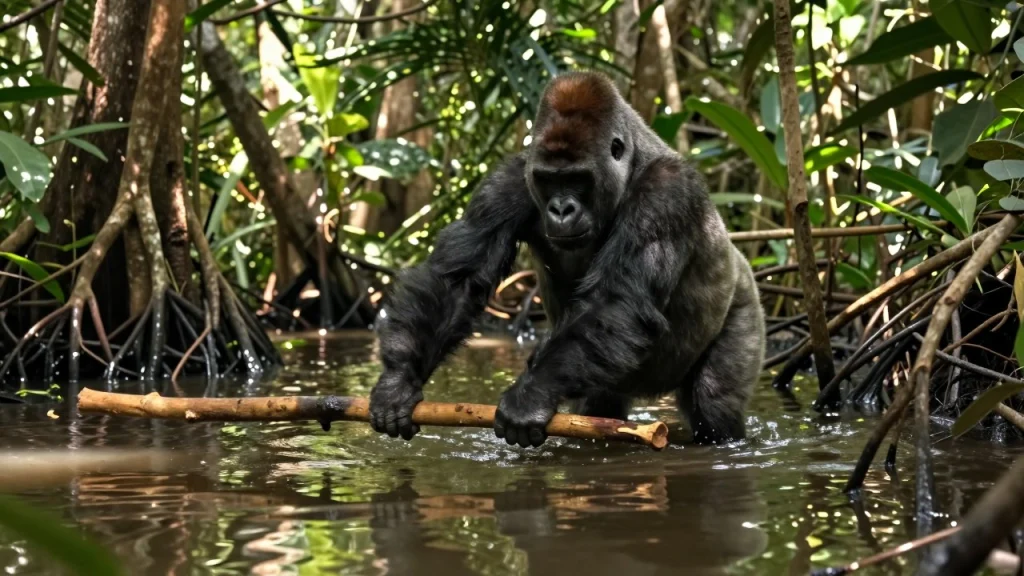
For years, scientists knew that captive gorillas used objects, yet not one had ever been seen doing so in a forest, despite decades of field research. The first wild reports came from a swampy clearing called Mbeli Bai in northern Congo, where an adult female used a branch to gauge the depth of a pool and steadied herself with it while wading across. A second female from another group used a detached trunk as a stabilizer while processing food, then as a bridge of her own to cross deep swamp.
Tool use stays rare outdoors because of what gorillas eat. They open nuts with their teeth and smash termite mounds with their hands, so they need a hammer or a fishing stick far less than chimpanzees do, and those first observations pointed to habitat, rather than food, as the trigger for picking up an object. In captivity the balance flips: gorilla tool use is less extensive than in other apes, yet captive western individuals have performed on a par with orangutans.
Patience is a gorilla strength
Against the movie version of the species, western gorillas are steady rather than flashy. In laboratory problem solving studies they outlast chimpanzees, showing more persistence and a sturdier memory. They will also tackle a task out of curiosity rather than for a food reward, and they will keep at it because the puzzle itself holds their attention.
That motivation is not what makes human cognition unusual, though. What separates people is flexibility, carrying a rule learned in one setting into a new one, and handing accumulated knowledge on through language. Those are exactly the abilities a slow, forest-dwelling, leaf-eating ape has little pressure to evolve.
Self-awareness shows the clearest gap
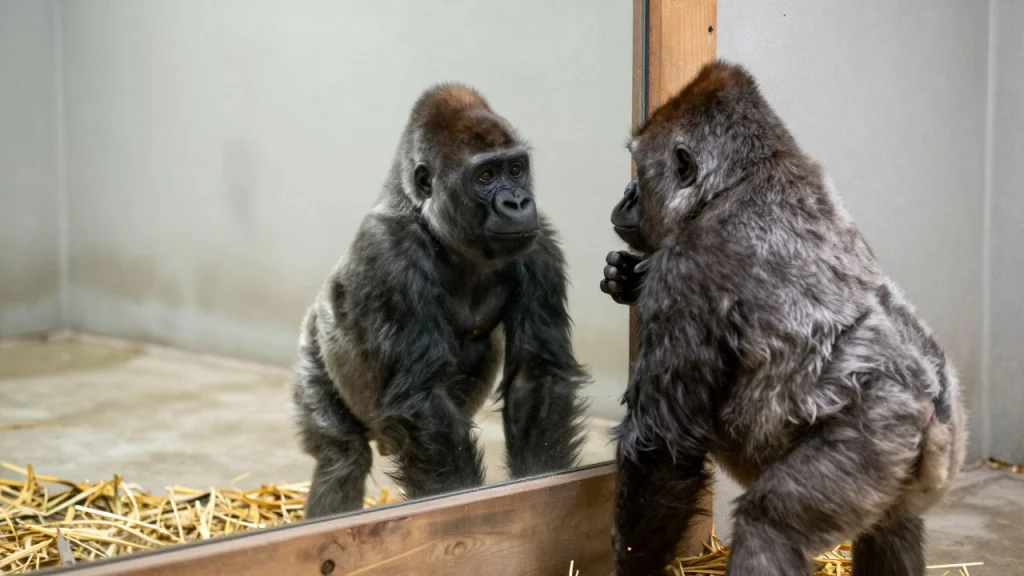
One experiment has separated people from the other apes for decades: the mark test. The subject is sedated and marked somewhere it cannot see, then watched without a mirror and again in front of one. The strongest evidence of this kind of self-awareness in nonhuman animals comes from great apes, and gorillas are the puzzling exception.
A recent review scored 21 published gorilla studies against a list of 15 methodological criteria, and most of the mark test studies inside it involved one to six subjects each. Positive results turned up less consistently than in chimpanzees or orangutans. A facial mark that only a mirror reveals is often ignored, while matching marks on the wrist draw an avid response. The review’s conclusion is cautious: rigorous methods have not guaranteed stronger evidence, and the accumulated gorilla case for self-recognition is not compelling.
The slow, long-lived ape behind the behavior
Size and pace explain much of what a gorilla brain is for. A mature male tips the scales at 300 pounds (136.1 kilograms) on average and can reach 500 pounds (226.8 kilograms), with a height of up to 6 feet (1.8 meters). They walk with arms that are longer than their legs and a reach that exceeds their standing height, climb up to 15 meters for food, and leave plant cover standing in any one patch.
That describes a heavy, slow, largely herbivorous animal with a long apprenticeship. A male is not a full silverback until roughly 13 years old, mothers bear a single infant of roughly 2 kg following nine months of pregnancy, and nursing then runs for 3 to 4 years. In the wild the species typically reaches 35 to 40 years, and captive individuals come close to 50. A primate that develops slowly, stays in one place and spends its day eating foliage has little evolutionary reason to be clever in human ways.
Why the question matters for a dwindling species
Wild western gorillas are classed as critically endangered, and the pressure comes from people: high disease levels and hunting drove their numbers down by over sixty percent in a 20 to 25 year span. Understanding what these animals can do is not academic bookkeeping, because the evidence base is thin. Some of the best known results come from a single named individual, and the mirror experiments rest on a handful of animals, so nearly every claim about gorilla minds stands on a narrow set of observations.
The bounded answer is this. Gorillas learn human sign language, grind away patiently at puzzles, and invent a tool when a swamp forces the issue, all with a brain one third the size of a person’s. Nothing measured so far puts a gorilla above a human in general intelligence, and the clearest evidence points the other way: a smaller neural budget, no consistent sign of mirror self-recognition, and an evolutionary history that never demanded abstract, cumulative thought.
Sources
- Animal Diversity Web, University of Michigan: Gorilla gorilla (western gorilla)
- Smithsonian’s National Zoo and Conservation Biology Institute: Western lowland gorilla
- PLOS Biology via PubMed Central: First Observation of Tool Use in Wild Gorillas (PLOS Biology)
- Brain Structure and Function via PubMed Central: Gorilla and Orangutan Brains Conform to the Primate Cellular Scaling Rules
- Frontiers in Human Neuroscience via PubMed Central: The Human Brain in Numbers: A Linearly Scaled-up Primate Brain
- Animal Cognition via PubMed Central: Mirror self-recognition in gorillas (Gorilla gorilla gorilla): a review and evaluation of mark test replications and variants