
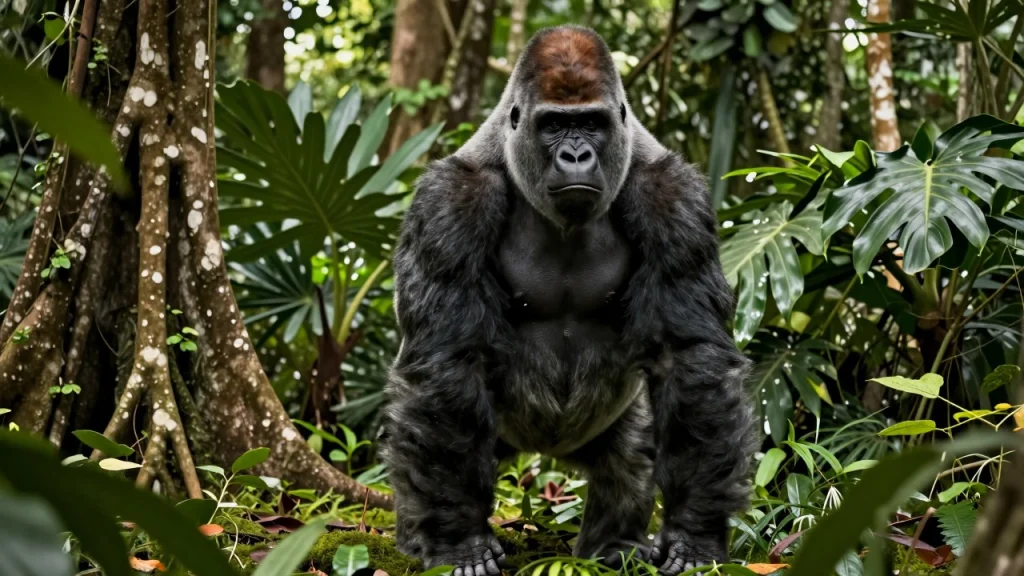
Western gorillas rank among the most powerful and heavily built primates on Earth. Gorillas rank as the largest extant primates, attaining complete physical maturity from 12 to 15 years of age.
A full-grown silverback delivers formidable mechanical force backed by substantial body mass. Adult males achieve an average weight of 300 pounds (136.1 kilograms) and can reach up to 500 pounds (226.8 kilograms). On two hind limbs, full-grown silverbacks stand upwards of 6 feet (1.8 meters) tall. Full-grown males develop an outstretched arm span reaching 8 feet (2.4 meters), whereas female spans measure 6.5 feet (2 meters) across.
Musculoskeletal scale and sexual dimorphism
The physical strength of gorillas originates in their specialized skeletal framework. Their bodies feature robust frames, long muscular arms, short lower limbs, massive heads, and males possess large, sharp canine teeth.
Physical size varies dramatically between sexes. Mature females register body weights from 150 up to 200 pounds (113.4 kilograms), reaching vertical statures of 4.5 feet (1.4 meters) tall.
Regional populations exhibit distinct physical dimensions across Central and East Africa. Eastern populations display extreme sexual dimorphism: females typically scale between 70 to 114 kg, whereas wild males average 160 kg. Within natural habitats, male western gorillas record an average mass of 180 kg, while female counterparts often weigh almost half that amount.
Upper body leverage and knuckle-walking biomechanics
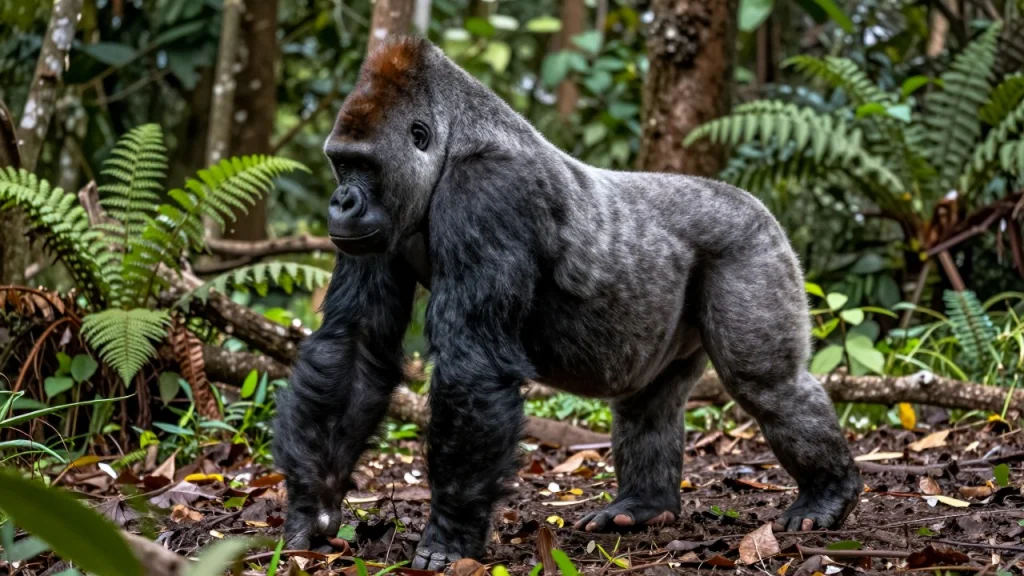
A gorilla’s upper body serves as its primary mechanical engine for movement and heavy physical labor. Muscular arms extend much longer than their legs.
Although they occasionally stand upright, western gorillas move in a hunched, quadrupedal posture with knuckles touching the ground.
The physical contact of knuckle-walking concentrates intense pressure onto specific points of the hand. While knuckle-walking on all fours, these apes support their heavy weight across the third and fourth digits of curled hands.
Manual dexterity and climbing capability
Gorillas complement their raw arm power with specialized adaptations in their hands and feet. A gorilla’s hands appear proportionately large, featuring broad nails across all digits alongside remarkably large thumbs.
Their hind limbs offer comparable grasping power for navigating complex forest environments. Grasping abilities extend to their hind feet: big toes remain opposable, functioning much like human thumbs to climb trees and seize food.
Despite their substantial weight, adult gorillas climb trees. Even heavy adult males climb into trees on occasion, staying close to the main trunk on larger branches capable of supporting their bulk.
Grip strength appears as a fundamental survival reflex from the moment a gorilla is born. Infants are born with an instinctive grasp behavior that enables them to hold securely onto their mothers’ chests.
Physical growth in young gorillas proceeds at a rapid pace. During their initial years, infant gorillas grow at twice the developmental rate observed in human babies.
Skull architecture and crushing bite force
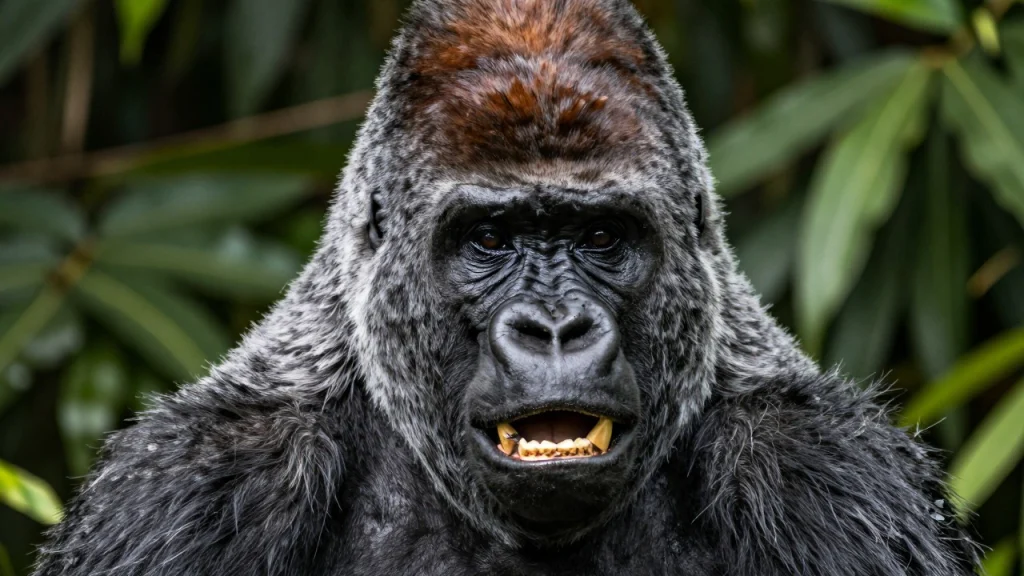
A gorilla’s physical strength is equally prominent in its cranial anatomy and jaw mechanics. The cranium of an adult male appears distinctly conical because of large bony crests situated on the top and rear of the skull.
The expansion of the sagittal crest serves an essential mechanical function. These prominent ridges anchor the massive muscles needed to operate and support their oversized jaws and teeth.
The resulting masticatory power allows gorillas to exploit extremely tough forest vegetation. This cranial ridge provides an expanded attachment zone for jaw muscle fibers, producing exceptional chewing power to break down tough vegetation.
Dental specializations directly complement this powerful jaw musculature. Western gorillas possess large jaw muscles alongside broad, strong teeth designed to pulverize tough plant fibers.
Functional strength in foraging and feeding
Gorillas regularly apply blunt physical strength during everyday foraging routines. Rather than probing with slender twigs like chimpanzees, gorillas smash the termite mound completely open to consume the insects inside.
Fueling such dense muscle mass requires an enormous volume of vegetarian food each day. An adult male consumes as much as 40 pounds (18 kilograms) in daily vegetation.
Processing this massive volume of roughage requires specialized internal adaptations. Their stomachs appear larger than their chests because enlarged intestines are necessary to digest cellulose in vegetation.
Social hierarchy, defense, and power displays
Physical power forms the foundation of gorilla social organization and troop protection. Family units typically assemble between 5 to 30 gorillas into a single troop, guided by an experienced, powerful silverback. The silverback carries sole responsibility for defending his family.
Within the troop, the leader’s sheer physical size commands absolute respect. Within the family unit, the dominant male is massive compared to other members, prompting everyone in the troop to defer to his leadership.
Physical features directly correlate with leadership status. Imposing body dimensions, long canines, and heavy jaw musculature grant dominant males heightened physical dominance and social influence within the group.
When defending against external threats, silverbacks employ energetic threat displays to showcase their strength. During defensive confrontations, a silverback frequently breaks off tree branches and shakes them vigorously at an intruder.
Acoustic demonstrations complement these physical gestures during intimidation rituals. To display raw power without physical combat, adult males stand erect, pounding their chests with clenched fists to show off their strength.
If pressed or provoked, gorillas growl loudly and become very dangerous to any potential threat.
Clashes between different social units represent high-stakes events that test a male’s strength. Although home ranges overlap without strict territorial boundaries, severe intergroup conflicts can occur when neighboring troops meet or an unattached male approaches.
Sources
- Smithsonian’s National Zoo & Conservation Biology Institute: Western Lowland Gorilla
- San Diego Zoo Wildlife Alliance: Gorilla
- Animal Diversity Web: Gorilla gorilla (western gorilla)
- Animal Diversity Web: Gorilla beringei (eastern gorilla)
- Zoo Atlanta: Western Lowland Gorilla
- Denver Zoo: Western Lowland Gorilla