
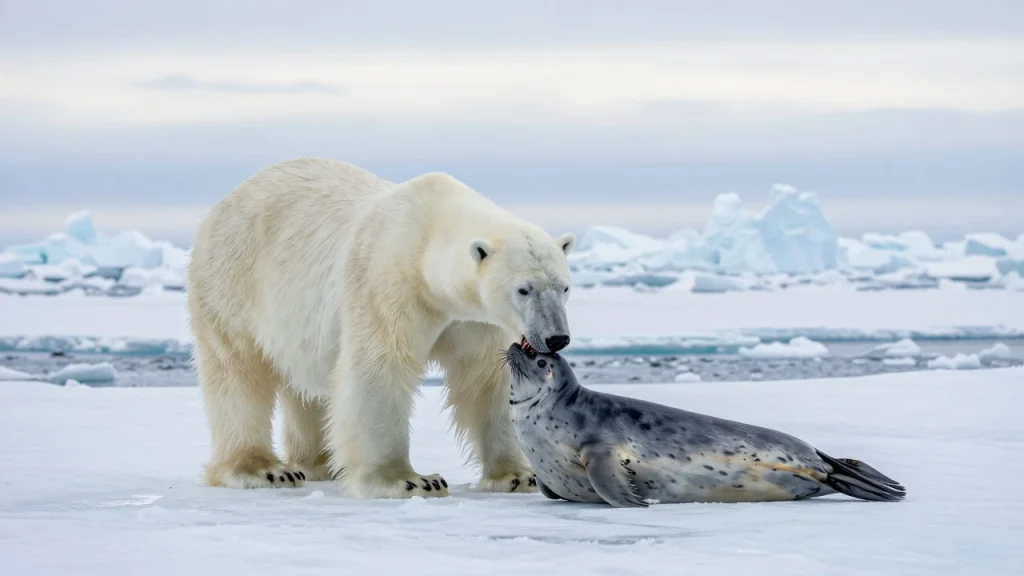
Polar bears are carnivores that feed mainly on seals, above all ringed seals. They take the skin and blubber first, and what is left is often scavenged by other polar bears or Arctic foxes. In summer, when preferred prey is missing, they switch to land plants and lichen, seaweed and kelp, berries, small mammals, birds and eggs.
Polar bears are carnivores, and the short answer to what they eat is seals, mostly their fat. Ringed seals are the staple of the Arctic diet, and a single one carries enough fuel to keep a bear going for 11 days. A polar bear typically eats something only every four to five days, which tells you how rich each meal has to be.
That arithmetic explains almost everything else about the species. Because one kill is worth so much, a polar bear spends its time waiting rather than chasing, and its body is built to store fat instead of protein. What looks like a simple answer, seals, is really a diet tied to a single moving platform: sea ice.
The short list of prey
National Park Service guidance is blunt about the hierarchy: these bears consume more fat and flesh than any other bear species, they feed above all on seals, and they switch to whale carcasses whenever one is available. The San Diego Zoo Wildlife Alliance fact sheet puts the scale of the seal component in numbers, with ringed seals making up more than half of the prey base across most Arctic regions.
The wider prey list is short, and the San Diego Zoo Wildlife Alliance compiles it like this:
- Ringed seals (Pusa hispida), the primary target everywhere
- Harp, hooded, bearded and harbor seals, taken in addition
- Walruses, beluga whales and narwhals, only occasionally
- Bowhead whale remains left behind by native subsistence hunters
- Birds and their eggs, including geese, eider and other waterfowl
Regional exceptions make the picture messier. In Viscount Melville Sound, beluga makes up about 20% of the diet, the highest consumption recorded for any subpopulation. In Svalbard, Norway, bears have been observed hunting reindeer, and one documented event involved a bear chasing a reindeer down in the water and overtaking it.
Why blubber, and not meat
The calorie density of blubber is the whole point. The insulating layer on a polar bear measures 2 to 4 inches, or 5 to 10 centimeters. When seals are unavailable, that stored layer becomes backup energy.
There is a nutritional subtlety behind the fat obsession. U.S. Geological Survey researchers note that although polar bears are entirely carnivorous on their sea ice habitat, their protein requirements are low and match those of the more omnivorous brown bear. A polar bear covers that shortfall with big shares of marine mammal blubber, which hold protein intake down. The same scientists describe this as a shift in perspective, away from a plain carnivore and toward what they call a lipivore, a fat-lover.
Two other details make blubber unusually efficient. The San Diego Zoo Wildlife Alliance reports that roughly 90% of the energy a bear consumes goes straight into fat stores rather than into anything else, and that fat digestion releases water, so eating seals partly solves the freshwater problem. Bears lay down most of that fat in late spring and early summer.
The skull shows what such a diet rules out. Those same fact sheet notes record that polar bear skulls and teeth are not well adapted for processing bone or tough plant foods, and that their molars have smaller grinding surfaces than a brown bear’s. A polar bear is built for soft, high-calorie tissue, and the flesh that surrounds it often goes untouched.
The waiting game
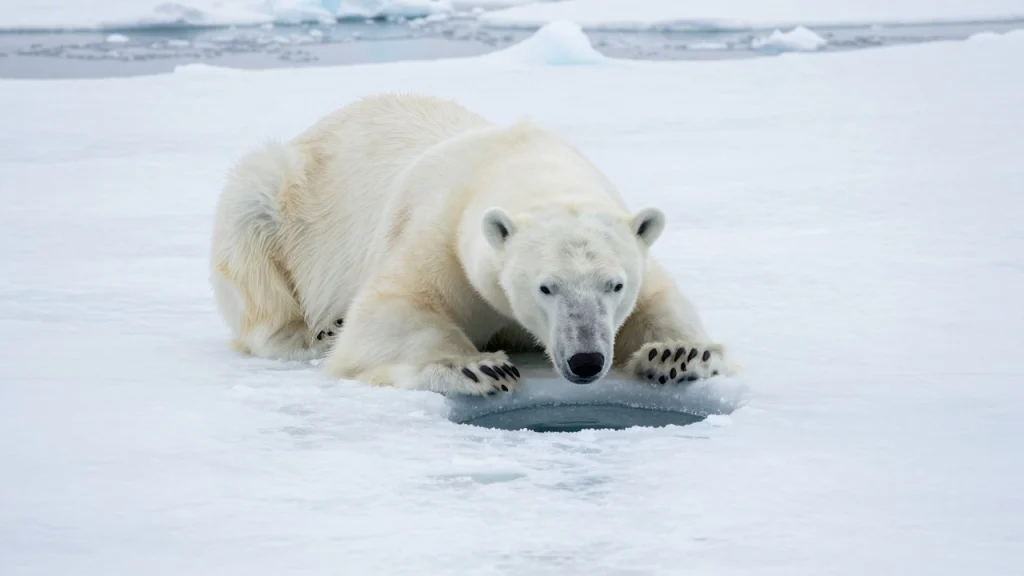
Hunting seals is expensive in energy if you do it the obvious way. A bear costs itself about twice what most other mammals spend simply moving through the Arctic environment, so bears rest often and prefer sit-and-wait tactics over pursuit. San Diego Zoo Wildlife Alliance describes the method in detail: bears locate ringed seal birth lairs and breathing holes by smell and sound, approach slowly to limit their own noise, then either break into the lair straight away or wait motionless and listening for hours until the seal comes back. Some swim underwater to stalk seals lying along the rim of a floe.
Scent does much of the early work. A polar bear’s nose is powerful enough to pick up a seal from 20 miles (32 kilometers) off, sniff out a den hidden under snow, and pinpoint a breathing hole from 1 mile (1.6 kilometers) away. Bears can also hold perfectly still above a hole for hours, waiting for a seal to surface.
The time budget shows how patient this is. Animal Diversity Web records polar bears as inactive 66.6% of the time, whether sleeping, lying or simply waiting on a kill, with 29.1% spent traveling and only 2.3% actually feeding.
What happens to a seal kill
A polar bear does not eat a seal the way a person eats a steak. It works from the outside in, taking the skin and blubber first and abandoning the remainder, which other polar bears and Arctic foxes then clean up. Animal Diversity Web flags the high calorie-to-weight ratio of blubber compared with meat as central to keeping the insulating layer intact and banking energy for lean times.
Two related facts round out the picture. Bears lack the caching habit of other bears, and they do not store unconsumed meat, so a surplus kill is simply shared rather than saved. On the other hand, their stomach is enormous, with a capacity beyond 70 kg (154 lb) in a single sitting, and they frequently take more prey than they can eat at once.
The menu when the ice leaves
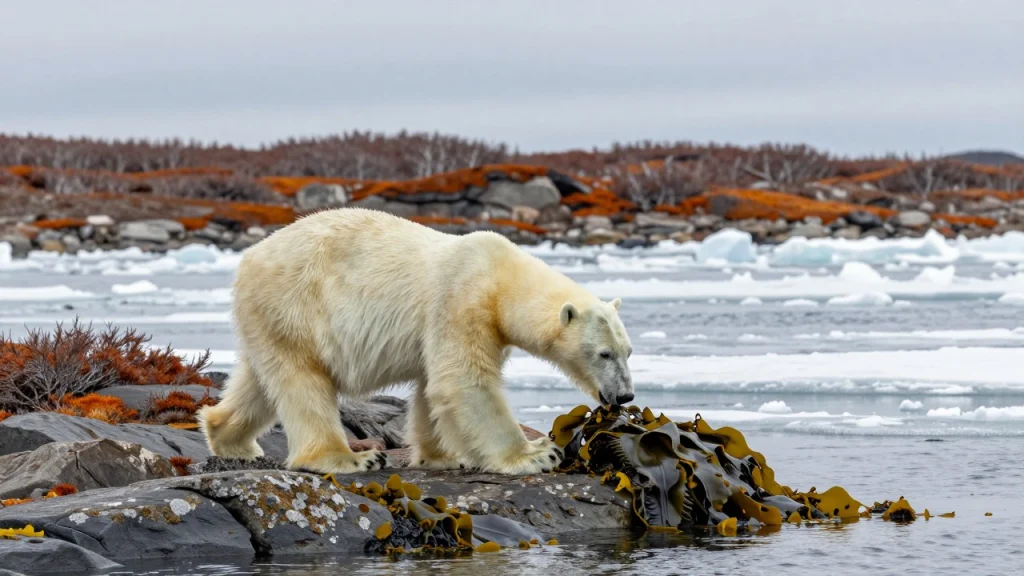
For several months a year, the hunting platform disappears and the diet has to change completely. The National Park Service lists what onshore bears turn to when food runs short: marine mammal carcasses, birds, fish, terrestrial mammals and berries.
A study of polar bears in Manitoba tracked daily energy expenditure alongside diet across 19 to 23 days in late summer. The animals ate an unexpectedly wide range of items, including berries, vegetation, birds, bones, antlers, seal and beluga. Yet the payoff was close to zero. The researchers found almost no gain in expected time to starvation from eating plants and carrion ashore, and 19 of the 20 animals lost mass whatever they ate. The land simply does not feed a polar bear.
Smaller dietary shifts show up in specific places. The San Diego Zoo Wildlife Alliance notes that in summer, when preferred prey is missing, bears take land plants and lichen, seaweed and kelp, berries, small mammals, birds and eggs. Along the coast, some bears also feed on human trash. The Alaskan population has been observed broadening its diet to harder foods in recent years.
Where ice melts completely, bears come ashore and either scavenge or fast until the ice reappears. The fasting end of that spectrum is extreme for maternity dens: a pregnant female’s metabolism carries her through as much as eight months with no eating or drinking at all.
Bears eating bears
Cannibalism is documented but uncommon, and it mostly affects the vulnerable. The San Diego Zoo Wildlife Alliance fact sheet states that the bears most at risk are cubs, though adult females are sometimes taken as well, and that such kills are inflicted much the way a seal hunt is carried out, with bites behind the head. The listed motives are hunger, avoiding competition, and male infanticide that opens breeding opportunities.
Why the diet decides the future
Every item on this menu traces back to sea ice, which serves as the platform bears hunt from. Animal Diversity Web records the IUCN listing of Ursus maritimus as vulnerable, and the San Diego Zoo describes climate change as a conservation crisis for the species, with its persistence threatened by record-breaking ice losses and industrial-scale development.
So the answer to what polar bears eat comes with a condition attached. They eat seal fat, and they eat it because the ice lets them reach it. Take the ice away and the biology has nothing to fall back on.
What do baby polar bears eat?
Polar bear cubs feed on their mother’s milk. The San Diego Zoo Animals & Plants page puts the fat content of that milk at 36 percent, making it the richest of any bear species. A San Diego Zoo Wildlife Alliance fact sheet describes bear milk as rich in fat and protein and low in carbohydrates.
Do polar bears eat humans?
No, not in any regular way: the U.S. Geological Survey found reported attacks on humans to be extremely rare. Dartmouth College notes that seals, the mainstay of their diet, are what these bears are after, not people. That same U.S. Geological Survey study judged most analyzed attacks to be predatory behavior, and nearly all of them involved 2 or fewer people. Hungry adult males in poor nutritional condition were the ones it found most likely to threaten human safety.
Do polar bears eat fish?
Yes, polar bears do eat fish. The UCAR Center for Science Education says almost all of their food comes from the sea, and that marine diet includes seals, fish and even beluga whales. Animal Diversity Web, University of Michigan lists fish too, along with sea birds and their eggs, small mammals and carrion of seals, walruses or whales. The U.S. National Park Service also includes fish among what bears eat once they are onshore and food is scarce.
Sources
- U.S. National Park Service: Polar Bears – Bears
- San Diego Zoo Animals & Plants: Polar Bear
- San Diego Zoo Wildlife Alliance Library: Polar Bear (Ursus maritimus) Fact Sheet: Diet & Feeding
- U.S. Geological Survey, Alaska Science Center: Q&A: Polar Bears and Zoos
- Animal Diversity Web, University of Michigan: Ursus maritimus (polar bear)
- PMC / Polar Biology: Polar bear energetic and behavioral strategies on land with implications for surviving the ice-free period
- U.S. Geological Survey: Polar bear attacks on humans: Implications of a changing climate | U.S. Geological Survey
- Dartmouth College: How Not to Get Eaten by Polar Bears | Dartmouth
- UCAR Center for Science Education: Polar Bears on Thin Ice – UCAR Center for Science Education