
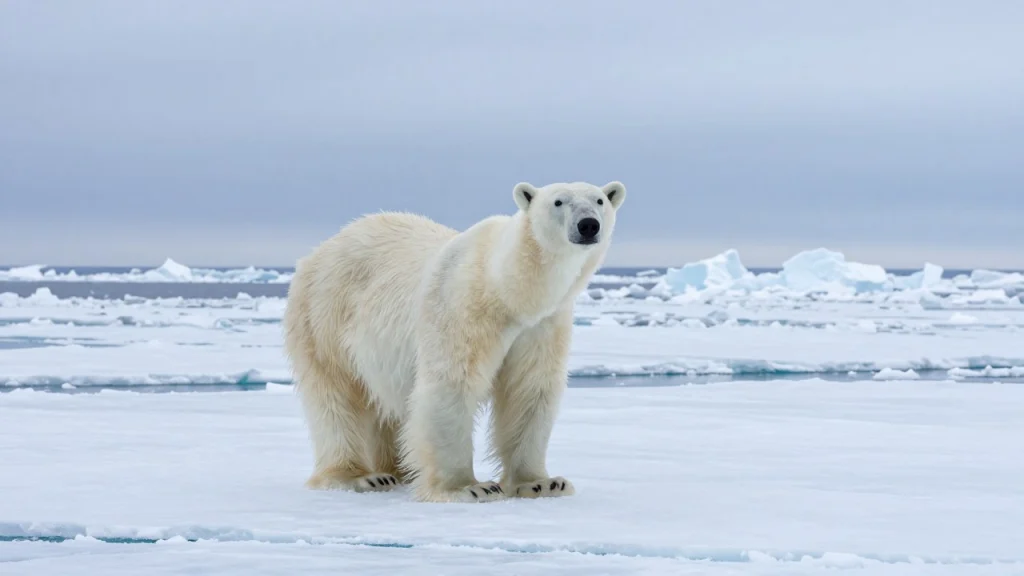
Polar bears live only in the Arctic, mostly on the sea ice of the Arctic Ocean and along its coasts. Their range covers five countries: Canada, the United States (Alaska), Russia, Greenland and Norway. None live in Antarctica.
Polar bears maintain a circumpolar distribution across the northern high latitudes, inhabiting the frozen marine wilderness that encircles the North Pole. Wild populations occur across five recognized territories designated as the Polar Bear Range States: Canada, the USA, Norway, Greenland, and Russia. These immense carnivores occupy an expansive geography encompassing frozen straits, remote archipelagos, and open marine expanses throughout the polar circle.
Natural geographic boundaries for this carnivore depend entirely on the presence of Arctic Ocean pack ice and the solid landfast ice adhering to adjacent shorelines. The drifting pack ice floating over open Arctic waters serves as their preferred habitat throughout the year. Because their survival requires accessible ice platforms, their presence across the Arctic reflects seasonal freeze and thaw cycles rather than fixed terrestrial boundaries.
Latitudinal boundaries from the North Pole to southern bays
At the northern extreme of their geographic distribution, explorers have verified polar bear sightings at 88°N, roughly ca. 100 miles south of the true pole. While animals travel near the North Pole, they occur in lower numbers there because deep central waters offer far less biological productivity than the shallow continental shelf along basin margins and nearby islands.
The southernmost permanent year-round territory occurs within Canada’s James Bay, where bears establish dens on Akimiski Island at about 53°N. During winter conditions, wandering individuals travel regularly to Newfoundland and show up sporadically in the Gulf of St. Lawrence when thick sea ice drifts toward latitude 50°N. Long-distance wanderers have also been reported visiting the southern margins of Iceland as well as Greenland.
Ice-bound ecosystems and seal hunting grounds
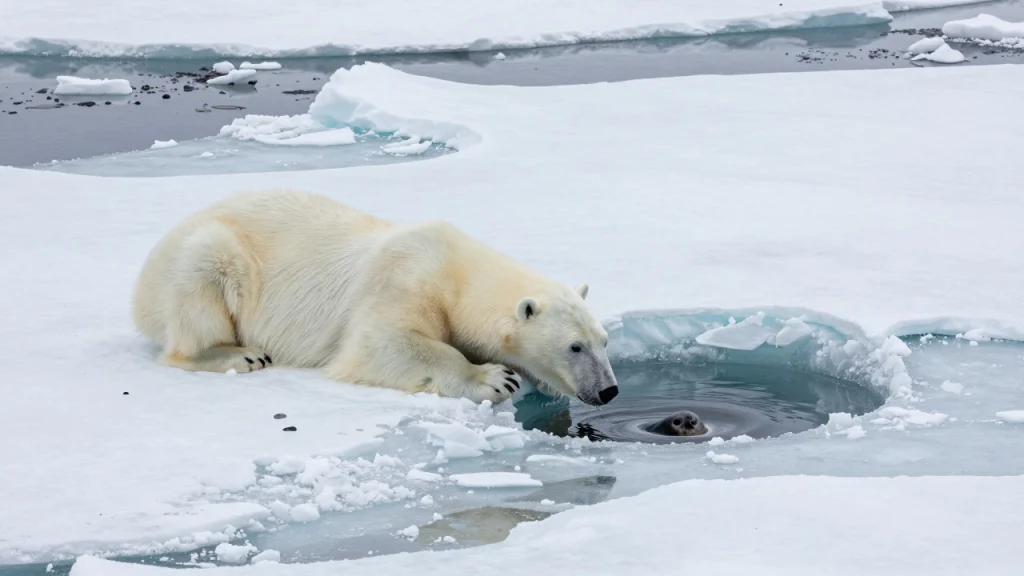
Wildlife biologists classify the entire Arctic population into 19 subpopulations that vary considerably in demographic size, reproductive output, and movement corridors between neighboring regions. These regional assemblages inhabit diverse marine ecological settings spanning the circumpolar basin. Frozen ocean serves as an irreplaceable platform because these predators remain totally dependent on sea ice to capture seals, relying primarily on ringed seals and bearded seals.
Across the circumpolar landscape, bears position themselves where cracks break the frozen crust or around open breathing holes that seals use for respiration. Among all available marine prey, ringed seals (Pusa hispida) provide their principal dietary staple. By staking out these vital openings, the predators intercept mammals that must periodically surface for air.
Dynamic zones featuring shifting ice edges and jagged pressure ridges where water continuously cracks and refreezes deliver the most lucrative hunting grounds. Their primary hunting method entails locating a seal respiratory opening and patiently waiting beside the ice hole until the animal emerges to breathe.
Seasonal movements and terrestrial retreats
To follow dynamic hunting platforms, individual bears will travel north and south by as much as 1,000 km during freezing and melting cycles. As warm summer weather sets in, bears must linger on islands with remaining shore ice, drift across moving floes, or endure landlocked periods onshore until cold conditions return.
While stranded onshore or resting between hunting trips, bears construct nests out of beach seaweed, carve snow caves into coastal bluffs, or settle into shallow drifts to create sheltered day dens. When winter arrives, pregnant females migrate to coastal terrain that offers deep snow drifts suitable for excavating maternity dens to give birth.
Anatomical adaptations for an icy marine existence
Physical traits reflect rigorous ecological specializations for surviving on shifting ocean crusts. Mature males reach body masses between 300-800 kg, or 660-1760 lbs, alongside lengths of 2.5 m, whereas smaller females register 150 to 300 kg, or 330 to 660 lbs, with spans of 1.8 to 2 m.
Several anatomical specializations enable polar bears to thrive in extreme subzero environments:
- Solar heat absorption: Beneath their dense pelt lies black skin that absorbs solar warmth, shielded by translucent hairs completely devoid of pigment.
- Ice surface traction: Specialized footpads covered in tiny bumps and depressions function like suction cups, creating vital traction against slick, frozen surfaces.
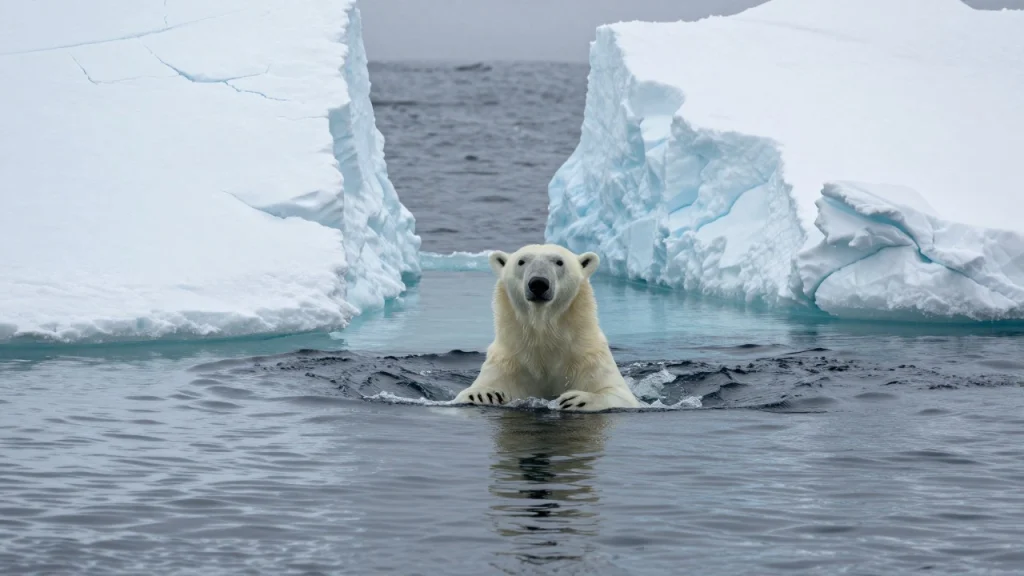
- Aquatic propulsion: To navigate freezing marine waters between floes, they rely on a water-repellent coat alongside partially webbed feet engineered for paddling.
When hunting food across open seas, bears have logged continuous journeys exceeding 60 miles (about 100 kilometers) without stopping to rest. In aquatic corridors, swimming bears attain velocities up to 6 miles per hour, or roughly 8 knots, while navigating between ice sheets.
While stalking marine prey beneath ice edges, wild individuals can remain submerged for extended durations, with the longest recorded dive reaching 72 seconds. When sprinting across solid crusts, polar bears achieve swift bursts reaching 30 km/h (about 19 mph) on suitable surfaces. Because heavy insulation retains heat so efficiently in freezing weather, running or exertion causes bears to overheat, prompting them to cool down in frigid water.
Evolutionary history and absence from Antarctica
Evolutionary research indicates polar bears emerged recently, from about 200,000 years up to possibly 500,000 years ago, branching from grizzly ancestors near eastern Russia or the Alaskan Panhandle.
Polar bears never migrated south to Antarctica because marine waters were never continuously frozen from the northern polar basin to the southern hemisphere.
Sea ice loss and future conservation
Satellite telemetry and field surveys reveal that regional groups are becoming increasingly geographically and functionally isolated as changing climate conditions diminish available sea ice.
In cooperative international management, the historic 1973 Agreement on the Conservation of Polar Bears serves as a vital wildlife treaty among northern governments. Modern population surveys indicate that about 26,000 polar bears survive across their wild circumpolar range today.
Which Arctic regions do polar bears live in?
Wild polar bears are commonly found across Baffin Bay, most of the Canadian Arctic Archipelago, and the Beaufort and Chukchi seas north of Alaska. The University of Alaska Fairbanks notes that these predators also inhabit northern Europe’s Barents Sea alongside the Kara, Laptev and East Siberian seas of Russia. Within the United States, the territory of wild polar bears is confined entirely to Alaska. In winter, Alaskan populations travel south toward St. Lawrence Island, occasionally venturing as far as the Kuskokwim Delta and St. Matthew Island.
Do polar bears live in Alaska?
The state supports two wild groups, identified as the Chukchi Sea and Southern Beaufort Sea populations, with the latter ranging along Alaska’s northern coast into Canadian Beaufort waters. These two wild subpopulations depend on Alaska for portions of their lives, with population estimates of 3,000 and 900 bears.
Do polar bears live at the North Pole?
No documented records place polar bears directly on the North Pole itself, though individuals undeniably reach its surrounding vicinity. The IUCN SSC Polar Bear Specialist Group notes that various expeditions and explorers have occasionally encountered bears within the permanent ice pack surrounding the pole. Wild individuals are documented approximately 100 miles south at 88°N, though the specialist group considers them probably not abundant there because central waters are less biologically productive than the continental shelf and basin edges.
Do polar bears live in Antarctica?
According to the IUCN SSC Polar Bear Specialist Group, these animals never had any opportunity to reach the Antarctic region because global marine waters were never frozen continuously from north to south.
Sources
- IUCN SSC Polar Bear Specialist Group: Frequently Asked Questions – Polar Bear Specialist Group
- IUCN SSC Polar Bear Specialist Group: Home – Polar Bear Specialist Group
- Animal Diversity Web: Ursus maritimus (polar bear)
- San Diego Zoo Wildlife Alliance: Polar Bear | San Diego Zoo Animals & Plants
- PubMed Central: Range contraction and increasing isolation of a polar bear subpopulation in an era of sea‐ice loss
- University of Alaska Fairbanks: Facts about polar bears | UAF news and information
- National Park Service: Polar Bears – Bears (U.S. National Park Service)
- Alaska Department of Fish and Game: Polar Bear Species Profile, Alaska Department of Fish and Game