
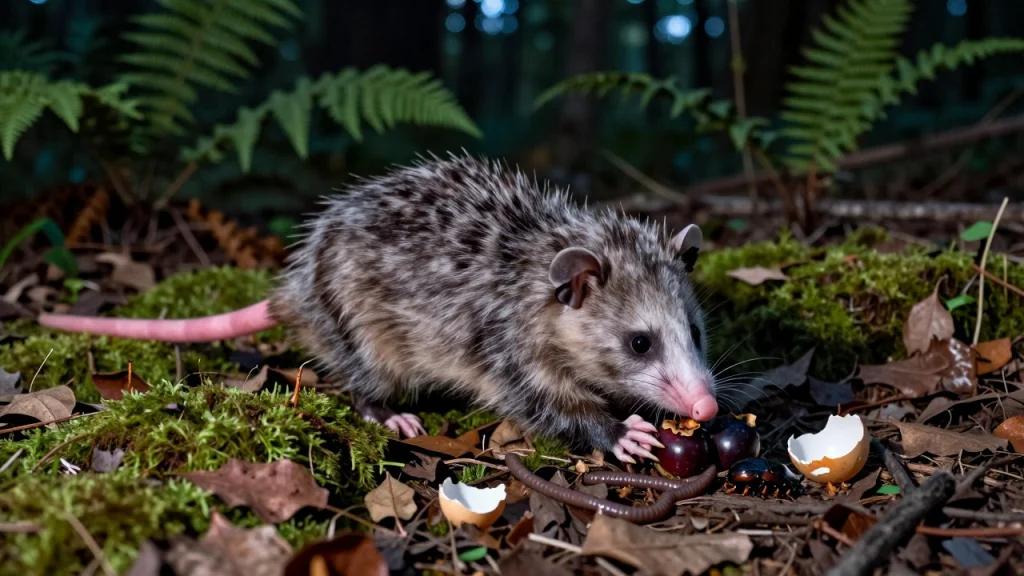
Opossums eat both plants and animals: insects, worms, fruit, seeds, small mammals and birds, and in some habitats reptiles or amphibians. Animal Diversity Web puts mammal tissue at 14 to 27% of the Virginia opossum diet, with fruit, seeds and bulbs at 10 to 18%, insects at 3 to 13.5% and earthworms at 5.5 to 9%. The mix shifts with the seasons, with more small vertebrates in colder months and more invertebrates, plants, fruit and seeds in warmer ones.
Opossums eat almost anything they can reach. The menu runs from insects, earthworms and snails to fruit, seeds, rodents, birds, reptiles and amphibians, and it includes dead animals, pet food and household garbage. Scientists who study the Virginia opossum (Didelphis virginiana) call it an extremely opportunistic feeder, which is a technical way of saying the animal keeps its options open and takes whatever is most abundant around it.
That flexibility explains why opossums live in woods, swamps, farmland and city neighborhoods alike, and it makes their diet easier to measure than most, because a researcher can empty a stomach and weigh what is inside.
What stomach analyses show
Stomach contents gathered from opossums across the United States give the clearest picture of the wild menu, and the proportions are strikingly balanced rather than dominated by a single item. Mammal tissue makes up 14 to 27% of the diet, fruit with seeds and bulbs from 10 to 18%, grasses and leaves from 6 to 11%, insects from 3 to 13.5%, earthworms from 5.5 to 9% and birds from 3 to 5%.
Two things stand out. First, animal food and plant food each supply a large share, so the opossum is a real omnivore rather than a predator that happens to nibble a leaf. Second, the wide spread on insects and earthworms reflects how much those items vary between places and seasons.
Other foods appear in smaller amounts and are more closely tied to wherever the animal was sampled. Reptiles and amphibians reached 22.5% in some stomachs, gastropods 10%, while carrion ran as high as 5%. Human refuse turned up too, with discarded pet food and rubbish making up 9% each in some samples. Those garbage figures are effectively a measure of how much people reshape a landscape, because opossums living near suburbs pick up such items readily.
The animal half of the menu
Smaller prey dominates the animal side. Invertebrates form a reliable staple for opossums in tropical regions, with earthworms, beetles and grasshoppers named as dependable food. National Park Service notes add eggs, lizards, worms and maggots to that list, and the Smithsonian counts small mammals, birds, insects and worms among the foods, adding plant stuff, fruit and seed, with reptiles or amphibians taken where the habitat supplies them.
Birds and mammals are among the vertebrate prey opossums actively hunt, and they are not shy about them. They take nestlings and eggs when they can reach a nest, and rodents such as mice and rats are a regular target in farmland and suburb. Older animals consume vertebrates more frequently than younger ones, which fits an animal that grows stronger and more capable of handling bigger prey as it ages.
Snakes are a special case. Opossums eat rattlesnakes and their close relatives because they carry genuine resistance to the venom of members of the viper family, and one zoo account goes as far as calling them virtually immune to rattlesnake, cottonmouth and other pit viper venom. Turning a dangerous animal into a meal is unusual among mammals of this size, and it gives opossums an option almost nothing else has.
The plant half and the seeds they move
Fruits, seeds, bulbs, grasses and leaves make up the rest of the plate, and they are not leftovers. Fruit and vegetables both feature on the list, while botanically they are working on a different task entirely: they are important seed dispersers, moving undamaged seeds away from the parent plant, particularly those of the genera Asimina and Diospyros. A mammal that swallows a fruit and later drops the seed nearby helps a woodland plant spread to new ground, which is a substantial service for anyone wondering who keeps a forest regenerating.
Carrion, refuse and the roadkill buffet
Carrion is dependable in a way live prey is not, and opossums take it without hesitation. Roadside carrion is easy calories, but it is also a serious hazard, since an animal crouched over a carcass in a traffic lane sits directly in a driver’s path.
Urban opossums add refuse to that list. They scavenge trash and pet food, and the National Park Service links their expanding range to their adaptability around people, describing how they forage on discarded food near human settlements. What looks like a nuisance animal in a garage is an animal running a cleanup route.
How the menu changes with the seasons
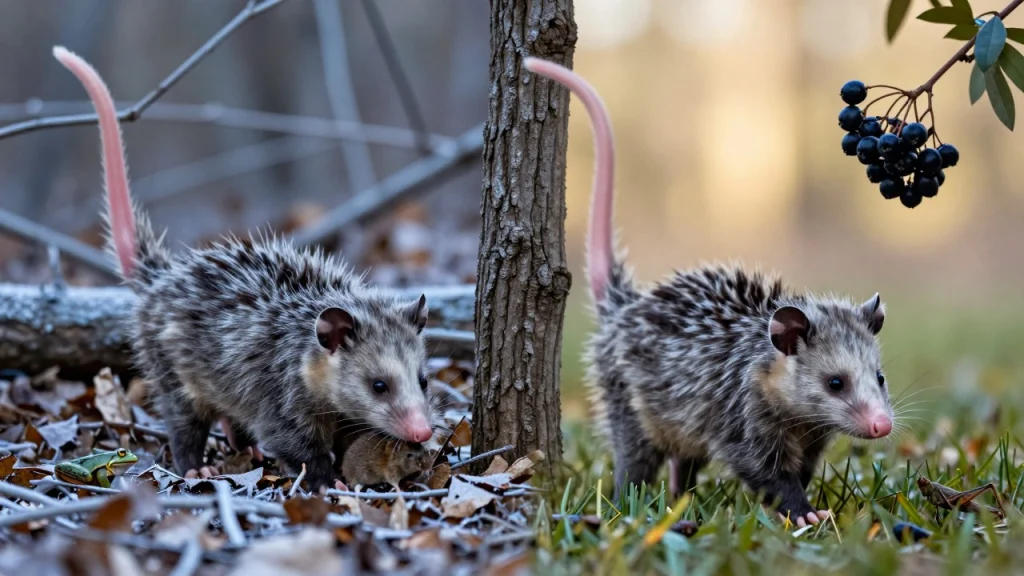
Opossums eat a different diet in winter than in summer, and the switch follows availability. In colder months small vertebrates make up a larger portion, while warmer months add more invertebrates, plant material, fruit and seed. Each animal adjusts to whatever it can find, and the transition is gradual rather than a hard change.
The same logic applies in the tropics. Common opossums, a related group in Central and South America, eat more mammals and birds during the dry season and lean harder on fruits, snakes and toads once the rains arrive.
How an opossum finds all of this at night
Sight alone would not serve a forager working in the dark, so opossums are built around smell and touch. A long muzzle channels air toward a keen sense of smell that picks out plants, insects and small animals a person walking past at night would never notice. Sensitive whiskers around the face help them move and locate prey in total darkness.
Their eyes suit low light rather than color. The ratio of rod to cone receptors in opossum eyes is 50 to 1, compared with 10 to 1 in a cat, so a far bigger share of their vision is built from light-gathering cells. Color discrimination is limited, which leaves the nose to do most of the sorting.
Teeth match a mixed diet. An opossum carries roughly 50 of them, more than any other land mammal found in North America.
The tick story and why it is disputed
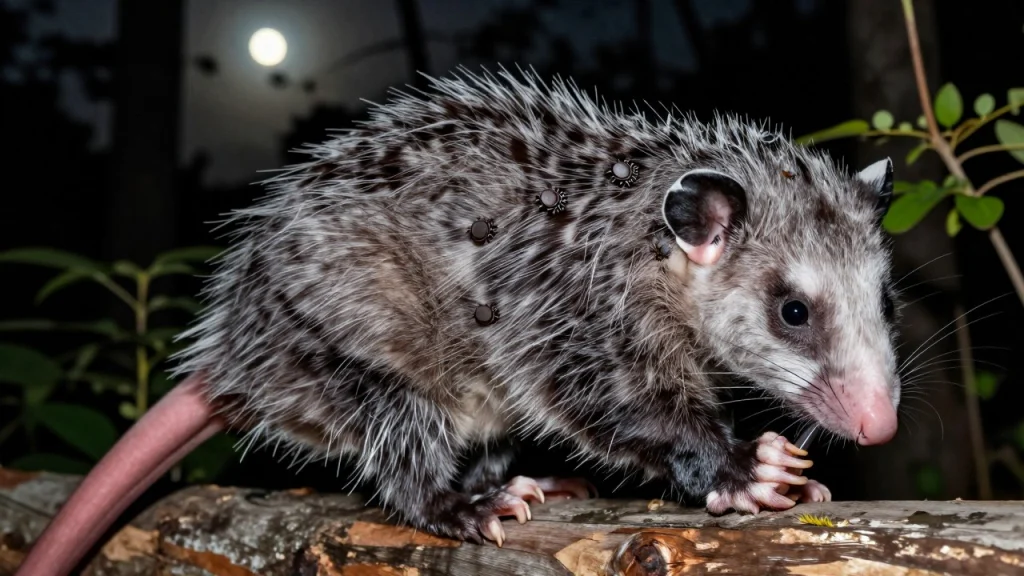
Opossums are widely credited with eating thousands of ticks a year and protecting people from Lyme disease. One zoo account puts a single animal at as many as 5,000 ticks in a year.
The peer-reviewed evidence points elsewhere. The estimate traces to a 2009 experiment that took five Virginia opossums, fixed 100 larval ticks on each inside a confined lab, then counted the ticks that fell off and assumed the rest had been eaten. The animals were not checked for ticks before release, and captives in a lab do not necessarily behave like wild animals. A 2021 paper opened 32 opossums collected in central Illinois: ticks sat on the carcasses, yet nothing tick-like turned up in the guts. Those authors also read 23 other published diet studies, and not one reported opossums eating tick nymphs or adults. What those studies did show, consistently, was a preference for insects and other invertebrates. Ticks are not a staple, and the idea that opossums are nature’s tick vacuum rests on a laboratory artifact rather than a wild fact.
Tropical cousins and the wider family
Opossums are a large and varied group, and diets differ across it. More than 100 species exist, from a pocket-sized pygmy form to the cat-sized Virginia opossum. Tropical species such as the common opossum eat a very broad diet, and their feeding habits are often described as opportunistic omnivory, the same strategy that lets the North American species live in cities.
Why the flexible menu pays off
A species that eats almost anything can live almost anywhere, and opossums have turned that into a comfortable existence beside people. Their success comes partly from thriving in urban areas, helped along by a small body, nocturnal habits and prolific breeding. An adult weighs 1.9 to 6 kg, light enough to den in a shed, a woodpile or under a house, and active at night when most people and larger predators are asleep.
The cost is a short life. In the wild these animals usually manage only about 1.5 to 2 years, so the population turns over fast, and the species is currently listed as least concern, so the cleanup crew is still hard at work in your neighborhood rather than behind a fence.
Diet in captivity is a different matter and a useful contrast. The zoo’s Virginia opossum is fed fish, meat, eggs, pellets, fruit, vegetables and mushrooms, a fixed menu meeting nutritional needs in an animal that would otherwise be foraging through a parking lot. In the wild the same animal assembles that variety on its own, one rubbish heap, insect swarm or berry patch at a time.
What do baby opossums eat?
Baby opossums begin eating solid food at around 85 days old. Animal Diversity Web puts full weaning between 93 and 105 days, while the Smithsonian’s National Zoo says young opossums are weaned after 105 days.
What attracts opossums to your yard?
Compost piles, trash cans and seed feeders for birds are the easy meals that bring opossums into suburbs, and the U.S. National Park Service notes that opossums scavenge trash and pet food and that their range has increased because of their adaptability to live near people. Alongside garbage and pet food left outdoors, opossums sometimes visit chicken yards and gardens for produce such as apples and strawberries as well as vegetables.
What is an opossum’s favorite food?
Despite eating mixed diets, Virginia opossums favor flesh foods, including insects and the bodies of mice, squirrels, rabbits, cats and other animals. Twenty-three published diet studies showed a consistent preference for insects and other invertebrates.
Sources
- Animal Diversity Web: Didelphis virginiana (Virginia opossum) | INFORMATION
- Animal Diversity Web: Didelphis marsupialis (common opossum) | INFORMATION
- Smithsonian’s National Zoo: Virginia opossum
- San Diego Zoo Wildlife Alliance: Opossum
- University of Illinois Extension: Reassessing the opossum-tick relationship: Is it a good idea to attract opossum’s to your yard?
- U.S. National Park Service: Virginia Opossum
- University of Maryland Extension: Woodland Wildlife Spotlight – The Misunderstood Opossum | University of Maryland Extension
- Connecticut Department of Energy and Environmental Protection: Opossum
- Missouri Department of Conservation: Virginia Opossum | Missouri Department of Conservation