
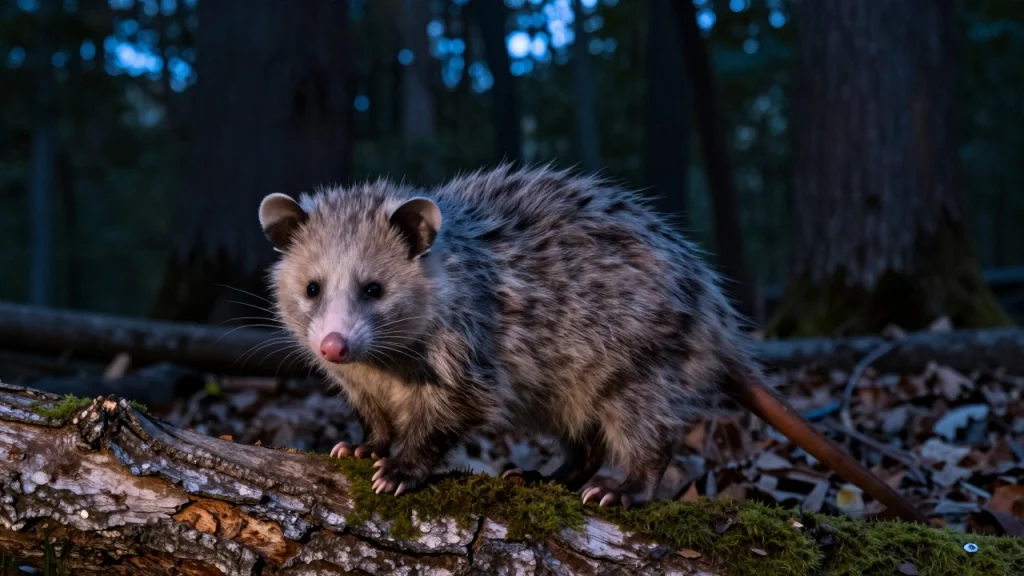
Opossums have a reputation for surviving almost anything, and yet their lifespan is among the shortest of any land mammal. The Virginia opossum, the only marsupial north of Mexico, typically gets just 1.5 to 2 years in the wild. Under human care the same species usually reaches age 3 or 4. That gap is the direct answer to the question, and it explains nearly everything else about opossum survival.
Captive records go further still. Virginia opossums held in captivity have been reported reaching 8 to 10 years, though animals that old are the exception.
Predators, cars and cold set the wild ceiling
A wild opossum meets threats a captive animal never does. Predation is the obvious one: owls, domestic dogs and coyotes hunt them, as do red foxes, raccoons, bobcats and other large snakes.
Traffic is the other constant. The Smithsonian’s National Zoo says that even where opossums are taken for food and fur, the bigger danger is collisions with motor vehicles. The common opossum of tropical Latin America fares no better, and is listed among the frequent victims of car strikes.
Weather completes the picture. The species handles extreme cold badly: its thermoregulation is inadequate and its fur gives little protection. Among grown animals, deaths bunch up in the cold season. This is a tropical animal that pushed north into regions with winters it was never built for.
Most opossums die well before their first birthday
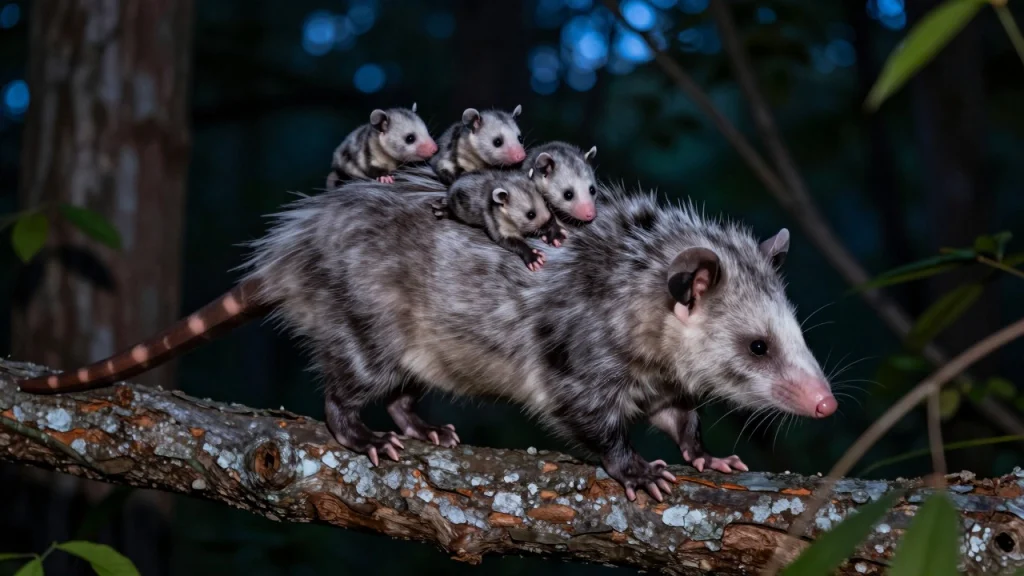
Lifespan figures for opossums are really statistics about dying young. Many altricial young never arrive in the pouch, and even of those that make it, about 60% are still lost after weaning.
The biology explains the bottleneck. Pregnancy is extremely short, at 12 to 13 days, and a litter of 4 to 25 young arrives at once, yet a female has only 13 mammae, and some of them may be nonfunctional. Once attached, pouch-young stay latched on for roughly 50 to 70 days, and the average litter that survives that far numbers about 8. They start on solid food at about 85 days, with weaning completed somewhere between 93 and 105 days.
So a young opossum is protected only while it is small, helpless and riding its mother. The moment it becomes a mobile target, its cohort thins out fast.
How the calendar adds up
Zoo and park accounts give a wider band than the field studies. San Diego Zoo Wildlife Alliance puts sexual maturity at six to eight months, with an overall span of two to four years. A National Park Service account rounds the figure to 2-4 years and describes an animal the size of a domestic cat. Animal Diversity Web is tighter, giving 2.5 years as the maximum in the wild.
Males also leave the breeding population early: they typically take part in breeding for one year. Females may edge out males in longevity, but past 2 years of age they lose the ability to reproduce. By the time an opossum counts as old, its reproductive career is already over.
The daily routine of a night hunter
Opossums are nocturnal and solitary, active between dusk and dawn, and they do not hibernate, instead slowing their activity through the coldest seasons. They take habitats from deserts to wet meadows, favouring woods and thickets beside water, and in high country they are found 3,000 meters above sea level. Despite its name, the species reaches as far south as Costa Rica and Mexico, and as far north as Ontario, Canada, on the east side of the Rocky Mountains.
Shelter changes with the situation. Denning sites vary, and the animal may use buildings, hollow trees or burrows dug by other wildlife. They switch dens often, staying put mainly while young are being weaned.
An insatiable generalist that keeps ecosystems clean
The diet is whatever is available. Stomach content studies show mammal tissue making up 14 to 27% of what they eat, with insects, earthworms, birds, grasses and fruit filling the rest. Local additions to the menu include pet food and refuse at 9% each, with carrion reaching up to 5%. They are also important seed dispersers, redistributing intact seeds of several forest genera far from the parent plant.
The sanitation value is large. Estimates put a single animal at 5,000 ticks consumed in a year, which curbs the spread of tick-borne illness such as Lyme disease, and the National Park Service puts the figure at upwards of 90 percent of every tick met.
A relative with an even shorter clock
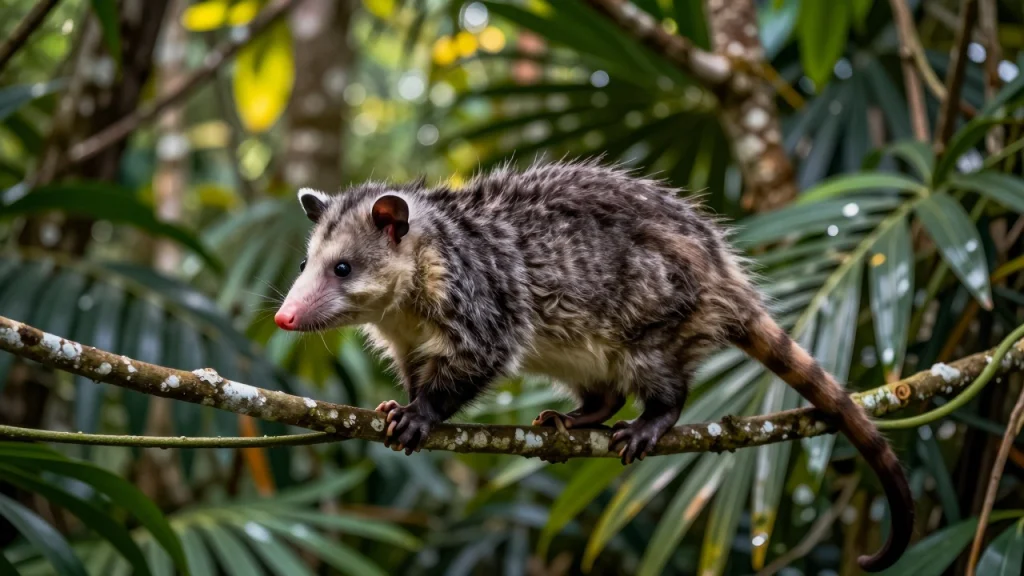
The common opossum of tropical Latin America is described as very short lived, typically fewer than 2 years, and in two separate studies the oldest animal recorded reached 20 months in one and 11 months in the other. More than 100 opossum species exist, spanning everything from the pocket-sized pygmy kind to the Virginia opossum, as big as a domestic cat.
Why two years is enough
Population genetics runs on turnover, not on long lives. Female opossums raise one to three litters per year depending on latitude, and litters are large, which is how a species that dies young keeps its numbers steady. The result is a secure status: the IUCN Red List places the Virginia opossum in the least concern category, and zoo observers report that opossum numbers are holding steady across most regions.
Built-up areas have helped rather than hurt. Survival odds improve in cities partly because predation risk is lower there, and city animals are about 34% heavier than their rural counterparts.
Living alongside opossums
Opossums are often persecuted, which is a shame given what they eat. With 50 teeth, they hold the largest dental complement of any land mammal in North America. Their body temperature runs lower than most mammals, which is why they make poor hosts for the rabies virus, and although infections do occur the disease is uncommon in them.
The famous defence is not courage but collapse. Cornered, an animal goes limp and feigns death, a response that may last from a minute up to 6 hours. The collective name for a group of them is a passel.
Sources
- Animal Diversity Web: Didelphis virginiana (Virginia opossum) | INFORMATION
- Smithsonian’s National Zoo: Virginia opossum | Smithsonian’s National Zoo and Conservation Biology Institute
- San Diego Zoo Wildlife Alliance: Opossum | San Diego Zoo Animals & Plants
- Animal Diversity Web: Didelphis marsupialis (common opossum) | INFORMATION
- U.S. National Park Service: Virginia Opossum – Big Thicket National Preserve
- U.S. National Park Service: Opossums