
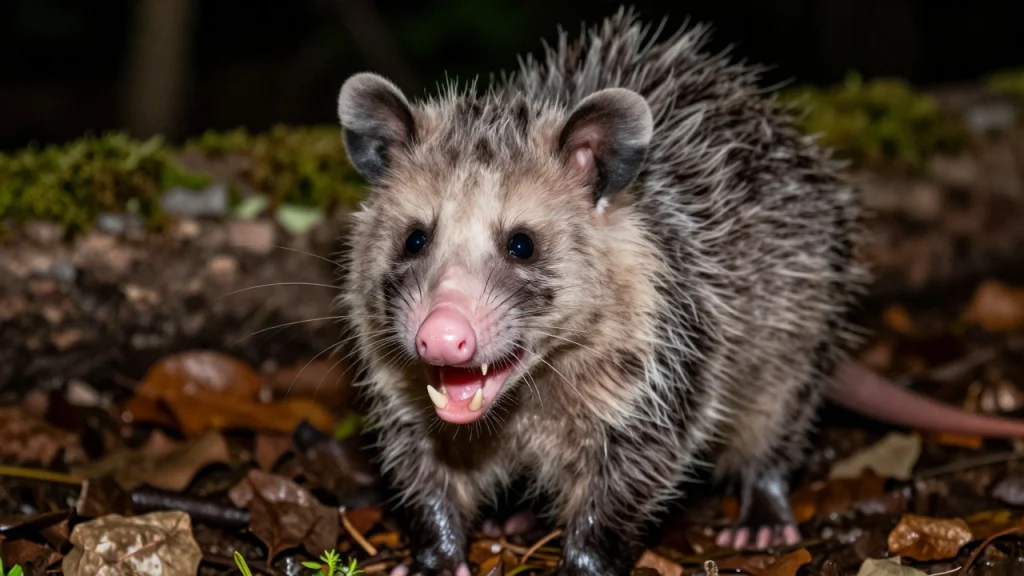
An adult opossum has 50 teeth, and that is the full adult set for its entire family rather than for one species. No land mammal in North America carries more, which is a striking number for an animal that moves slowly, weighs about the size of a domestic cat, and does nearly all of its business after dark.
The count comes from a dental formula, which for opossums is written 5/4, 1/1, 3/3, 4/4. Add the entries on both sides of the upper jaw and both sides of the lower jaw and you arrive at 50. Because every member of the family carries that same formula, the answer does not shift depending on whether you are looking at a Virginia opossum or one of the family’s smaller species.
How the 50 break down
Read 5/4, 1/1, 3/3, 4/4 as pairs. The number before each slash counts one side of the upper jaw, and the number after it counts the matching side below. So each side of the upper jaw holds 5 incisors and a single canine, plus 3 premolars and 4 molars, while the matching side below holds 4 incisors alongside the same canine, premolar and molar counts. The upper jaw therefore ends up with two more incisors than the lower one, and that surplus is where the family’s incisor advantage comes from.
A generous incisor supply is normal for the group. As a whole, marsupials tend to carry more incisor teeth than the average mammal, and opossums sit at the roomy end of that range.
Why such a full set: a general purpose jaw
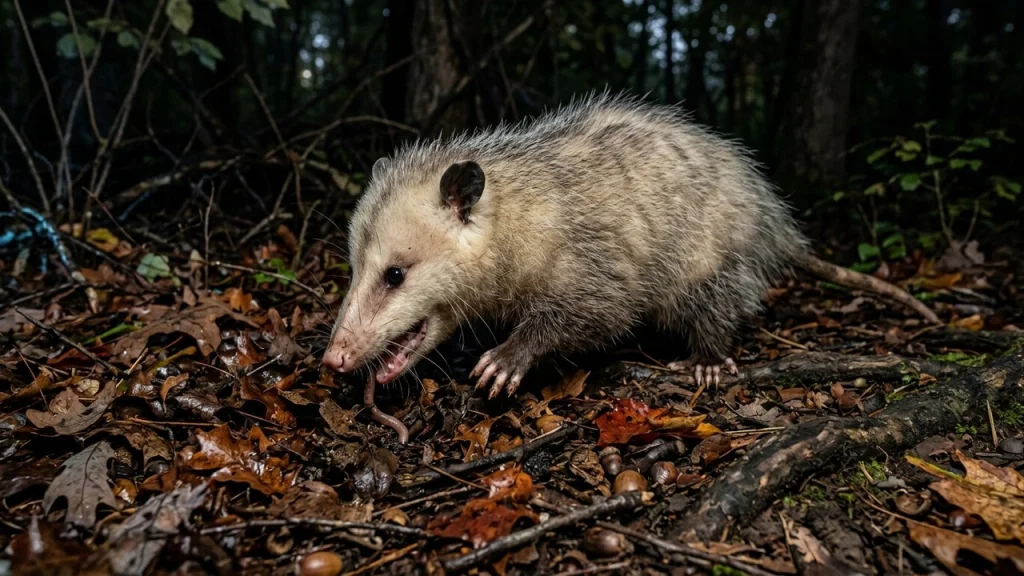
Opossums belong to a family that specialists describe as an ancestral group, and the skull shows it. The long snout, pronounced sagittal crest and short limbs are an assortment of features associated with early mammals, and the dentition follows the same conservative blueprint instead of specialising in one kind of food.
A review of mammalian dental diversity makes the point from the developmental side. The genus Didelphis keeps the primitive number of teeth in every tooth class, matching the counts set out in that formula, and the same review places the opossum molar closest of all living mammals to that ancestral condition, trigon and trigonid included. That old design carries both shearing and crushing surfaces on the same crown, which is a large part of why opossums and bats still wear it today.
The shapes follow from the menu. Individual teeth vary by position rather than by job, with cone-shaped upper incisors, a lower row of polyprotodont incisors and prominent canines. Didelphids are opportunistic omnivores, taking invertebrates, vertebrates and plant material as opportunity allows, and stomach content studies of the Virginia opossum show how mixed the outcome is:
- Mammal tissues: 14 to 27%
- Fruits, seeds and bulbs: 10 to 18%
- Grasses and leaves: 6 to 11%
- Insects: 3 to 13.5%
- Earthworms: 5.5 to 9%
- Birds: 3 to 5%
No single category dominates, and none of them calls for a dedicated cutting blade or a single crushing pad. Fifty teeth is a lot of general purpose equipment.
What the count does not tell you
A high tooth count is not a measure of bite force, and the two are worth separating. The canines in this family are large by opossum standards, but nothing in the skull suggests a predator that wrestles large prey, and the diet confirms it. The animal is also not fast: Virginia opossums top out at 7.1 to 7.4 km per hour, which is why display and escape, rather than pursuit, shape how an opossum meets a threat.
Where published numbers conflict, follow the formula. A San Diego Zoo overview of marsupials gives 52 for the Virginia opossum, yet the same organisation’s opossum page, the family account and the recorded dental formula all land on 50.
Teeth as a signal
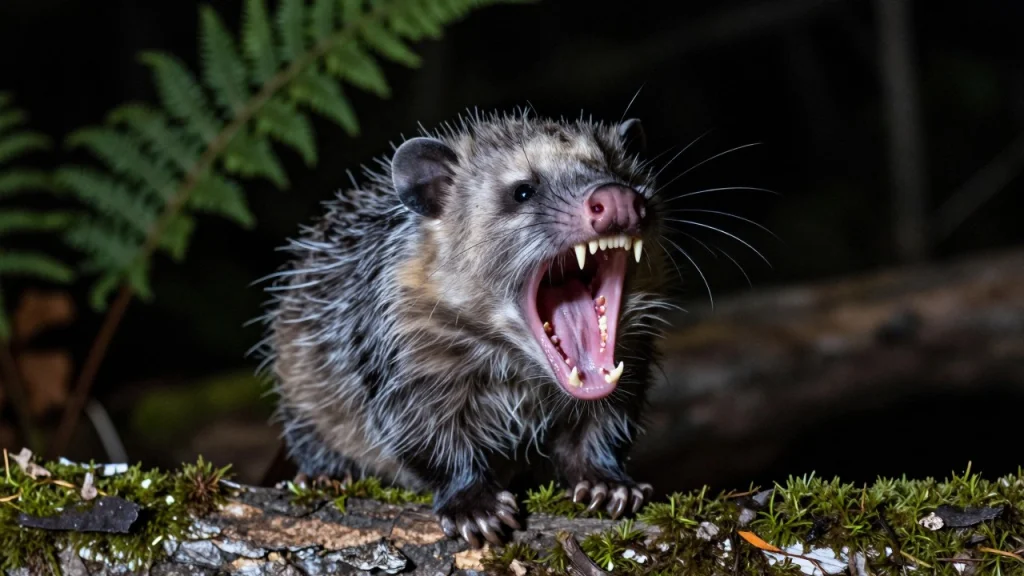
The best known use of that tooth row is display. A cornered adult draws its lips back to expose the teeth, hisses or screams, and often runs. The famous performance that gives the species its nickname is not a deliberate act. It is an involuntary catatonic state in which the body stiffens, the eyes close, and a foul-smelling fluid is released from the anal glands, a sequence that can run for up to four hours. For a predator hunting a hot meal, that is a convincing reason to lose interest.
So a 50-tooth grin does defensive work instead of offensive work, and it costs the animal nothing but a moment of exposure. At that running speed, that is a good trade.
Living with the teeth
The dentition is only part of the toolkit, and the rest of the body is tuned to darkness. Members of the family are nocturnal and often crepuscular. Their eye rods outnumber cones 50:1, where a cat manages 10:1, which buys strong night sight and only limited colour recognition. Hearing is skewed the same way, favouring high frequencies over general noise.
Spacing out matters as well. A typical home range covers 12.5 to 38.8 hectares, and females range over a smaller area, which lowers the odds of meeting a rival while foraging.
Grooming links the mouth to the neighbourhood in a practical way. One estimate puts a single animal at 5,000 ticks eaten in a year, a habit that cuts down on tick-borne disease in the wider area. Opossums are also unusually resistant to pit viper venom, to the point that they actively hunt rattlesnakes, a real advantage when snakes are on the menu.
Reproduction sets the clock. A female in a warm climate may raise three litters in a year after a gestation of 12 to 13 days, and pouch young latch on for 50 to 70 days, with a female averaging about 8 of them per litter. Across the family the number of functional mammae ranges from 4 to 27, so teat count is a species variable rather than a fixed figure. Because newborns arrive highly underdeveloped, the complete 50-tooth set is an adult achievement rather than something a pouch young can be counted to have.
Lifespan is brief. Wild Virginia opossums survive about 1.5 to 2 years, and across the family wild individuals usually make it 1 to 3 years, while captive animals can reach 8 years. On the IUCN Red List the species sits in the least concern category, which suits an animal that flourishes beside human settlements and ranges further north than any other marsupial.
The number to remember
50 teeth, the same for every opossum, written 5/4, 1/1, 3/3, 4/4. The count runs high because the jaw is deliberately unspecialised, a broad omnivore’s toolkit rather than a predator’s edge.
Sources
- Animal Diversity Web: Didelphidae (American opossums and opossums)
- Animal Diversity Web: Didelphis virginiana (Virginia opossum)
- San Diego Zoo Wildlife Alliance: Opossum
- San Diego Zoo Wildlife Alliance: Marsupial
- Smithsonian’s National Zoo: Virginia opossum
- PubMed Central: Mammalian dental diversity: an evolutionary template for regenerative dentistry