
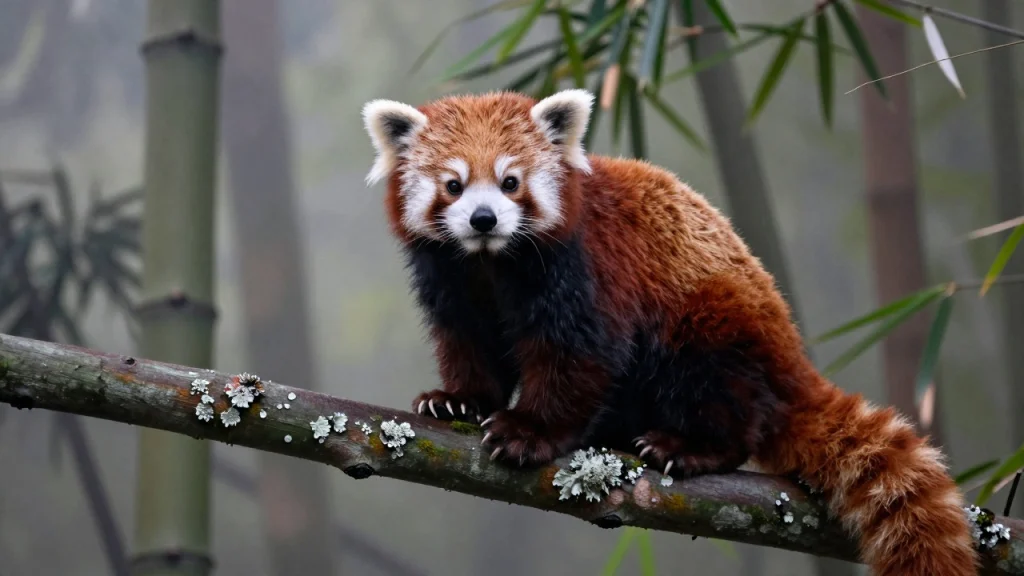
No. The red panda (Ailurus fulgens) is not a bear, and it is not a close relative of the giant panda either. DNA research has placed it in a family of its own, Ailuridae, of which it is the only living member. Its closest living relatives sit on a different branch of the carnivore family tree, alongside skunks, raccoons and weasels.
The name is a historical accident rather than a family connection. A French zoologist described the western form in 1825, about half a century before the black-and-white bear was formally cataloged, and built the genus name from a Greek word for cat plus a species name meaning fire-colored.
A family of one, and a history of wrong turns
Because the ringed tail, head shape and teeth looked raccoon-like, the animal was first written up as a member of the raccoon family, a placement the Smithsonian still calls controversial. DNA evidence then pushed some researchers toward the bear family instead. Molecular work settled it later, showing the red panda to be an ancient lineage within the order Carnivora, more closely tied to the musteloid group than to any ursid. Taxonomy follows shared ancestry, and shared ancestry puts this animal on a branch of its own.
How finely the species splits is still contested. The Smithsonian’s National Zoo points to two distinct forms, Ailurus fulgens fulgens and Ailurus fulgens styani, the second larger and deeper red, while Zoo Atlanta still calls the same two subspecies. The family assignment does not move: Ailuridae, not Ursidae.
Cat-sized, built for cold forest
Adults weigh between 8 and 17 pounds and measure 22 to 24.6 inches, with the tail adding another 14.6 to 18.6 inches, which puts them roughly the size of a house cat.
The coat is engineered for wet, cold mountain forest. A soft, dense woolly undercoat lies beneath long, coarse guard hairs, and long, bushy tails help these arboreal animals hold their balance and stand up to harsh cold and wind. Dense fur completely covers the feet, which carry widely separated toes and claws that can be partly retracted. The cinnamon red coat, sometimes saddled with orange or yellow and paired with a soft cream face mask, blends into the red moss and white lichen coating trunks in bamboo forest.
A bamboo specialist that is not a panda
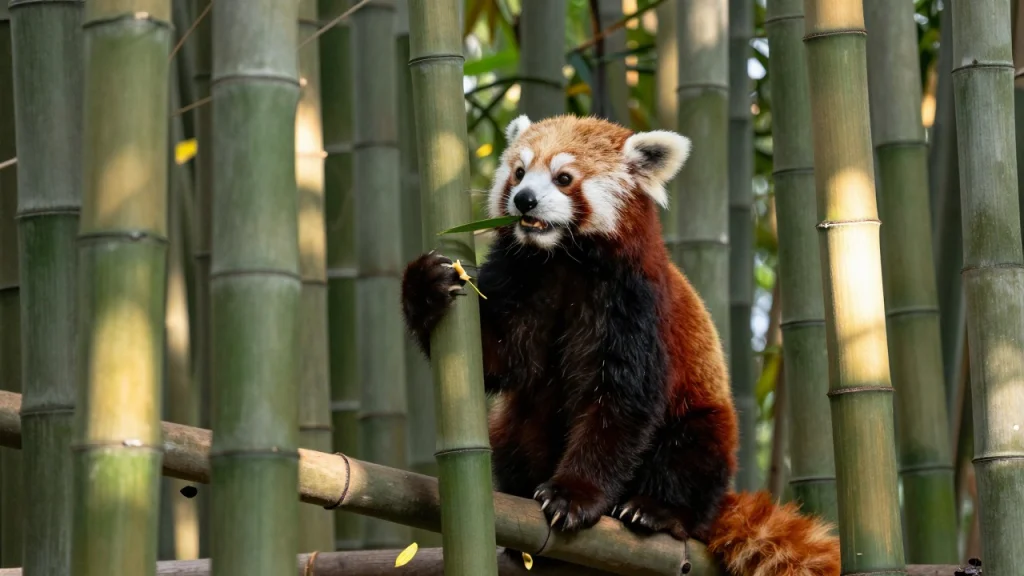
Roughly 95% of the diet is bamboo, and the animal is choosy about which parts it takes. Unlike the giant panda, which consumes nearly every part of the plant above ground, red pandas pick the best leaf tips and, in season, the tender shoots. The wider menu adds berries, blossoms, bird eggs, bamboo foliage and the tender leaves of other plants. In the wild, stems are bent down so the leaves fall within reach of the mouth.
The animal recovers very little of what it swallows: only about 24 percent of what it eats is actually digested. To cover that shortfall it takes 20 to 30 percent of its body weight daily, roughly 2 to 4 pounds of shoots and leaves, and one study recorded a female consuming approximately 20,000 leaves in a single day. Roughly half of their waking hours go on foraging.
The real oddity is the plumbing. Despite a mostly leaf-based menu, the red panda keeps a simple carnivore stomach, and its teeth are unusually robust for an animal of its size. The red panda solves the gripping problem with an enlarged wrist bone that looks like a sixth digit and works almost like a thumb to hold bamboo while eating, but the giant panda bites off large chunks in one go while the red panda works on one well-chosen leaf at a time.
Home in the high forests
The species inhabits temperate forest high in the Himalayas and other mountains, with bamboo in the understory, and it ranges from northern Myanmar west to the Sichuan and Yunnan provinces of China. Across that range it is found between 2,200 and 4,800 meters in elevation.
These are deciduous and coniferous woods, usually over a bamboo understory that includes hollow trees, where the average temperature runs 10 to 25 degrees Celsius and average annual rainfall is 350 centimeters. They also seek out fallen logs, tree stumps and a water source, and in part of India the animal uses a tropical forest. What is left today amounts to a scatter of small territories, each above 4,000 feet, across China, Nepal, India, Bhutan and Burma.
Life in the canopy
Skilled climbers, red pandas use trees for cover, to stay out of predators’ reach, and as winter sunbathing perches. The ankle joints are extremely flexible, and the two lower leg bones are fixed in a way that lets one rotate around its own axis, so the animal can descend a trunk headfirst.
The species is normally solitary, and it is busiest at daybreak, dusk and overnight. In human care the animals are awake for roughly 45 percent of the day, and they get more active when the weather turns cool, notably through the winter breeding period. In significantly cold temperatures they go dormant, dropping their metabolic rate and bringing it back up every few hours when they wake to look for food. The snow leopard is one of the main predators.
Smell does a lot of the social work. Red pandas mark their range with anal glands and urine, plus glands set between their footpads. They read odors with the underside of the tongue, which carries a cone-shaped device that gathers liquid and takes it close to a gland inside the mouth, an adaptation unique among carnivores. The animal can also release a strong smell from glands sited at the base of the tail, which may give a predator pause.
Red pandas round out their signaling with visual cues, such as head-bobbing stare-downs, and with a wide range of calls. The display vocabulary includes:
- arching the tail and the back
- slowly raising and lowering the head with a soft puffing sound
- turning the head and clacking the jaw
- head shaking from side to side
- standing upright on two legs with the forelegs held overhead
- staring
Vocalizations include a high-pitched whistle from newborns in distress, an ear-splitting, grumbly bark from threatened adults, and high-frequency twitters with low-frequency bleats used in the breeding season.
Breeding and cubs
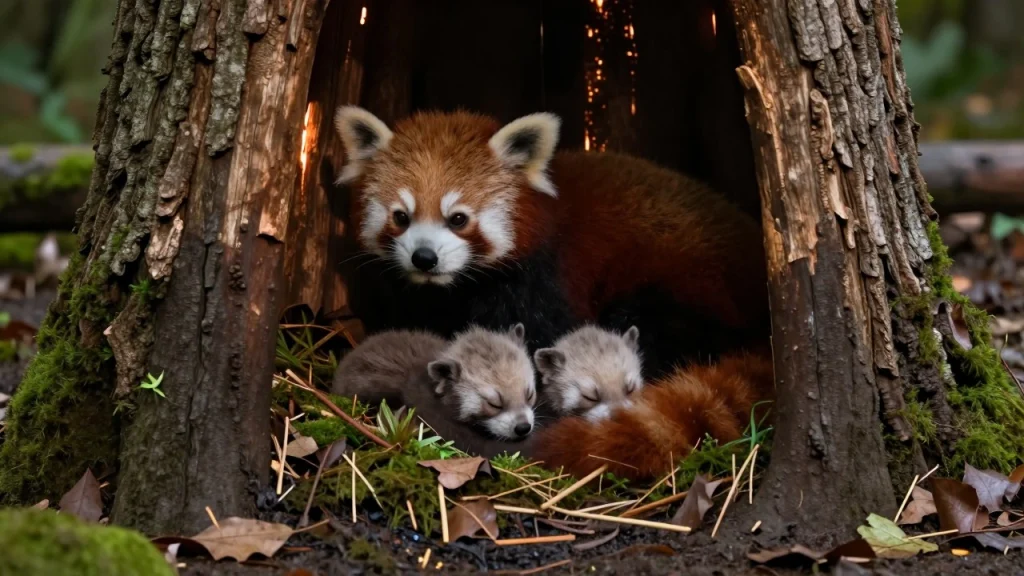
Mating season falls in early winter, and births follow in the warmer months, with the peak of arrivals in June. Litters run from one to four young, and pregnancy lasts approximately 134 days. A female can conceive on just one or two days in a year, and a delay in implantation holds the egg back.
Before giving birth, the female builds a nest in a hollow tree, a stump, a root mass or a bamboo thicket, lining it with moss, leaves and other soft vegetation. Newborn cubs arrive in a thick buff and gray coat, with eyes and ears sealed shut. Those open when they are 2 to 3 weeks old, and nursing continues until 13 to 22 weeks old. Males show little or no interest in young, so the mothers do all the rearing. Offspring remain with the female for roughly a year, then reach reproductive maturity at 18 months. In the wild a red panda can reach 14 years of age, and eight to ten is the typical span.
Why the species is endangered
The International Union for the Conservation of Nature lists the species as endangered, and the animal is under legal protection across India, Bhutan, China, Nepal and Myanmar. The main pressures are habitat loss and degradation, plus human interference and poaching.
Cutting forests removes the hollows the animal nests in and the food it relies on, and it leaves small groups stranded in patches of unusable ground. Bamboo grows unreliably in degraded forest, which adds stress on top of a shrinking range, and diseases that spread from domesticated animals reach wild red pandas as well. Animals are also taken in traps set for other species, including musk deer, and are outcompeted by local livestock for food. Trade is regulated: the species sits in Appendix II of the international convention on trade in threatened species, and it was declared endangered in March 1988.
Nobody can pin down how many red pandas remain in the wild. A 2015 estimate put the total at 10,000, which is a 50 percent drop since 1997. Protected areas now cover part of the range: 20 for India, 35 for China, 8 for Nepal and 5 for Bhutan.
What the name gets wrong
The answer lies in the classification rather than the appearance. Ailuridae settles the question, and a house-cat size with a bamboo-heavy diet mean the animal shares a menu and a look with pandas while living like a small, tree-dwelling carnivore. Current conservation work runs on four fronts: guarding against habitat loss, reducing habitat degradation, cutting deaths from poaching and man-made threats, and improving awareness.
Sources
- Smithsonian’s National Zoo: Red panda | Smithsonian’s National Zoo and Conservation Biology Institute
- Animal Diversity Web: Ailurus fulgens (red panda) | INFORMATION | Animal Diversity Web
- San Diego Zoo Wildlife Alliance: Red Panda | San Diego Zoo Animals & Plants
- National Geographic: Red pandas, facts and photos | National Geographic
- Zoo Atlanta: Red Panda – Zoo Atlanta