
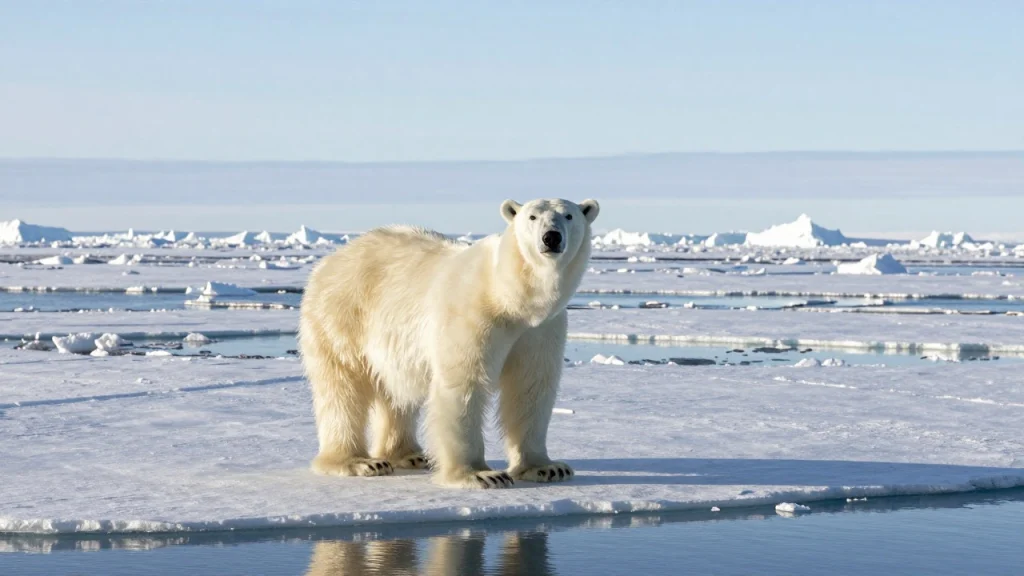
Understanding the lifespan of the Arctic apex predator illuminates how cold-climate specialists survive in harsh circumpolar environments. In natural Arctic habitats, biologists calculate that polar bears live between 25 and 30 years. General zoological profiles similarly record a representative life span of 25 yrs. Reaching this milestone demands tremendous physical resilience, as individuals must consistently locate seals across drifting pack ice while enduring severe subzero conditions.
San Diego Zoo Wildlife Alliance reports that lifespan varies between the sexes, with females surviving 20 to 25 years on average and males typically attaining 15 to 18 years. Under attentive zoological care, the greatest documented survival belonged to a captive female who died at the Detroit Zoo during 1991 after reaching 43 years and 10 months old.
Wild Longevity and Age-Specific Survival Rates
Polar bear longevity in polar ecosystems depends heavily on demographic stage and resource accessibility. Across most northern expanses, annual adult survival rates of approximately 0.90 or higher remain widespread, whereas lower survival figures occur infrequently. For fully grown individuals navigating these northern environments, estimated annual adult mortality ranges from 8 to 16%. These resilient demographic patterns correspond directly with scientific expectations for a dominant apex predator situated in an undisturbed ecosystem featuring reliable resources.
Survival probabilities fluctuate substantially as individuals progress from infancy toward old age. Demographic models reveal a distinct survival progression across developmental classes, where relative annual survival probabilities rank lowest in Age0 cubs, rising through Age1, Age2, Ages20+, Ages3–4, and peaking in Ages5–19. Mature bears enjoy high survival security, while juveniles and elderly bears experience much higher vulnerability.
Researchers observe distinct survival trends across these developmental brackets:
- Vulnerable infants (Age0 and Age1): Dependent cubs and yearlings experience low survival.
- Newly independent juveniles (Age2): Researchers hypothesized that survival could be lower during the Age2 stage, the first year a young bear forages on its own without its mother.
- Transitional subadults (Ages3–4): Developing subadults show survival odds close to adult baselines.
- Prime breeding adults (Ages5–19): Experienced adults exhibit the highest annual survival probability of any age group.
- Aging adults (Ages20+): Older bears face biological senescence and elevated mortality.
Early Life Stages and Cub Development
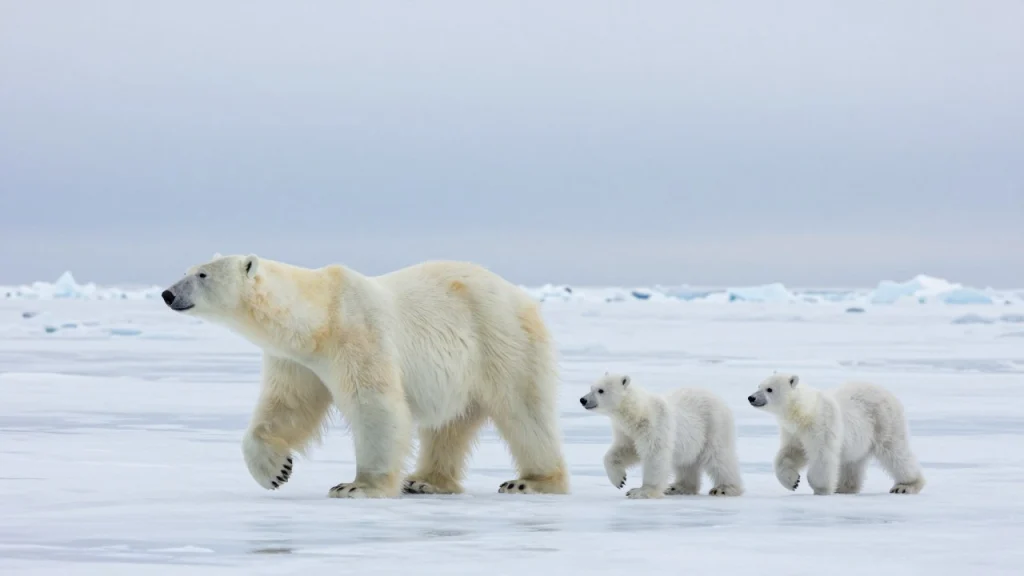
A polar bear’s life journey begins in deeply excavated snow drifts along Arctic coastlines. Mothers bring forth an average of 2 cubs inside protected winter chambers between November and January, though overall litter sizes can span 1 to 4 offspring. Upon arrival, newborn young weigh around 700g.
Survival through early infancy requires extraordinarily calorie-rich maternal investment. Maternal lactation delivers critical calories, providing milk containing 36 percent fat, which constitutes the richest milk among all bear families. This concentrated nutritional fuel enables rapidly maturing infants to expand their body mass 15-fold prior to departing their snow shelter in springtime.
Despite rigorous maternal care, field researchers calculate that the mortality rate for cubs falls between 10-30%. Young bears accompany their mother through early life until approximately two years of age, when they finally achieve independence. Biological maturation occurs at divergent intervals, with female maturity occurring at 3 to 4 years while males attain adult breeding readiness around 6 years.
Arctic Hunting, Energetics, and Daily Survival
Surviving several decades on the Arctic ocean requires specialized predatory behaviors and physiological stamina. Because these apex predators spend the predominant portion of their existence upon frozen ocean waters for subsistence and shelter, biologists classify them as the sole bear taxon regarded as marine mammals. Frozen oceanic floes serve as essential territory, This social pattern keeps each cub with only its mother while it grows up.
Dietary specialization centers around fat-rich prey species. To satisfy substantial energetic requirements, their primary prey consists of ringed seals ( Pusa hispida ). Upon securing a kill, hunters prioritize lipid-rich blubber because of its remarkable caloric density.
Securing prey in expansive polar terrain demands acute patience and remarkable stealth:
- Patient ambush: Hunting strategies demand supreme discipline, consisting of motionless vigils beside respiratory ice openings or meticulous stalking followed by an explosive sprint toward unsuspecting quarry.
- Low capture rates: Fewer than 2% of hunting attempts result in a successful meal.
- Long-range olfaction: Scent detection proves astonishingly keen, allowing bears to detect potential prey up to 32km away and identify seals hidden beneath packed snow drifts from 1km away.
- Extensive travel: Nomadic wanderings across frozen seas frequently require walking 15 miles per day, while individuals have also been observed swimming distances exceeding 50 miles from coastline shores.
- Aquatic endurance: When water travel becomes unavoidable, polar bears attain speeds of up to 6mph, paddling steadily across open channels for numerous continuous hours.
Anatomical Specializations and Environmental Hazards
Specialized physical structures enable polar bears to reach advanced ages despite brutal Arctic climates. Dense fur covering the soles of their paws provides vital friction across slippery snow and slick marine ice. Directly beneath their heavy winter coats lies jet black skin. Each strand in their outer coat is completely translucent, and only appears white because it reflects visible light. Evolutionary researchers determine that these Arctic specialists diverged about 200,000 years ago from ancestral brown bears.
Humans and rival conspecifics represent the only predators capable of threatening Ursus maritimus. This intra-species risk poses a grave danger to nursing families, as adult males will occasionally hunt small cubs during opportunistic encounters.
Contemporary climate projections underscore that northern marine habitats are destabilizing, as sea ice loss accelerates and historic minimums recur with growing frequency.
Sources
- Animal Diversity Web: Ursus maritimus (polar bear)
- San Diego Zoo Wildlife Alliance: Polar Bear | San Diego Zoo Animals & Plants
- WWF-UK: Top 10 facts about polar bears | WWF
- North Carolina Zoo: Polar Bear | North Carolina Zoo
- Ecology and Evolution: Survival and abundance of polar bears in Alaska’s Beaufort Sea, 2001–2016