
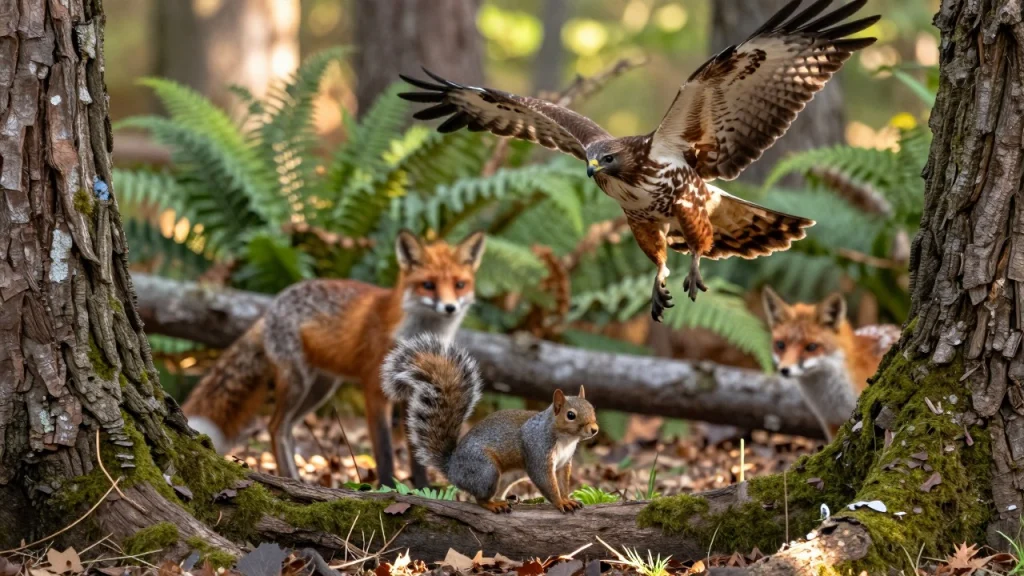
A squirrel’s biggest enemy depends directly on its habitat and ecological niche. In dense temperate woodlands, agile tree-climbing carnivores such as pine martens, weasels, and large birds of prey pose the most persistent lethal danger to tree squirrels. On open northern plains and tundra hillsides, ground squirrels face heavy predation from raptors like golden eagles alongside large terrestrial hunters, including foxes and grizzly bears. In developed suburbs and city parks, domestic cats and motor vehicles emerge as the leading hazards to squirrel survival.
Because squirrels occupy vital roles as seed foragers and abundant prey throughout global ecosystems, dozens of specialized predators hunt them daily. To survive relentless pressure from sky, ground, and tree branches, these rodents rely on an array of evolutionary adaptations. They combine acute sensory perception, intricate burrow tunnels, aerial leaping agility, and acoustic alarm calls to evade their enemies and protect their young.
Forest predators and canopy survival
In North American deciduous forests, eastern grey squirrels (Sciurus carolinensis) encounter a wide spectrum of natural carnivores. Terrestrial hunters, semi-aquatic mammals, and raptors frequently pursue them throughout the timbered landscape. Across North American forests, eastern grey squirrels encounter numerous carnivores, including American mink, red foxes, bobcats, coyotes, and raptors like red-tailed hawks.
Foraging demands force these rodents to divide their time between high canopy branches and forest soil. For sustenance, eastern grey squirrels consume nuts, buds, and flowers harvested across more than 24 oak species and 10 varieties of hickory, walnut, pecan, and beech trees. When foraging on the ground, squirrels face increased exposure to stalking carnivores, making rapid escape routes critical for their daily survival.
To evade capture on the forest floor, tree squirrels bolt directly toward tree trunks and ascend rapidly into the upper limbs. Their remarkable nimbleness among canopy branches makes these tree squirrels exceptionally hard for pursuers to catch. By swiftly navigating thin twigs and leaping between branches, squirrels easily outmaneuver heavier terrestrial hunters that cannot follow them into the canopy.
Living under constant predatory risk influences reproductive habits and life expectancy. While eastern grey squirrels achieve a maximum wild lifespan of 12.5 years, one protected female living in captivity reached more than 20 years of age. To shelter dependent young within the nest, lactating females sometimes reduce their home range territory by as much as 50%.
Pine martens and coevolved defenses
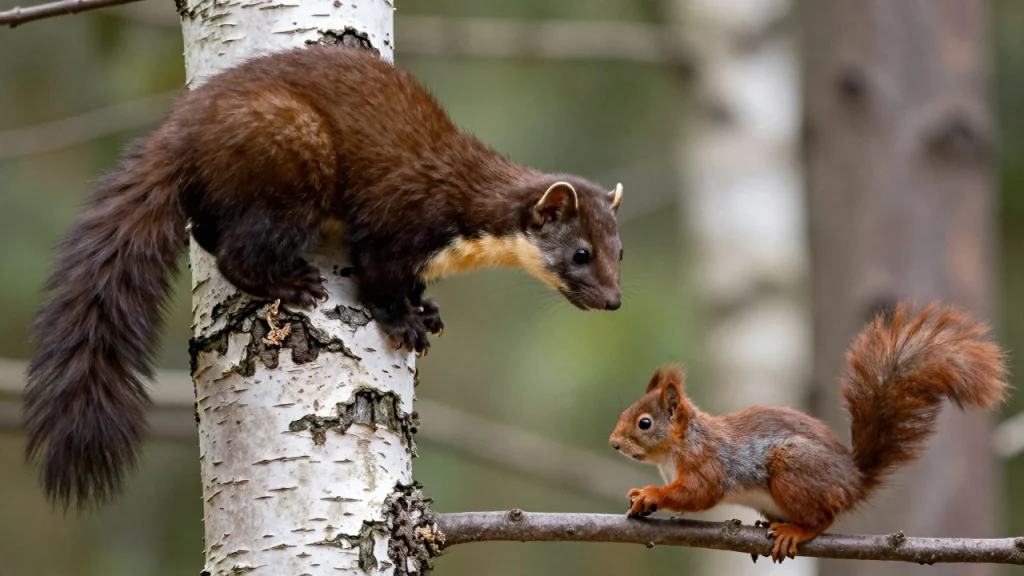
In European woodlands, the native pine marten (Martes martes) serves as one of the most effective arboreal hunters of squirrels. As an accomplished tree climber, the marten can pursue squirrels directly into the high canopy, eliminating the vertical refuge that tree squirrels rely upon to escape ground carnivores. However, field studies reveal that this predator does not affect all squirrel species equally due to evolutionary history.
Field surveys using spatial capture-recapture tracking demonstrated that predation pressure is asymmetrical, with grey squirrel distribution heavily depressed by contact with pine martens. In contrast, the presence of hunting pine martens yields an indirect positive benefit for red squirrel numbers by curtailing competitive invaders.
Across regions where native predator populations have strongly recovered, red squirrels dominate the landscape, while invasive grey squirrels survive mostly in isolated pockets where martens remain scarce. Ecological evidence confirms that the resurgence of this native hunter overturns the competitive advantage and disease dynamics that once favored grey squirrels.
This divergent outcome stems directly from evolutionary history. Because grey squirrels do not share an evolutionary past with pine martens, they fail to recognize danger signals left by the carnivore and do not mount antipredator defenses. Native red squirrels, by contrast, possess finely tuned chemical detection mechanisms. Remarkably, red squirrels identify recent visits by pine martens even without encountering urine or feces deposits.
Behavioral tests revealed that red squirrels reacted to predator cues by visiting feeding stations less often, shortening their meal times, and increasing vigilance. During foraging trials, red squirrels fed exceptionally little during the 8 h after a pine marten visit, ignoring accessible bait. By devoting extra time to inspect perceived threats, vigilant squirrels significantly lessen their likelihood of being captured.
Arctic tundra survival and burrow engineering
In northern alpine environments, squirrels face an entirely different set of environmental challenges and carnivores. The arctic ground squirrel inhabits open mountain slopes where tall trees are completely absent. Without vertical branches for refuge, these ground-dwelling rodents depend on subterranean tunnel architecture to evade enemies.
As subterranean rodents, arctic ground squirrels excavate complex colonies in well-drained soils that offer wide vistas of the terrain. Because numerous northern carnivores feed on them, naturalist Adolph Murie famously termed arctic ground squirrels the “staff of life” in Denali. During short northern summers, these ground squirrels form a primary seasonal diet for grizzly bears, foxes, gyrfalcons, and golden eagles.
To survive in an open biome crowded with hungry carnivores, ground squirrels time their seasonal life cycles with great precision. Field biologists observe that retreating into underground winter dormancy early provides better protection than staying aboveground, even while surface food remains available. Mature adults begin entering hibernation once they accumulate sufficient lipid reserves, frequently retreating by late August despite remaining forage.
Reproductive timing also reflects these intense survival constraints. Reproductive activity begins in May, producing one seasonal litter of 5 to 10 offspring delivered in June. Developing at a rapid pace underground, the pups typically leave their burrows in mid-July.
Unlike adults, youngsters require far more time to forage and store body fat, often staying active until late September. Prolonged surface foraging into the autumn freeze exposes youngsters to significantly higher predation risk than experienced adults. When winter subsides, adult males are typically the first individuals to conclude hibernation. These pioneering males tunnel through drifts and remain near subterranean entrances until the spring snowpack thaws.
Urban perils and domestic hunters
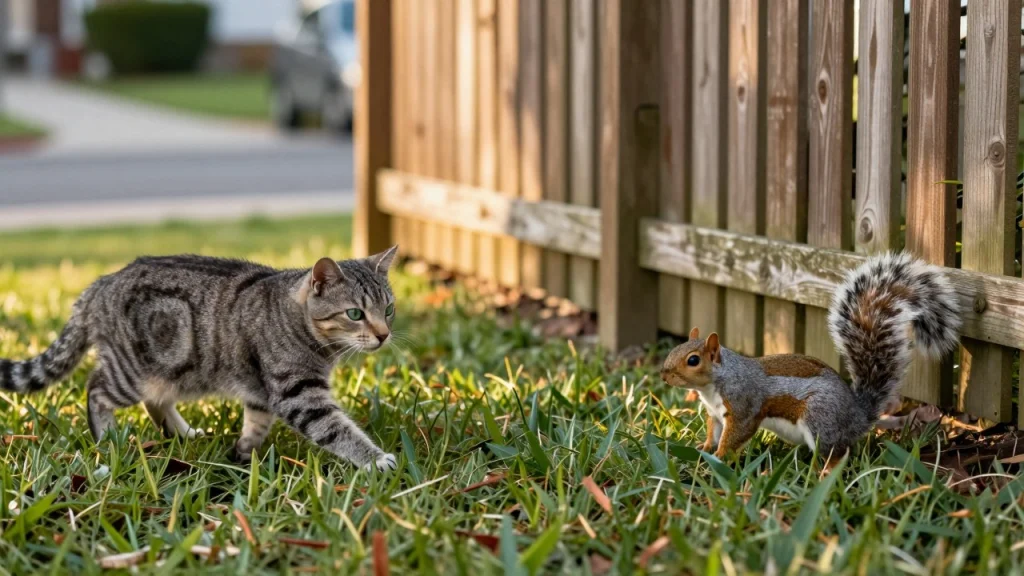
When squirrels settle in residential suburbs, municipal parks, and urban green spaces, the roster of enemies transforms dramatically toward human-associated hazards. Wild woodland carnivores give way to domesticated animals and mechanical hazards introduced by human infrastructure.
Encounters with pets represent a major source of trauma for urban wildlife, with small herbivorous species regularly suffering violent attacks from domestic cats. Animals living near urban and suburban housing face heightened danger from companion animals, often sustaining deep bite trauma that necessitates professional veterinary care.
Wildlife rescue records in the Czech Republic documented 259 bitten red squirrels admitted for treatment, comprising 4.83% of all intakes. Bitten squirrels suffered some of the highest mortality rates among patients, rivaling the severe fatalities seen after vehicle collisions or acute exhaustion.
For patients brought in after vehicular impacts, unassisted death became the leading outcome at 72.88%. Patient admissions peaked during the warmer months of spring and summer, with April recording the highest intake of 1207 individuals. Orphaned juveniles formed the most common intake group, making up 57.93% of all admitted red squirrels.
Alarm signaling and visual communication
To minimize deadly surprise encounters, squirrels maintain acute sensory monitoring of their surroundings. Visual surveillance and social signaling form their primary defensive communication against approaching predators.
Social interaction among eastern grey squirrels incorporates multiple vocalizations along with expressive postures, such as energetic tail flicking. When noticing a stalking carnivore, watchful sentinels produce loud alarm sounds to notify neighboring squirrels of approaching danger.
These vocal alarms and rhythmic tail movements alert nearby kin to seek safety inside hollow trees, subterranean burrows, or dense foliage. Through coordinated sensory awareness, tree agility, and rapid defensive communication, squirrels actively mitigate the pressure exerted by their most formidable wild enemies.
Sources
- Animal Diversity Web: Sciurus carolinensis (eastern gray squirrel)
- National Park Service: Arctic Ground Squirrel – Denali National Park & Preserve
- Royal Society Open Science: Red squirrels exhibit antipredator behavioural changes in response to a native predator, the pine marten
- Proceedings of the Royal Society B: Biological Sciences: The enemy of my enemy is my friend: native pine marten recovery reverses the decline of the red squirrel by suppressing grey squirrel populations
- Animals (Basel): Eurasian Red Squirrels (Sciurus vulgaris) in Wildlife Rehabilitation Centres: Causes of Admission, Outcomes, and Seasonal Trends in the Czech Republic