
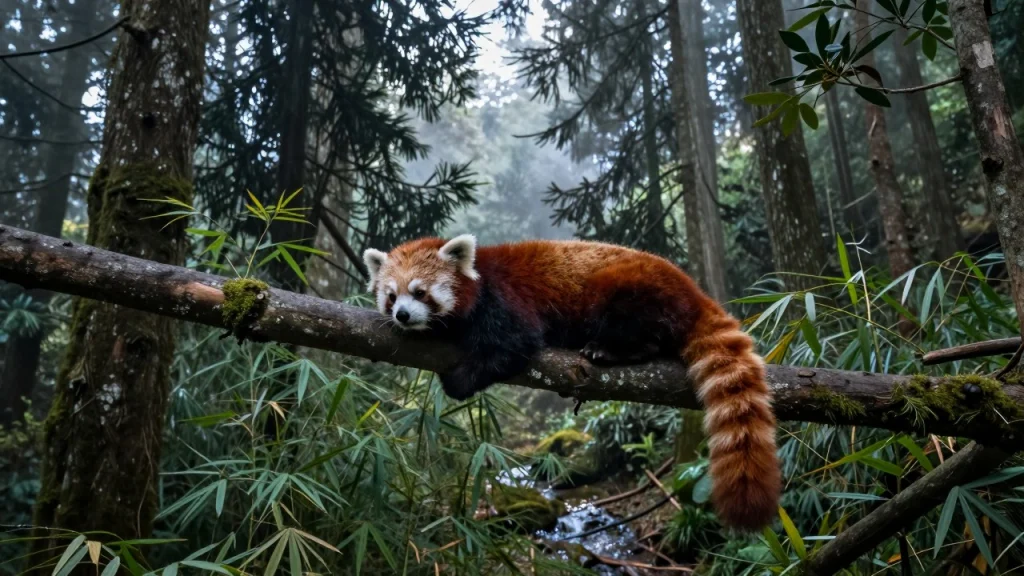
Red pandas live in a narrow band of mountain forest along the eastern Himalayas and into southwestern China. Their range reaches into Nepal, northern India, Bhutan, northern Myanmar, the Chinese provinces of Sichuan and Yunnan, and Tibet, with typical elevations running from 2,500 m to 4,000 m.
That is only half the answer. The other half is why: a red panda needs cold high ground, closed canopy and a bamboo understory in the same place at the same time. Where those three line up, the species is at home. Where one of them is missing it drops out, and the result is a range that looks broad on a map but is really a chain of scattered mountain pockets.
The arc the range follows
The distribution is an arc rather than a solid block. The northern edge follows the Namlung Valley in Mugo District, then the Lake Rara country; the southern edge follows the Liakiang Range; and in western Sichuan the upper Min Valley closes off the north and east.
Field surveys put real numbers on that arc:
- Across the range, the preferred band reported for eastern Himalayan temperate broadleaf forest with a bamboo understory runs from 2,400 to 3,900 m.
- In Bhutan’s Jigme Dorji National Park, droppings and footprints turned up from 2,414 to 3,618 m, averaging 2,750.8 m.
- The broadest span recorded across the mountains stretches from 2,200 to 4,800 m.
That spread is not random. Red pandas are not evenly spread across it, and researchers suspect that human disturbance is one reason low ground is increasingly avoided in favour of habitat at middle elevations.
A tropical exception
Not every red panda lives in the cold. In part of India the species lives in tropical forest, and some individuals there manage in woodland down at 700 to 1,400 m, well below the temperate forests that hold most of the species. It is a small corner of the range, but it shows that the real requirement is dependable food and cover rather than a fixed temperature.
The forest has to have the right parts
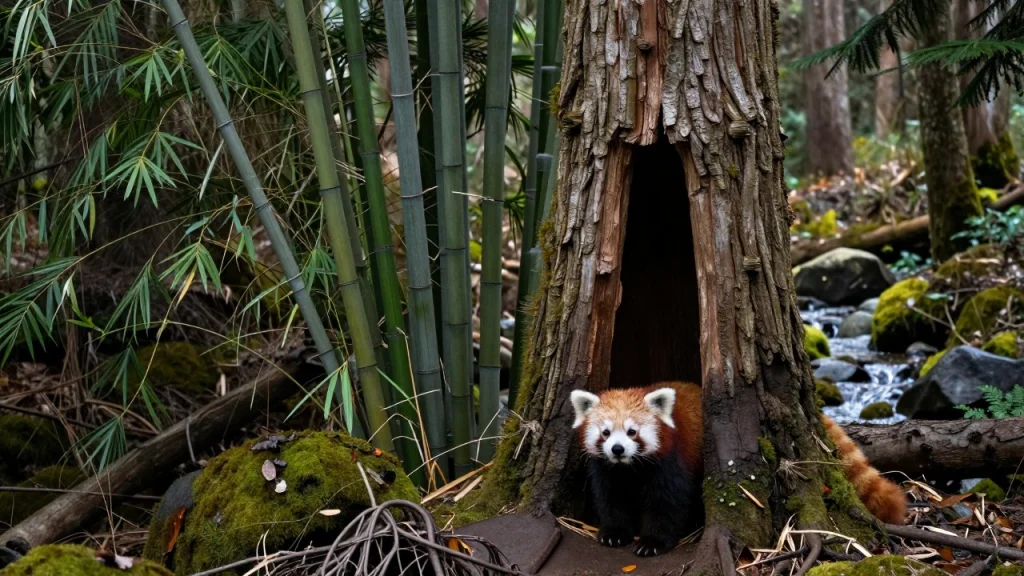
Red pandas need a particular set of features, not a particular type of forest. The Smithsonian lists what matters most: water close at hand, the right amount of cover and altitude, and enough bamboo. Animal Diversity Web describes the usual setting as temperate deciduous and coniferous woods, usually with an understory made up of bamboo and hollow trees, in a belt that averages between 10 and 25 degrees Celsius and 350 centimeters of rain a year.
The hollow trees are not incidental. A female builds her nest in a tree hole, a hollow stump, among tree roots or in a bamboo thicket, then pads it with moss and other soft material, so a forest without cavities is a forest with no safe nurseries. San Diego Zoo Wildlife Alliance also lists deadfall, stumps and running water among the essentials, and field work in Bhutan tied red panda presence to fir forest and to being near the closest stream.
Why bamboo and altitude pull together
Bamboo is the reason this animal lives where it does. It grows fast on mountain slopes and almost nothing competes with a red panda for it, which makes the plant dependable but low in calories. Roughly 95% of the diet is bamboo, eaten selectively: where a giant panda will chew through woody stalks, a red panda picks out tender leaf tips and, when they are available, young shoots.
The return on that effort is poor. Digestion is inefficient, with just 24 percent of the bamboo swallowed ever absorbed, and one study clocked a female at roughly 20,000 leaves a day. To extract enough energy from such poor food, a red panda spends very little: in severely cold weather it can go dormant, dropping its metabolic rate and waking every few hours to look for food, which lets it live on almost as little energy as a sloth.
Bamboo variety also shapes where individuals settle. A single home range can hold as many as 40 bamboo species, yet each animal concentrates on one or two of the tastiest, so a hillside crowded with bamboo is not automatically good red panda country.
Life in the canopy
The species is a tree animal, and much of its range is only usable because the canopy is there. It sleeps in nests set in evergreens, and its long furry tail, which cannot grip, works as a counterbalance on narrow branches while it feeds. On the ground that same tail is carried straight out behind, a good sign of how little time the animal spends walking about at forest level.
Predators are the other reason the trees matter. Snow leopards are named as a primary predator and dholes are listed beside them, while the canopy itself offers both a lookout spot for sunbathing and a fast route out of danger. If climbing fails, a threatened red panda stands on its hind legs and strikes out with its claws.
Red pandas are solitary, and each wild animal covers a home range of about 1 square mile, so they stay hidden even where the habitat looks ideal. They are busiest at dusk, dawn and after dark, sleeping through the hottest hours of the day. Cooler months make them livelier, and activity peaks during the winter mating season.
Two red pandas, two mountain blocks
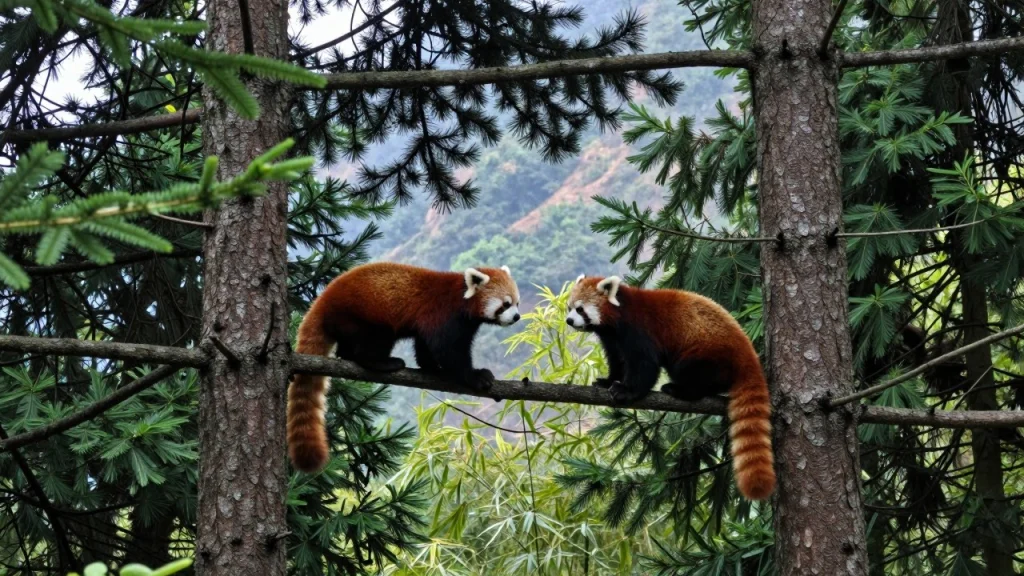
The species is not spread evenly across that arc, and modern genetics has split it in two. Red pandas were long treated as a single species with two subspecies, and newer genetic studies suggest two distinct ones instead, one western and one eastern. The older name Ailurus fulgens styani is still widely used for the eastern form.
The practical split holds either way. The western form lives predominantly in Nepal and also turns up in India and Bhutan, while the Chinese form is mainly a creature of China and Myanmar, including the Yunnan and Sichuan provinces.
Why the range keeps contracting
Red pandas carry an Endangered listing on the IUCN Red List, and they are legally protected across their range. Protection has not stopped the losses. The main pressures are loss of habitat, disturbance by people, and poaching, and peer-reviewed surveys rank habitat loss, fragmentation and degradation at the top of the threat list. The mechanisms are plain once you know the habitat:
- Clearing forest strips out nesting cavities and food at the same time, and chops the population into fragments separated by ground the animal will not cross, which in turn drives inbreeding.
- Livestock compete directly with red pandas for bamboo leaves while degrading the same slopes.
- Domestic dogs hunt red pandas and can pass on canine distemper.
- Hunters who target musk deer catch red pandas in traps by accident.
- Degraded forest grows bamboo unreliably, which adds stress on top of everything else.
Designated parks dot the mountain range from Myanmar to China, yet even inside many of them grazing, hunting and logging continue. Zoo specialists put the adult population at around 10,000, and researchers believe the total population has fallen by 40 percent across the past two decades.
What keeps a home range usable
The habitat a red panda needs is specific and, in many places, already broken. They turn up where there is canopy, a dense bamboo understory, water close by and undisturbed ground, and they avoid ground near people as well as ground grazed by livestock.
Reproduction is timed to the same calendar. Mothers usually bear two cubs, and the birth season runs from May into July, which is when the tenderest bamboo shoots and leaves appear. Cubs stay with their mother for about a year, until they are close to full-grown. Wild red pandas typically live 8 to 10 years, and individuals in zoos have reached 15.
So the short version is this: red pandas live in a ring of high mountain forest from Nepal to southwestern China, in trees above a bamboo understory, at the middle elevations where the food grows. The distribution looks like a wide arc on a map and like scattered real patches on the ground, and that patchiness is why the IUCN’s recommended actions for the species begin with shielding habitat rather than counting the animals still left.
Sources
- Animal Diversity Web (University of Michigan): Ailurus fulgens (red panda) | INFORMATION | Animal Diversity Web
- Smithsonian’s National Zoo: Red panda
- San Diego Zoo Wildlife Alliance: Red Panda | San Diego Zoo Animals & Plants
- PLOS ONE (via PubMed Central): Distribution and habitat use of red panda in the Chitwan Valley of Nepal
- Ecology and Evolution (via PubMed Central): Habitat requirements of the Himalayan red panda (Ailurus fulgens) and threat analysis in Jigme Dorji National Park, Bhutan
- San Diego Zoo Wildlife Alliance Library / IUCN SSC Species Survival Plan: Red Panda (Ailurus fulgens) Fact Sheet: Distribution & Habitat