
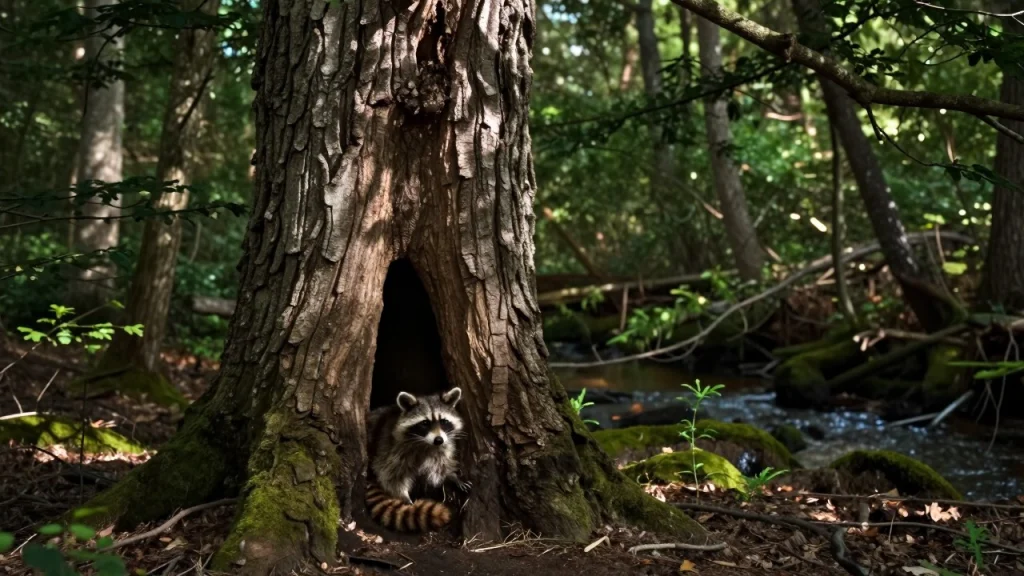
Where do raccoons live during the day? Because these medium-sized mammals follow a nocturnal lifestyle, they spend almost all daylight hours secluded in sheltered chambers known as dens. Across natural landscapes, raccoons seek daytime shelter inside arboreal cavities, rocky fissures, and subterranean burrows.
When establishing an arboreal roost under ordinary circumstances, these animals typically settle inside an expansive bough rather than the central trunk of a hollow tree. These arboreal resting chambers span diverse vertical positions, situated anywhere from ground level up to 60 feet in height above ground.
Forest canopies provide security against terrestrial threats while animals sleep. Remaining sheltered inside these hidden refuges throughout daylight hours allows raccoons to shield themselves from most carnivores. Forested environments located adjacent to aquatic features serve as their preferred landscape. Sustaining their daily physiological and foraging needs demands immediate proximity to reliable water sources.
Natural den selection in wild forests
These animals show a strong ecological inclination toward damp forest ecosystems with substantial canopy cover. In wild settings, individuals fashion daytime roosts within tree cavities, natural caverns, stone cracks, vacated woodchuck tunnels, and several alternative sanctuaries.
Rather than excavating deep burrows from scratch, raccoons take advantage of preexisting landscape contours and abandoned structures.
Conifer canopies also provide reliable daytime roosting perches in specific geographical environments. Field observations within the California coastal municipalities of Pacific Grove and Carmel revealed that fully grown Monterey pines ( Pinus radiata ) frequently served urban raccoons as diurnal sleeping perches.
These adaptable mammals exhibit little fastidiousness regarding the precise nature of their physical shelters.
Urban daytime dens and human structures
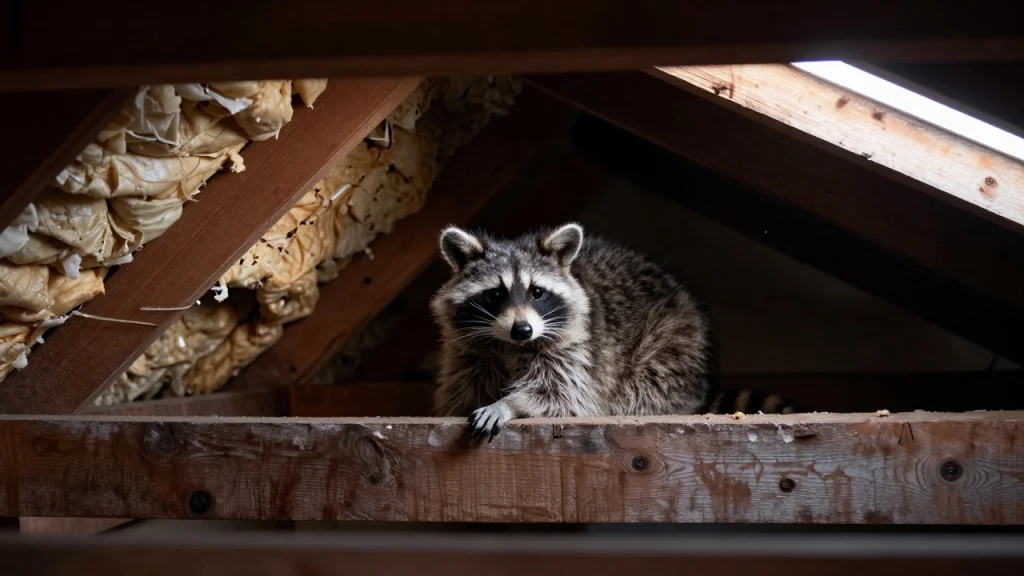
Across metropolitan neighborhoods, household chimneys, building attics, and subfloor structural voids frequently function as regular denning spots.
Whenever metropolitan development lacks suitable timber hollows, raccoons exploit diverse structural enclosures such as stone piles, junk heaps, residential attics, foundation voids, patio platforms, storage sheds, drainage culverts, storm sewers, and subterranean excavations dug by other wildlife.
Damaged mesh screening, compromised roof soffits, uncapped flues, or shattered window panes frequently provide convenient architectural breaches for invading mammals.
Suburban individuals also readily establish living spaces under outdoor wooden decking or manufactured housing foundations. Developed communities offer abundant shelter possibilities, encompassing low-standing patio decks, residential crawl spaces, auxiliary outbuildings, stormwater conduits, and household chimneys.
Maternal dens and seasonal nursery habits
Most nuisance reports from property owners involve a nursing mother rearing her young offspring within a chimney flue or household attic.
Adult raccoons maintain a largely independent existence, but maternal females remain alongside their litters during initial months of life.
Homeowners can frequently prompt a nursing mother to relocate her dependent litter by introducing fabric strips or cotton wads saturated with male raccoon urine or rival predator scent into the infested ceiling or crawl space.
Daily activity cycles and daytime sightings
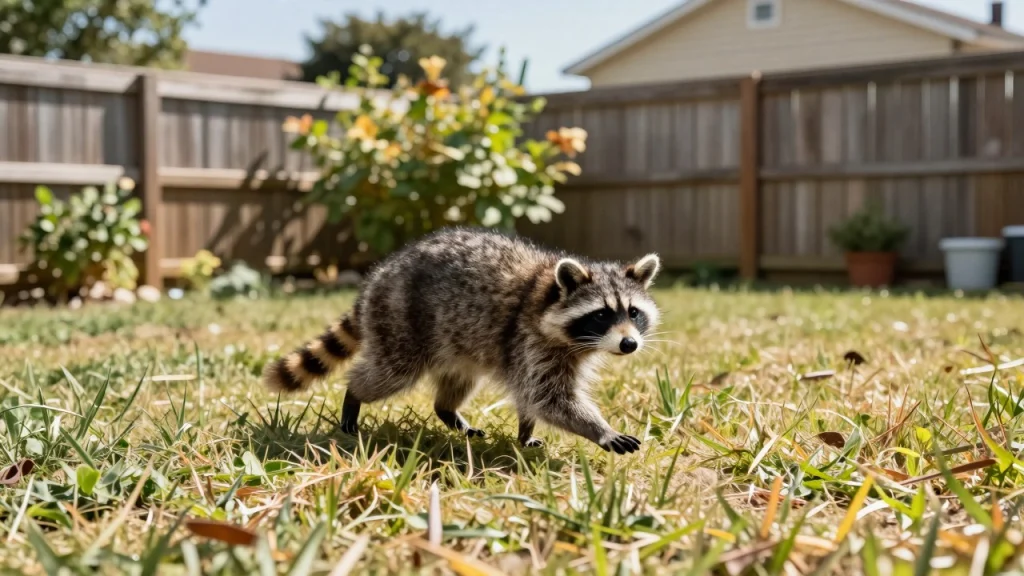
Because their internal rhythms align with nighttime darkness, raccoons seldom display movement during daytime hours. Resting motionless inside a sheltered retreat during daylight allows raccoons to evade numerous natural threats.
Even while resting quietly inside their refuge, these animals maintain keen environmental vigilance and react fiercely when confronted by danger.
Typically, individuals depart their sleeping shelters shortly following nightfall and sustain continuous foraging through dawn. Foraging animals generally avoid roaming excessive distances away from a cozy resting station.
When moving from their resting quarters toward bountiful feeding grounds, raccoons follow direct linear pathways. A single raccoon typically patrols an established home range spanning 1 to 3 square miles, displaying territorial defense particularly among male individuals.
Nevertheless, individuals facing acute nutritional distress will emerge from shelter during sunlit hours. Hungry raccoons occasionally forage at midday when human activity creates favorable feeding opportunities. The middle of the day frequently provides the calmest window in residential communities, as residents depart for jobs and classrooms while domestic canines remain secured indoors.
Observing an animal moving about in daylight does not indicate that the creature carries rabies or presents an active hazard.
Winter denning and cold-weather dormancy
As autumn concludes and winter begins, raccoons develop dense, insulating fur while consuming all accessible nourishment to survive oncoming freezing spells.
During freezing winter stretches, raccoons remain inside their secluded chambers for multiple consecutive weeks without consuming food.
Contrary to popular misconception, raccoons undergo winter torpor rather than true hibernation, subsisting on accumulated fat reserves and sacrificing up to 50 percent of total body mass.
Animals frequently remain resting inside their chambers long after twilight has passed, refusing to leave shelter whenever severe storms or harsh conditions occur.
Den cleanliness, ecological interactions, and conservation
These creatures consistently deposit bodily waste at designated latrines positioned across the soil, along fallen logs, within elevated boughs, or inside standing water.
On its Red List of Threatened Species, the International Union for Conservation of Nature (IUCN) classifies raccoons under the category of Least Concern.