
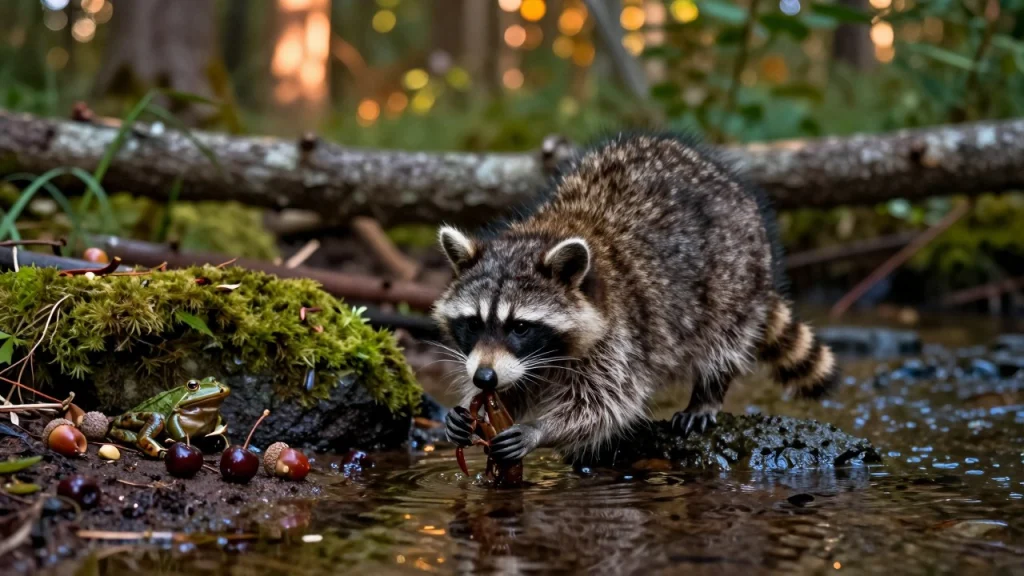
Raccoons eat both plants and animals based on whatever is available nearby, including nuts, berries, crayfish, and discarded human food. They also consume tubers, seeds, insects, frogs, fish, rodents, and bird eggs. In towns, they frequently supplement their meals by scavenging backyard produce, compost heaps, and unsecured garbage cans.
Raccoons eat almost anything, and that is the honest answer to the question. The species is an opportunistic omnivore, so its menu simply reflects whatever is available nearby. Wild raccoons are neither dedicated hunters nor dedicated fruit eaters, and in many habitats plant foods contribute more to the diet than animal foods do.
The animal side is broad too, with invertebrates outweighing vertebrates, and a short list covers most of a wild raccoon’s intake: crayfish, insects, rodents, frogs and bird eggs. Carrion from animals run over on the road gets used by some raccoons as well. The result is a forager willing to try nearly anything, in the water or on the ground.
What plant foods make up the menu
Wild fruit and nuts form the core of the plant side of the diet, and which items appear depends on the trees and shrubs growing nearby. Where people grow food, the selection widens into orchard and garden produce, and cultivated crops can dominate in farming regions. Typical choices include:
- Wild grapes, cherries, apples and persimmons
- Berries and acorns
- Peaches and plums
- Figs, citrus and watermelons
- Beech nuts and walnuts
- Seeds, grains and tubers dug from the soil
Corn deserves its own line, because in some areas it is the most important item in the entire diet.
Animal food taken from water and land
A large share of the wild catch happens in water. Raccoons are nocturnal foragers with quick paws, and they seize crayfish, frogs and other aquatic creatures. On land they pull mice and insects out of hiding and raid nests for eggs, and fish show up on the plate too. Habitats with standing or slow-moving water close by tend to carry the most food, which is why the species is found almost everywhere alongside lakes, streams and ponds rather than in dry country.
Carrion is opportunistic by definition, and roadkill can be a reliable, if grim, source of calories for a hungry individual.
Raccoons inspect food with their paws
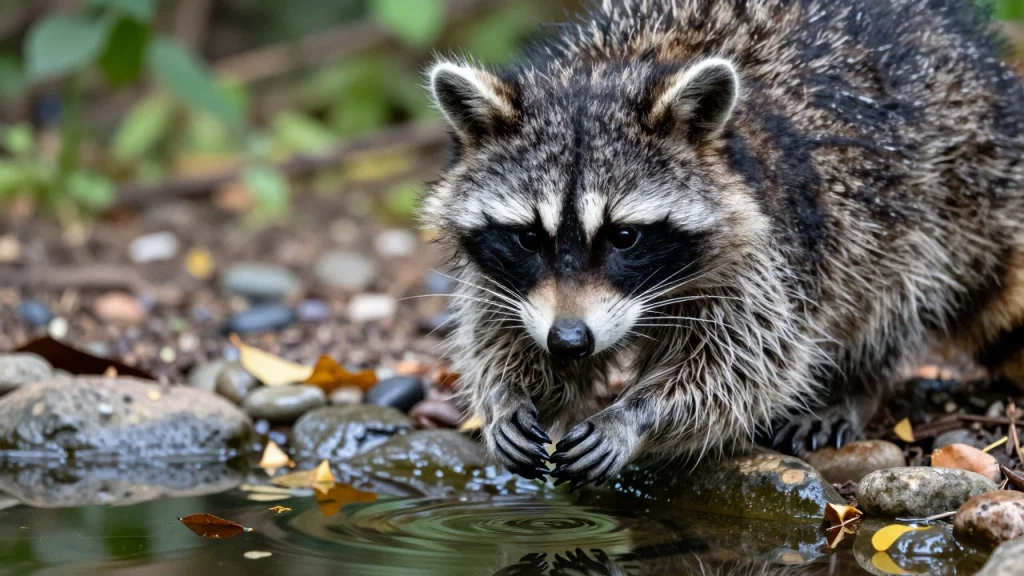
Raccoons do not simply bite and swallow what they find. They have a highly developed sense of touch, and their forepaws resemble slender human hands, sensitive enough to pry open a crayfish claw or work a fastened lid. Food is usually picked up in the front paws before it reaches the mouth, and their long, dexterous fingers are adapted to find and handle a wide variety of fare.
That habit explains the most famous thing about them. The habit of dunking food is so closely linked to this animal that washing its meal is the first thing most people assume. Paws this dexterous have defeated locks and trash can lids in suburban yards.
How the menu shifts through the year
Autumn is a fat-building season, when raccoons concentrate on fatty nuts and seeds to get them through the coming winter. Deep winter is closer to a fast: they spend weeks inside a den without eating at all. They do not hibernate, living off stored fat reserves instead, and that winter fast can cost up to 50 percent of body weight.
Movement narrows in the cold months too. They stay near a den they are comfortable in and range outward only as far as hunger requires. Typical home ranges measure 1 to 3 km across, though western populations can spread to 10 km. In between meals they move in a straight line between den and rich food patch, which suggests they know where the good spots are and head straight for them.
When young raccoons start eating solid food
Cubs arrive blind and helpless, and the first weeks are spent on mother’s milk alone. Their eyes open at around 3 weeks of age, and solid food begins at roughly 7 weeks. By about 20 weeks the cubs are out foraging with her at night, and they stay with her through their first winter.
What city and suburban raccoons add to the diet
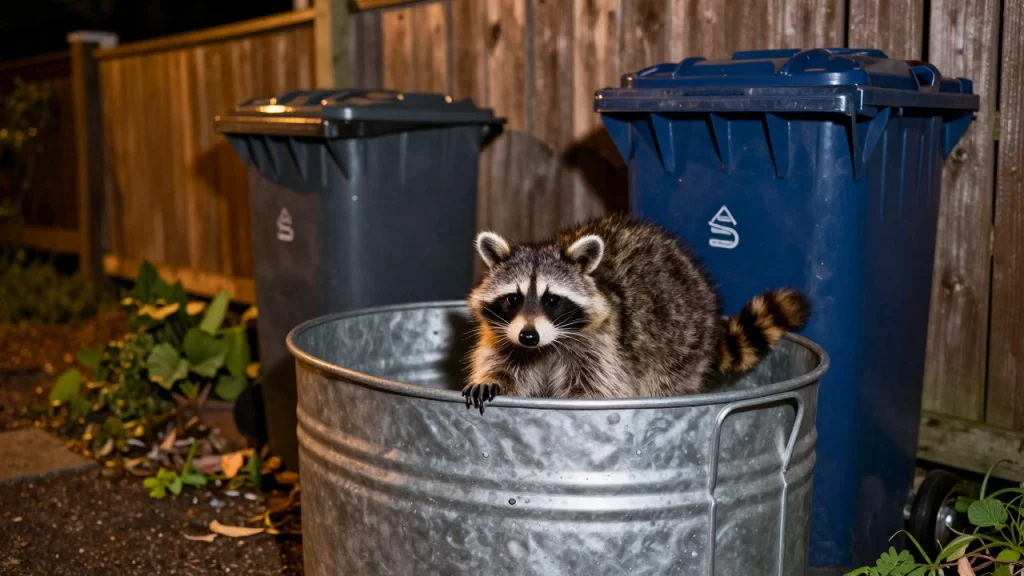
Where people live, the menu tilts sharply toward human food. Suburban and urban raccoons have folded rubbish into the diet, they are known to dumpster dive and feast on human leftovers, and they have even pried open metal garbage cans to get at what is inside. Fruit and plants from gardens and farms get taken as well.
Other raccoon species eat differently
The genus holds species with much narrower tastes. The crab-eating raccoon, Procyon cancrivorus, has a diet that leans on fruit in a way the northern raccoon’s does not. It also takes a wide spread of animal food:
- Invertebrates
- Crustaceans
- Insects
- Nuts and vegetables
- Fish, frogs and small turtles
The Cozumel raccoon, Procyon pygmaeus, is the most specialized of all. More than 50% of its diet consists of crabs, with fruits, insects, crayfish and other animals, vertebrate and invertebrate alike, supplying the rest depending on availability. It is found nowhere else, being confined to a single 486 square km island lying about 17.5 km from the shore of the Yucatan Peninsula in Mexico.
Status, lifespan and why the diet matters
The common raccoon is listed as a species of Least Concern. Adult body mass ranges from 1.8 to 10.4 kg. Lifespan in the wild is much shorter than the maximum suggests: an individual can reach 16 years, but most never see a second birthday, and those that clear that early danger average about 5 years in the wild. The Cozumel raccoon, by contrast, is considered critically endangered, with a population that includes fewer than 250 mature individuals.
So the short answer: almost anything reachable. The balance between plants and animals shifts with water, season and neighbourhood, and that flexibility, not any single food source, is what lets raccoons live from wetlands and woods to city streets.
What do raccoons like to eat most?
Insects and larvae rank among a raccoon’s favorite foods, according to the University of Maryland Extension, even though the animals consume almost anything from plants or animals. According to the University of California Statewide IPM Program, sweet corn is especially desirable to raccoons. In certain areas, corn becomes the most important single component of their overall diet.
Do raccoons eat chickens and their eggs?
Raccoons prey on penned poultry when they can reach them. At certain times and places, raccoons focus their feeding on bird and turtle eggs, insects, crayfish, crabs, frogs, fish, and small mammals.
What foods attract raccoons to a yard?
Pet food left outside overnight provides a high-ranking food resource, while bird feeders serve as a dependable extra food source. Gardens and homes attract raccoons because they provide food and potential den sites.
Sources
- Animal Diversity Web: Procyon lotor (Guadeloupe raccoon) | INFORMATION | Animal Diversity Web
- San Diego Zoo Wildlife Alliance: Raccoon | San Diego Zoo Wildlife Alliance
- National Geographic: Raccoon | National Geographic
- U.S. National Park Service: Raccoon – Missouri National Recreational River (U.S. National Park Service)
- Animal Diversity Web: Procyon pygmaeus (Cozumel raccoon) | INFORMATION | Animal Diversity Web
- Animal Diversity Web: Procyon cancrivorus (Crab-eating raccoon) | INFORMATION | Animal Diversity Web
- University of California Statewide IPM Program: Raccoons
- University of Maryland Extension: Raccoons
- University of Florida IFAS Extension: Northern Raccoon