
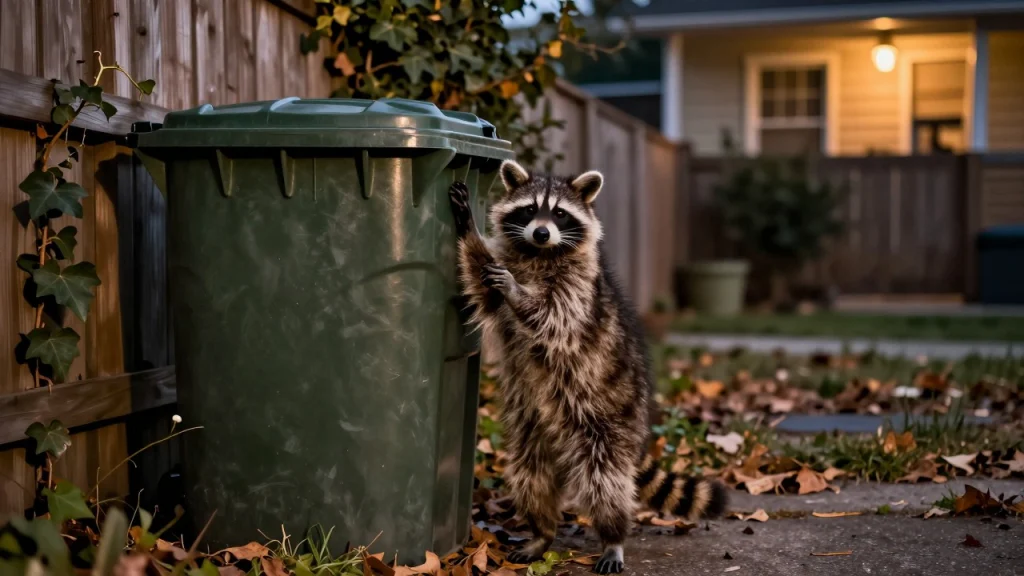
Raccoons remember, and researchers are finally putting numbers on it. In the strongest field work so far, wild raccoons held on to a learned foraging skill for months at a stretch, with an average retention window close to a year, and one tagged animal re-opened a puzzle she had already solved in an earlier year.
What has not been demonstrated is that a raccoon stores a mental picture of you as a person. What the research does show is that raccoons learn what humans mean, in terms of food, safety and routine, and that the lesson lasts far longer than a single encounter.
What field tests can and cannot measure
Raccoon memory is usually measured with hardware instead of guesswork. One team fitted a radio-frequency identification reader to a food dispenser in Laramie, Wyoming, so wild visitors were logged one by one. Another group set multi-compartment puzzle boxes in residential yards and again read every visitor by tag.
The hardware mimics real behavior. Living beside people, raccoons spend a lot of their time forcing lids off plastic bins, bags and bottles, so a task that demands dexterity reproduces something they already do at garbage cans. Ability still varies widely: of 35 raccoons offered a single-solution box, eight solved it, roughly 23 percent of those tested.
Retention runs for months, not a few encounters
The clearest measurement comes from a field study where puzzle containers sat in protected areas split into recreation zones, where people are present, and preservation zones, which are left largely alone. The average gap between an animal’s last trial in one season and its first in the next was 348 ± 7 days, and the researchers found no evidence of a shift in how often those raccoons succeeded.
What was learned in autumn was therefore still intact the following summer. That matters because winter can mean weeks in a den with no meals, so a skill has to survive a long stretch with no practice. On their reading, the retention time spans many months and averages close to a year.
Earlier laboratory work, reviewed in the same paper, found trained raccoons holding problem-solving knowledge for up to 286 days, and a researcher who tested them in 1907 concluded the ability lasted more than a year. Those figures come from captive animals, so read them as a ceiling rather than a promise about the animal under your deck.
The most vivid single result came from a residential backyard, where one adult female met a single-latch box in two consecutive years and came back with the latch still solved, which the authors take as proof that a raccoon can recall an innovation across a long gap. Her speed told the same story: less than 5 s to open her first door in the later season, after more than 31 s the year before.
Figures from cages need care. Wild-caught raccoons tested in captivity completed many more reversals, a test that flips an established reward association to see whether the animal can change its behavior, than the same kind of animal tested outdoors, a mean of 27 against 13.
The authors blame the gap on vigilance and social interference, since a wild raccoon still has to scan for rivals while it works.
The memory system is built for the fingers
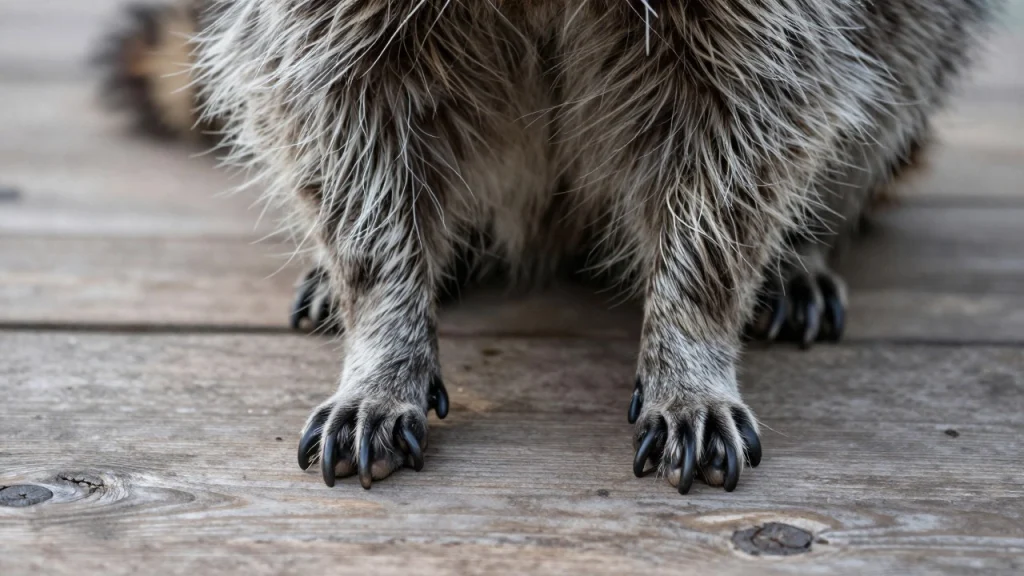
Raccoons lean on touch more than sight. Their front paws are shaped like slender human hands, which makes them unusually dexterous, and the density of sensory cells in those paws runs four to five times that of most mammals, with about 75 percent of the sensory-processing part of the brain given over to touch. San Diego Zoo Wildlife Alliance notes that they have been known to work locks and raid bins for food, which is exactly the sort of motor solution a raccoon keeps.
What raccoons learn about people is habituation, not trust
Habituation is what happens when an animal cuts its response to a stimulus that turns out to be harmless, and exposure drives the change. In the Laramie work, young raccoons lost their wariness of the device fastest, yet they did worse than adults once the reward rule was reversed. The animals that worked the device out in the wild were the docile ones, so a raccoon’s tolerance of people and its learning ability look linked. A bold raccoon at your bin is not a tame one.
Field evidence ties that tolerance to us directly: in Quebec, only the raccoons in the recreation zones, where human routines make food predictable, improved their success rate from one trial to the next. Managers list unwanted habituation, alongside disease risk, property damage and contact with pets, among the reasons to keep contact between people and raccoons low. And because raccoons are primary carriers of rabies, approaching a relaxed-looking animal is a bad idea.
The map a raccoon remembers is small
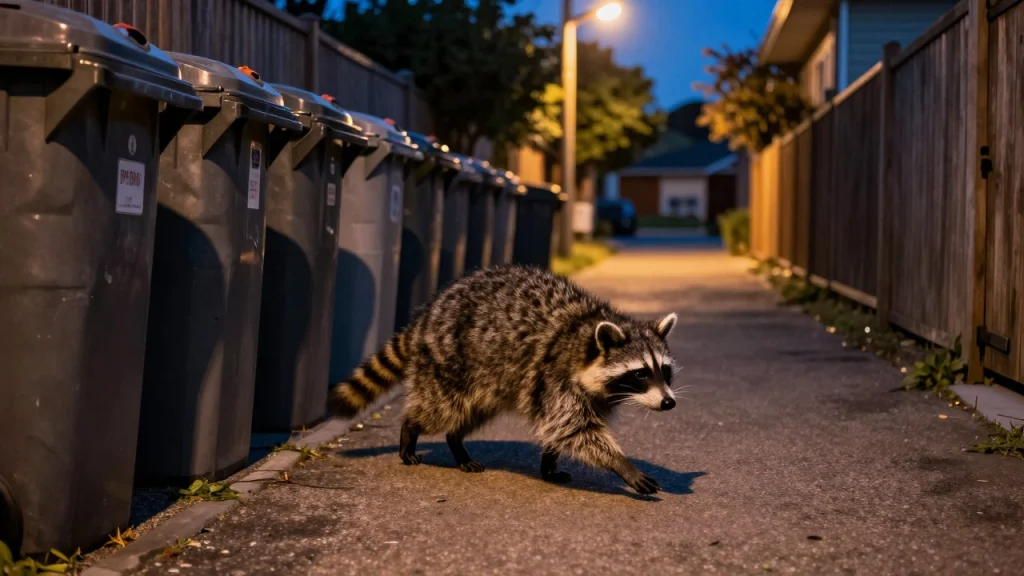
The everyday version of the question is about your property, and raccoons do learn a local map. Home range diameters typically run 1 to 3 km and reach 10 km in the western part of the range, and individuals beeline between the den where they sleep and the richest feeding patch they know. Trash from people is part of the diet in suburban and urban areas, so a bin that is always full is a landmark worth keeping in mind.
Tree hollows are the favorite dens, but the species is flexible about the rest:
- Burrows left by woodchucks
- Caves and mines
- Empty farm and town buildings, including barns and garages
- Storm drains and houses
- Chimneys, attics and the crawl space under a home in city areas
Is it the same individual each summer? Researchers can tell raccoons apart, and in one puzzle study the variation in solving technique between raccoons was larger than the variation inside a single animal, so each one worked in its own signature style. Among themselves the black mask doubles as an identification feature. Since the species is nocturnal, spends its nights out of sight and is usually solitary, the only real groups are mothers with young, and the number of raccoons a person can get to know is small.
Lifespan puts a ceiling on memory
A raccoon in the wild can reach 16 years of age, but most are dead before their second birthday, and the usual killers are people, through hunting, trapping or cars, plus malnutrition. The animal that learns your habits is therefore unlikely to still be around a decade from now, and many never reach two summers.
Status and what to expect
The species is not in trouble, since the IUCN Red List classes it as Least Concern, and San Diego Zoo Wildlife Alliance points out that few native North American species have held their ground against urban growth the way raccoons have. Remembering places is the same talent that lets them live in cities at all.
So the answer has layers. A raccoon remembers your yard, your bins and your routines for months, and sometimes from one year to the next. What it learns about you personally is that you are harmless or that you are a food source, and that judgment is refreshed at every visit rather than stored as a name. Keeping garbage sealed and never offering food keeps that arrangement one-sided, and it is the only reliable way to stop a wild raccoon’s memory of your house from working in its favor.
Sources
- Animal Diversity Web, University of Michigan: Procyon lotor (Guadeloupe raccoon) | INFORMATION | Animal Diversity Web
- San Diego Zoo Wildlife Alliance: Raccoon | San Diego Zoo Animals & Plants
- Behavioral Ecology, Oxford University Press: Exposure to humans and task difficulty levels affect wild raccoons (Procyon lotor) learning
- Journal of Experimental Biology: Environmental, individual and social traits of free-ranging raccoons influence performance in cognitive testing
- Proceedings of the Royal Society B: Biological Sciences: Wild raccoons demonstrate flexibility and individuality in innovative problem-solving
- National Geographic: 5 Fun Facts About Raccoons