
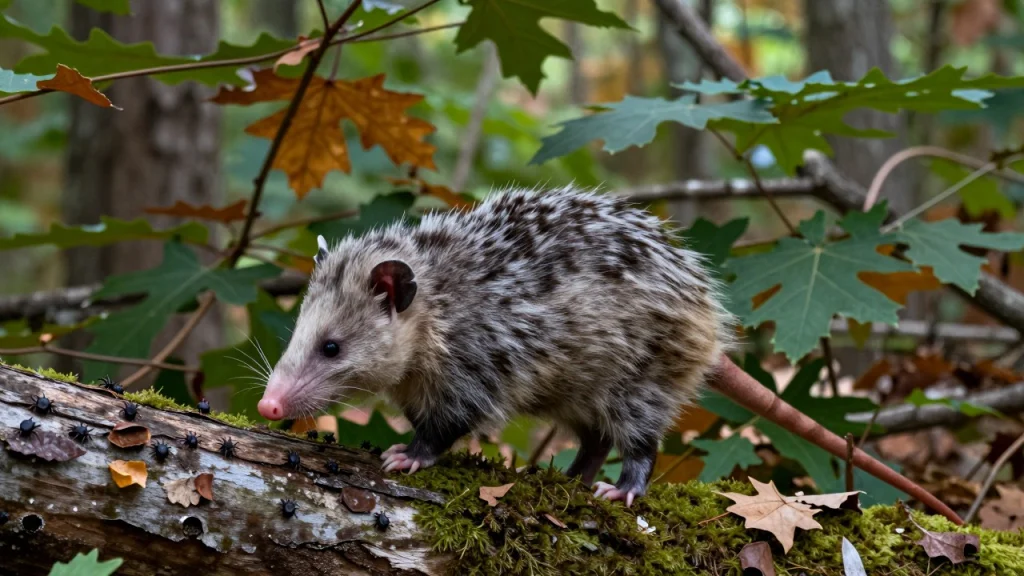
Probably not, at least not in the huge numbers the popular story claims. The idea that opossums are living tick vacuums spread widely online, but the evidence behind it is thin. Later work looked inside wild opossums and found no ticks at all.
The myth is easy to follow once you see where it started. A lab experiment suggested that opossums remove ticks by grooming, and a calculation turned that into a giant yearly tick body count. Here is how that happened, what dissections found, and what opossums really eat.
Where the opossum tick myth came from
The claim goes back to a study of how different animals host blacklegged ticks (Ixodes scapularis). Researchers kept four opossums in a lab and placed 100 larval blacklegged ticks on each one.
Other animals were tested too. After four days, the team counted the ticks that had fed and dropped off.
Only a small share fell off the opossums. On average, just 3.5 ticks dropped from the four animals, roughly 3 percent of those placed on them. Compared with the other test animals, the opossums were far better at ending up with fewer ticks on their bodies, as a news report on the work put it.
From lab result to the 5,500 ticks claim
The authors assumed the missing ticks had been groomed off and swallowed. A news account of the study repeated that more than 90 percent were groomed away and swallowed.
The researchers then worked backwards from wild opossums. They reasoned that if 97 percent of ticks were eaten and only 199 were counted on wild animals, the opossums must be hosting more than 5,500 larval ticks. That figure became the famous “5,500 ticks” line.
Why the tick eating claim does not hold up
The weak point is the assumption itself.
A critique points out that ticks may simply have stayed put. It notes that after four days the parasites were probably still on the opossums, feeding slowly. Ticks also feed more slowly at lower temperatures and on hosts with lower blood pressure, and opossums fit that description.
What dissections found
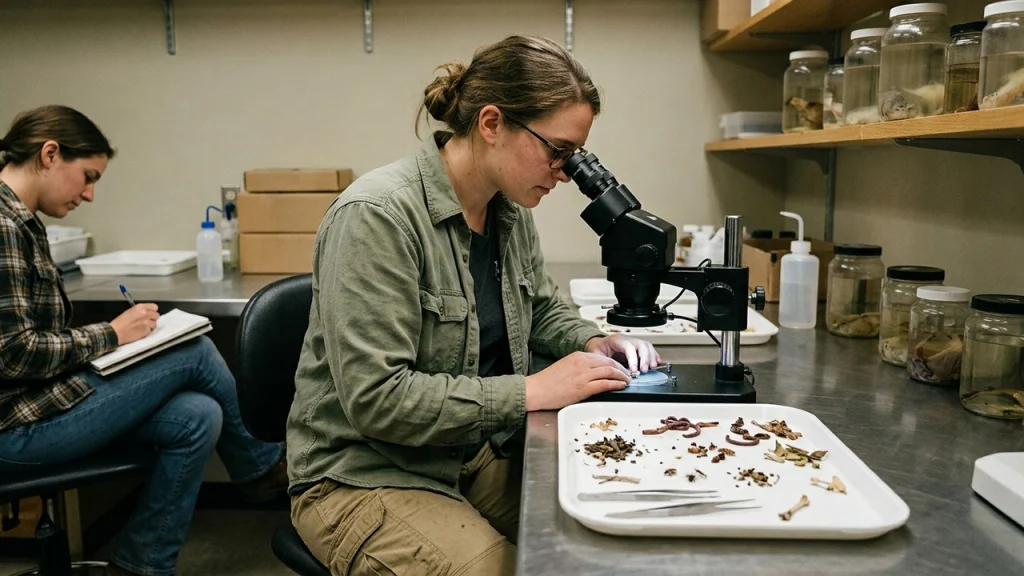
A later study from central Illinois tested the idea directly. Researchers searched the contents of 33 opossum stomachs with a dissecting microscope, bit by bit.
The stomachs held worms, a single French fry, pieces of broken glass and a shrew that was mostly undigested. No ticks turned up. The team did find three intact fleas, which might hint at some grooming, but still no ticks.
The team also combed the literature and found 23 published accounts of opossum diets. Together they covered over 1,280 opossums from across the United States, and not one reported ticks in the stomach or anywhere else in the digestive tract.
One extension educator summed up the reaction to the new work by saying the field may have been a bit hasty about the “possums eat 5,500 ticks per week” idea.
What opossums actually eat
Opossums are not picky. The Animal Diversity Web describes the Virginia opossum as an extremely opportunistic feeder, and its menu changes with season, habitat and range. The diet spans vertebrates, invertebrates, plants, fruit, grains and carrion.
Season shifts the balance. In colder months small vertebrates take up more of the diet. In warmer months opossums lean toward invertebrates, plant material, fruits and seeds.
Across the United States, stomach studies usually point to a mix in which mammal tissue makes up 14 to 27%, fruits, seeds and bulbs 10 to 18%, grasses and leaves 6 to 11%, insects 3 to 13.5%, earthworms 5.5 to 9% and birds 3 to 5%.
In Portland, Oregon, stomach analyses showed garbage making up as much as 9% of an opossum’s diet, with pet food adding another 9%. So the animal is a flexible scavenger, not a specialist that hunts parasites.
Life as a night-shift forager
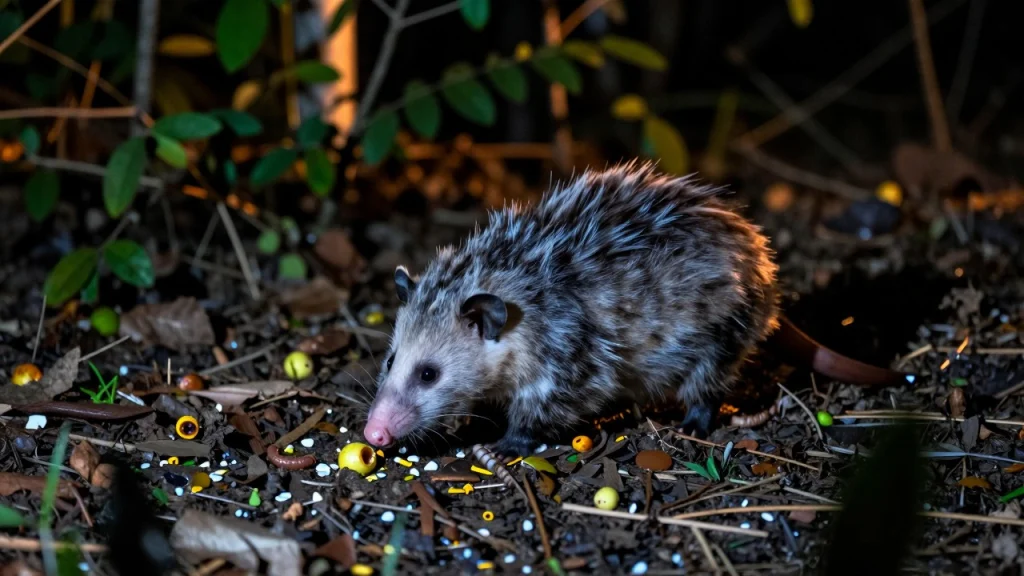
Virginia opossums are solitary and nocturnal. They live mostly on the ground, yet they climb well and may den in trees.
Their range is wide. Today they occur from Costa Rica to southern Ontario, Canada. In the wild they typically live only 1.5 to 2 years.
Should you attract opossums to control ticks?
No. Because the tick benefit is unproven, opossums are a poor reason to change your yard. Putting out food and shelter can also attract other animals, including raccoons, feral cats, rats, mice and other rodents.
Opossums still play a useful role as scavengers and generalist feeders. Just do not count on them to clear ticks from your property. Tick checks, tidy vegetation and repellents do that job better.
The short answer
Opossums might swallow the odd tick by accident, but the best evidence shows no sign that ticks are a real part of their diet. The famous number came from an assumption, and the stomach data do not support it. Enjoy opossums for what they are: tough, adaptable omnivores.
Sources
- Animal Diversity Web: Didelphis virginiana (Virginia opossum)
- Outdoor Illinois Journal: Debunking the Myth: Opossums Don’t Eat Ticks
- University of Illinois Extension: Reassessing the opossum-tick relationship: Is it a good idea to attract opossum’s to your yard?
- Cary Institute of Ecosystem Studies: Opossums – killers of ticks