
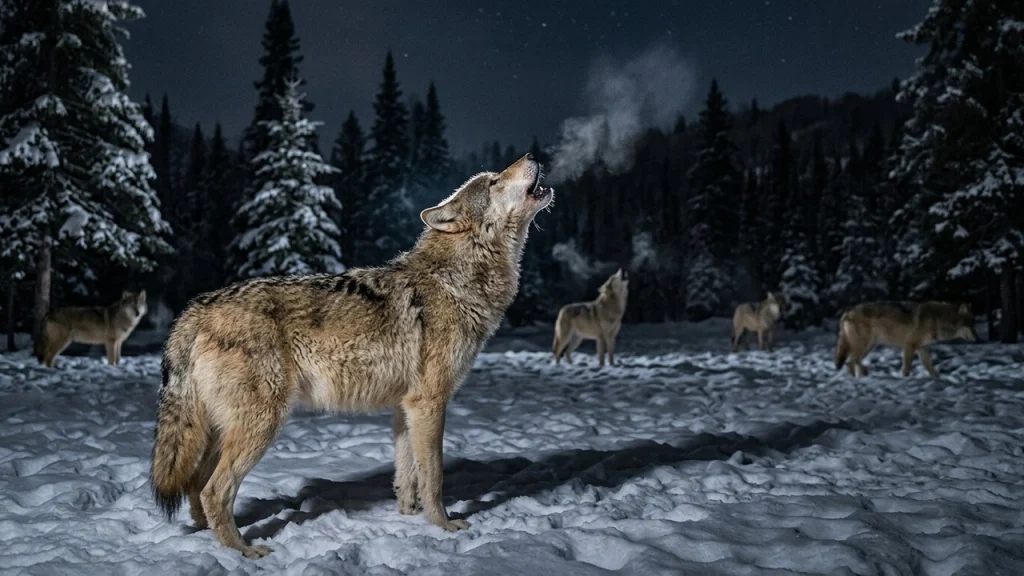
The call does several things at once: it holds scattered members together, fires a pack up for a hunt, and states a territorial claim over long distances. The Smithsonian’s National Zoo says howling may be heard at night. Wildlife biologists still cannot account for every reason wolves howl, and the popular idea that the howl is aimed at the moon is a myth.
Researchers with the U.S. Geological Survey recorded 605 spontaneous chorus howls and 224 solo howl series across a total of 1,225 pack-days between 2018 and 2021, in a study covering 24 wolf packs at six study areas across North America, Asia and Europe. Those group howls generally reached their high point after dark and before dawn. The U.S. National Park Service puts the same pattern more simply: calling comes more often in the evening and early morning, and most of all during winter breeding and pup rearing.
What the howl is for
The call works as a signal that tells pack members where each one is and when to gather for group hunts. Animal Diversity Web notes that the species hunts as a group mainly on prey as large as moose, elk, bison, musk oxen and reindeer.
The National Park Service says howling is probably secondary to scent. Individuals also differ in their calls, and other wolves pick up on those differences from 6 to 7 miles away.
Why night and early morning stand out
Calling picks up during breeding season, which for gray wolves runs from January through April. The National Park Service puts February at four times the May rate, a figure drawn from a decade of records holding more than 11,000 howls. That yearly pattern tracks the annual cycle of testosterone and estradiol measured in wolf blood, and the National Park Service reads it as evidence that reproductive condition shapes howling all year rather than only in the breeding season.
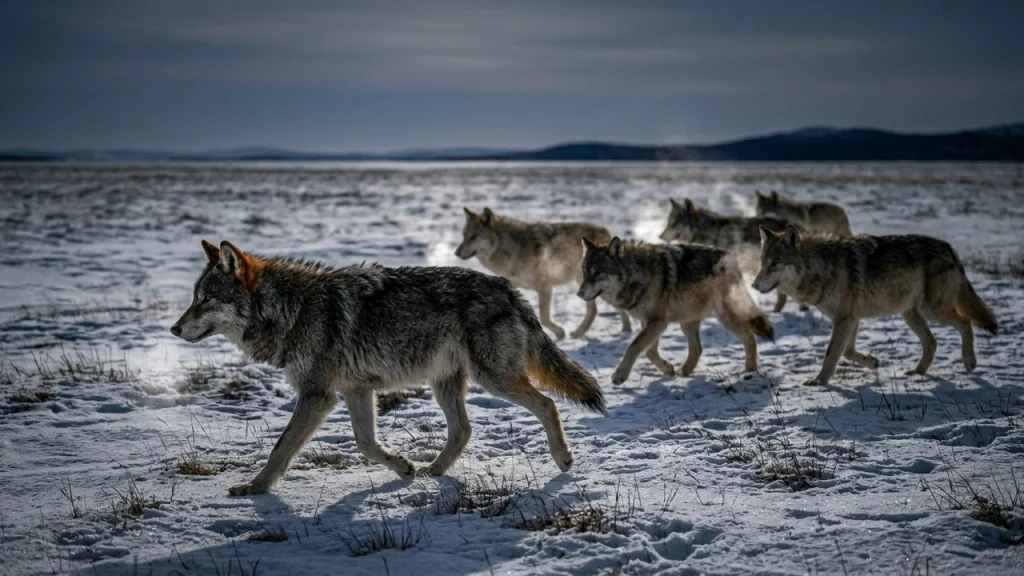
Animal Diversity Web reports that wolves usually move at night over long distances, sometimes covering as much as 200 km in a day at a typical 8 km/hr. The Smithsonian’s National Zoo says a pack usually numbers five to eight individuals, though one pack of 36 has been reported.
Whose howl answers back
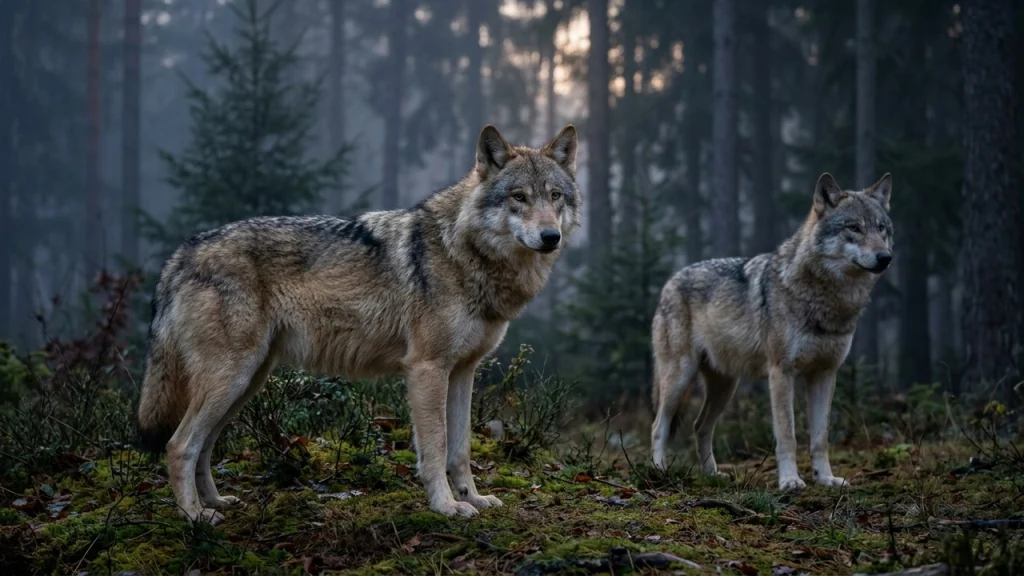
The National Park Service tallied 1,509 answering howls from pack mates and from wolves outside the pack. From October to the end of February, wolves from outside the pack replied more and more often than pack mates did, and in the denning and summer months almost every answer came from inside the group.
Wolves pick out the harmonic overtones in each other’s calls well enough to know who is calling from a distance, and a higher level of excitement carries in the pitch of the voice. Work by Palacios and colleagues from 2007, cited by the National Park Service, found structural differences in the base frequencies of the calls of different wolves.
Howls that answer a single call
A wolf cut off from its group uses a shorter call that climbs in pitch. Once the pack answers, the separated animal switches to low, even notes that give the group a bearing. A National Park Service account describes a wolf lifting its head and sending out short, deep calls that shifted both upward and downward in pitch; the first attempt drew nothing, and the second brought several wolves to their feet and heading that way.
Calls triggered by people, bears, vehicles or wolves from outside rank among the most dependable triggers. The National Park Service also says wolves may call before and after a hunt and to raise an alarm, and one account ends with the resident pack killing the wolf identified as 302 after several days. The same service reports having seen howling precede several other wolf deaths.
What is still unsettled
Two questions stay open. The National Park Service says nobody yet knows whether wolves produce referential calls. How much they call also shifts with the area, the size of the group and how many people live nearby, with higher rates where fewer people do. The U.S. Geological Survey says the high rates recorded in Yellowstone National Park, which had more than 800,000 visitors during the study, could reflect wolves accommodating to human activities such as wolf watching.
One species account puts pack territories anywhere from 130 to 13,000 square kilometers, held against intruders.
Sources
- U.S. National Park Service: Why Wolves Howl
- U.S. National Park Service: Wolf Ecology Basics
- Smithsonian’s National Zoo: Gray wolf
- Smithsonian’s National Zoo and Conservation Biology Institute: Why Do Wolves Howl? And Other Top Wolf Questions Answered
- Animal Diversity Web: Canis lupus (gray wolf)
- U.S. Geological Survey: Automatic recorders monitor wolves at rendezvous sites: do wolves adjust howling to live near humans?