
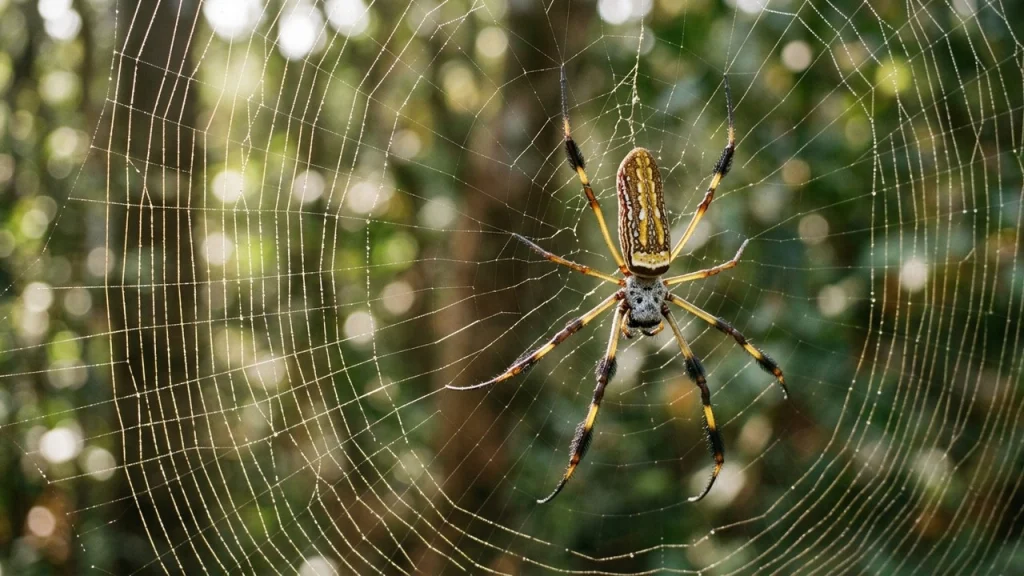
It depends on the silk: one spider silk variety measures just above 1 GPa in tensile strength, inside a steel range that runs from 0.2 GPa to nearly 2 GPa, while a study in Proceedings of the National Academy of Sciences found values of up to 3 GPa.
Weight changes the comparison. The University of Cambridge’s Department of Engineering says the strength to density ratio of silk, measured per unit of weight, is higher than steel’s, and silk is almost six times less dense than the metal. That is a per-weight result rather than a statement about raw strength.
How the two materials compare on strength
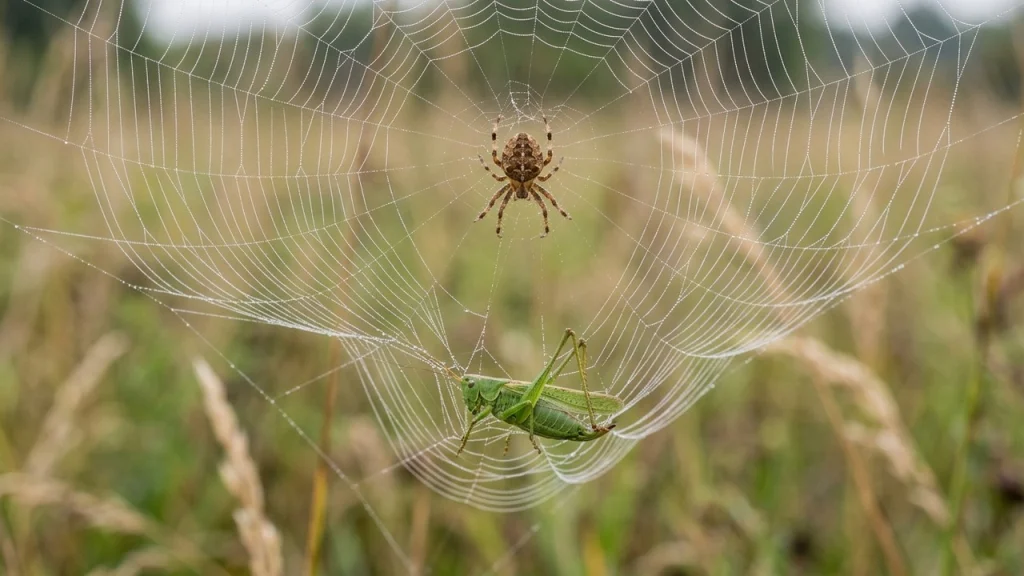
Silk also loses out on another property. It is many times less stiff than steel.
Which silk is the strongest
Spiders spin more than one kind of fiber, and the differences matter. Orb-weaving spiders carry many glands, and those glands make seven distinct silks that do different jobs and behave differently under load. A review in Advanced Science says the MA glands produce dragline silk, also called the lifeline, which spiders use to escape predators and which also serves as frame thread and web radius material.
Among everything a spider produces, that dragline reaches the highest tensile strength. The same review gives MA silk from C. darwini at 1652 MPa tensile strength with toughness of 354 MJ, higher still. A different kind of ranking comes from the San Diego Zoo Wildlife Alliance, which names the golden orb weaver as the producer of the strongest silk of any spider.
What gives dragline silk its properties
The fiber is built from proteins. Silk consists almost entirely of large ones, and dragline silk draws on spidroins: the major ampullate spidroin 1 (MaSp1) and major ampullate spidroin 2 (MaSp2). A review in Advanced Science describes spidroins as high molecular weight proteins, typically 250 to 400 kDa.
Structure does the rest of the work. According to that review, beta sheets gather into crystalline regions set inside an amorphous matrix, where they act as crosslinks and add mechanical strength, while the amorphous parts supply elasticity. That same review considers the MaSp1 rich outer core to be the main contributor to the tensile strength in spider silk, with MaSp2 playing no direct part in it and serving elasticity alone.
Under load the fibers fail in a particular way. Imaging with atomic force microscopy showed that spider dragline and silkworm silk both consist of twisted nanofibril bundles measuring 30 to 35 nm across, and the review notes that stretching produces nano-cracks in place of large ones.
Toughness, and what water does to silk
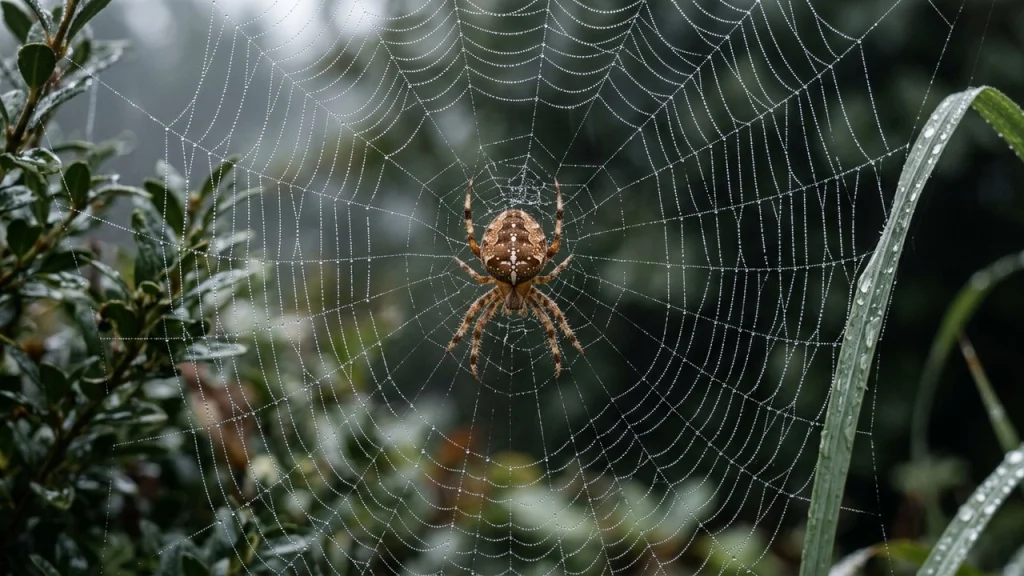
Toughness is measured separately from tensile strength. A review in BioScience puts the toughness at two to three times that of synthetic fibers such as Nylon or Kevlar, and a Proceedings of the National Academy of Sciences study describes spider silk as one of the toughest natural materials anywhere. That work gathered more than 1,000 spiders and looked at the physical properties of their dragline silk, recording toughness as high as 0.45 GJ/m3 next to the 3 GPa tensile figure, and strain at break of up to 60%.
Other silks report different toughness values. Aciniform silk, the kind used to wrap prey, reaches 376 MJ/m3, which is more than any other spider silk.
Moisture moves silk too. The same Proceedings study notes a tendency to lose up to 60% of its length when wet, a change called supercontraction, and once relative humidity goes past 60% a dragline fiber swells while its length falls by more than 50%. A review in Advanced Science says supercontraction could tighten the web in rain or dew, keeping its integrity and shape.
Conditions also explain why published figures disagree. The Proceedings of the National Academy of Sciences work says its own measurements may shift a good deal with outside factors such as humidity and silking speed, which makes results from different literature hard to compare directly.
Where silk and steel come from
The two materials have completely different origins. Silk is a protein assembled inside living cells at body temperature; steel is made in a furnace.
Researchers have also tried to rebuild the protein outside the spider. A review in Advanced Science reports that artificial silk made from heterodimers reached a tensile strength of 834 plus or minus 34 MPa, an extensibility of 32 plus or minus 1% and a toughness of 143 plus or minus 6 MJ m-3.
Sources
- Advanced Science (Wiley), via PubMed Central: Spider Silk-Inspired Artificial Fibers
- Proceedings of the National Academy of Sciences, via PubMed Central: Molecular mechanisms of the high performance of spider silks revealed through multi-omics analysis
- University of Cambridge, Department of Engineering: Spider silk is a wonder of nature, but it’s not stronger than steel
- BioScience (Oxford University Press), via PubMed Central: The elaborate structure of spider silk: Structure and function of a natural high performance fiber
- Animal Diversity Web, University of Michigan: Araneus diadematus
- San Diego Zoo Wildlife Alliance: Golden orb weaver