
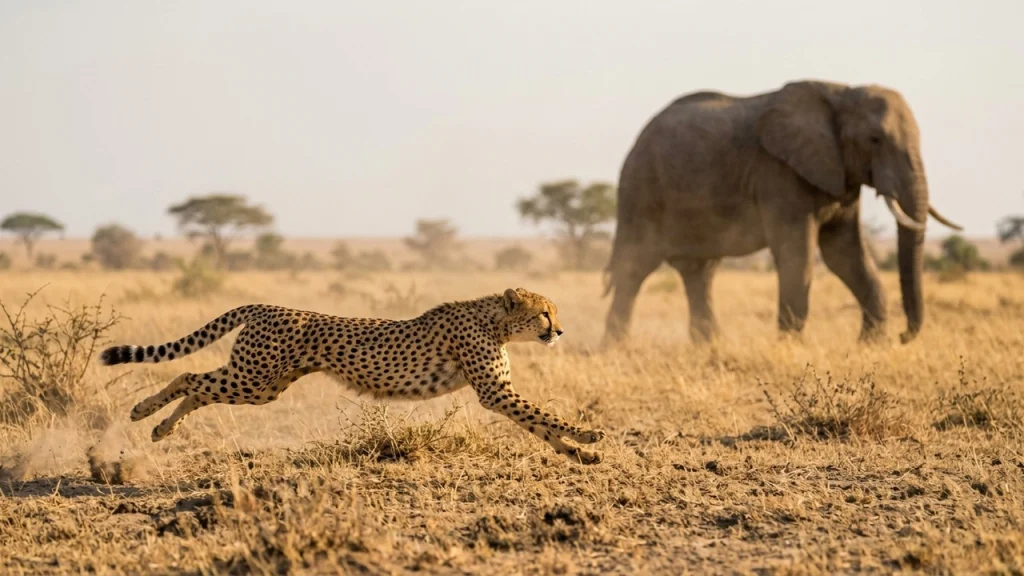
Maximum running speed rises with body mass until it reaches a critical mass, and then decreases. Small animals run up against the kinetic energy their musculoskeletal system can supply, while large animals run up against the work density of their muscle. No giant can be built by scaling a smaller animal up, since the constraints become excessive.
African elephants are the largest living terrestrial organisms, and Animal Diversity Web says they have a regular pace of 6 km per hour and can reach speeds of up to 24 km per hour when running.
How gravity takes a share of muscle work
A study in Nature Communications reports how much of the work a muscle does goes into holding the body up against gravity. For a large insect of 15 g, gravity consumes 1% of every unit of muscle work. A moderately large reptile of 20 kg, built on the same geometric plan, demands about 10%.
Below a body mass of 10 kg, gravity takes under 10% of muscle work. In a large mammal above roughly 2 t, most of the muscle work goes into gravitational potential energy. The same study models a body with a gear ratio of 0.3 and muscle at about 20% of body mass across all limbs, and a body mass of about 15 t is where static equilibrium would sit.
What the heaviest runners manage on land
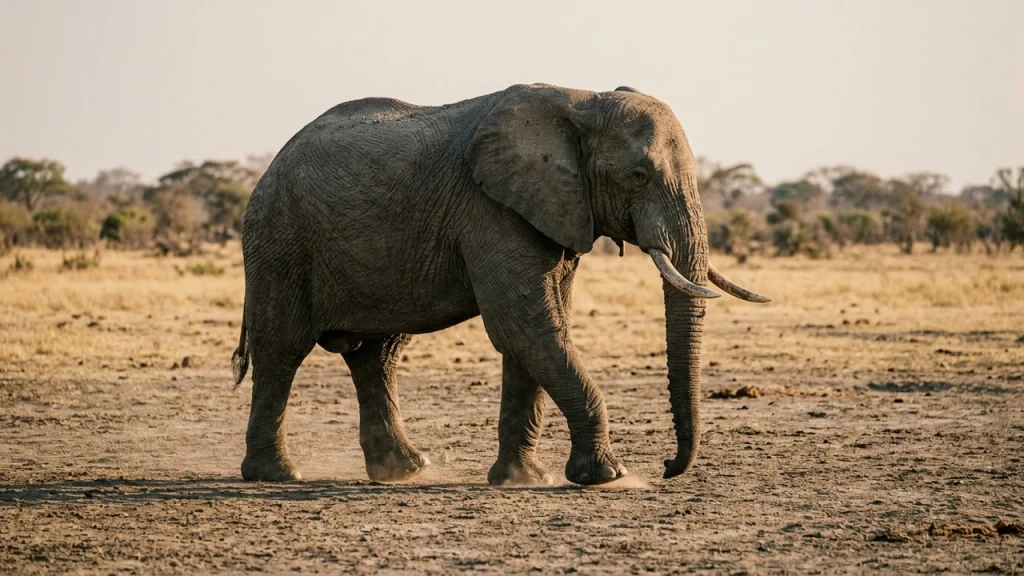
Elephants of 6000 kg and 4000 kg alike reach similar top speeds of about 7 m/s. Hippos of about 3000 kg trot and never gallop, and those large animals top out at roughly 7 m/s. Elephants also never use a gait with an aerial phase, and a review in the Journal of Experimental Biology reports that at giant size whole gaits can be lost.
Stride length and the way an animal stands
In its review, the Journal of Experimental Biology says a big rhinoceros seems able to move faster than an elephant or hippo of similar size, probably because it is built and stands differently. An elephant reaches only 62% of its mass-predicted stride length, while a rhino reaches 100%.
Top speeds across the size range
The San Diego Zoo Wildlife Alliance gives the cheetah a maximum of 70 miles per hour (112 kilometers per hour), and says a cheetah spends more than half of its running time off the ground. A pronghorn holds 55 mph across half a mile, and stays at speeds approaching 45 mph over much longer stretches. No predator in its range comes anywhere near that pace. For a giraffe, the record running speed is listed as 34.7 miles per hour.
The same zoo says a cheetah pants intensely and can reach a body temperature of 105 degrees Fahrenheit (41 degrees Celsius). It then needs about 20 minutes before its breathing and temperature are back to normal.
Walking instead of running
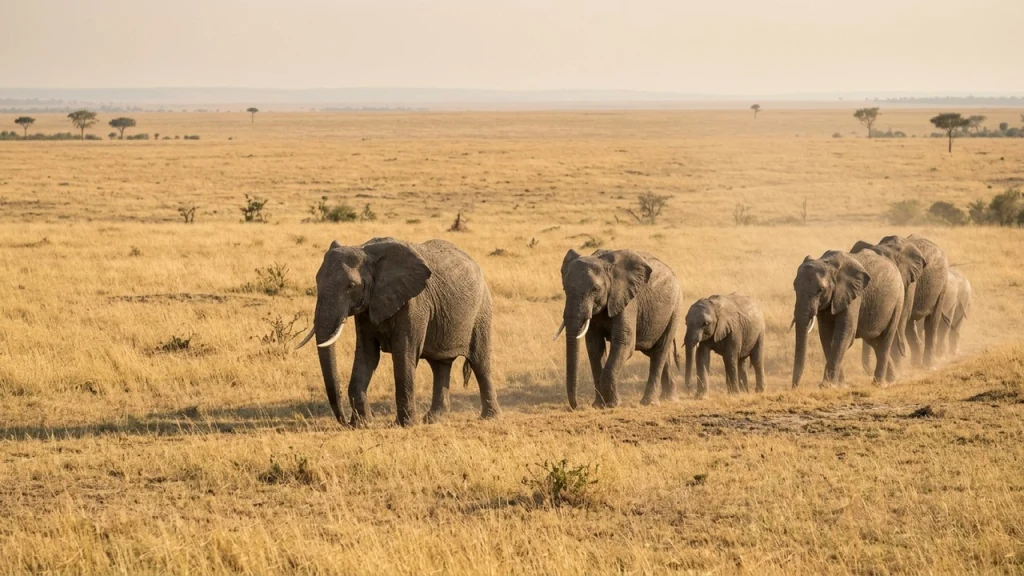
The larger a tetrapod, the slower the walking speed it prefers. African elephants average roughly 10 km walked per day, and giant tetrapods travel farther but migrate a similar number of body lengths compared with smaller ones.
Sources
- Nature Communications: Dynamic similarity and the peculiar allometry of maximum running speed
- Journal of Experimental Biology: The evolutionary biomechanics of locomotor function in giant land animals
- Animal Diversity Web: Loxodonta africana (African bush elephant)
- San Diego Zoo Wildlife Alliance: Giraffe
- U.S. National Park Service: Pronghorn
- San Diego Zoo Wildlife Alliance: Cheetah