
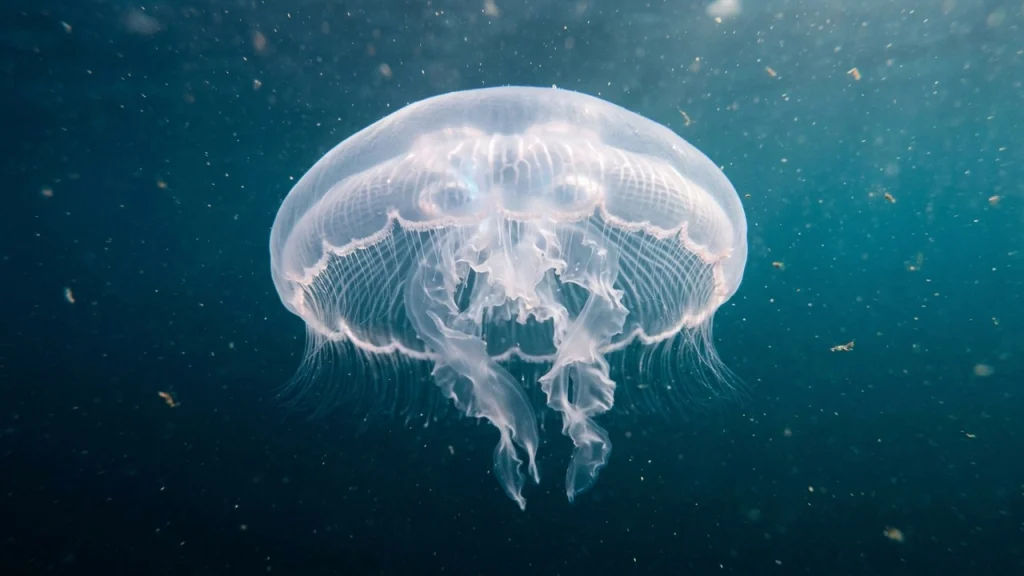
No, jellyfish do not have brains. They manage with nerve nets that pick up cues in the water and shape responses.
The idea of a thinking jellyfish brain is mistaken. Jellyfish form a radially symmetric lineage that appeared more than 500 million years ago lacking any brain. In scyphozoan polyps and medusae there is no cephalization and no brain. Feeding brings together self sufficient parts with no central brain.
Simple bodies run by nerve nets
Jellyfish bodies are mostly water, at about 95 percent, according to the National Oceanic and Atmospheric Administration. The same agency lists these animals as lacking blood and hearts. Body parts still produce unified actions through coordinated exchanges between self governing sections, as portrayed in a systems neuroscience study. Radial symmetry lets jellyfish notice food or threats coming from any direction, according to the same agency.
Two linked nets, in outer skin and lining the gut, help time muscle contractions and sensory input, as outlined by the Animal Diversity Web. The same site places their meeting point at marginal sensory clubs called rhopalia. Beneath the swimming muscles, a motor net of mainly large bipolar cells sends electrical impulses through the giant fiber nerve net or the motor nerve net to elicit rhythmic contractions, as detailed in a study of scyphozoan development. The same study describes a diffuse net that gathers input from sensory cells outside the rhopalia and uses slender extensions from multipolar cells.
Senses around the bell edge
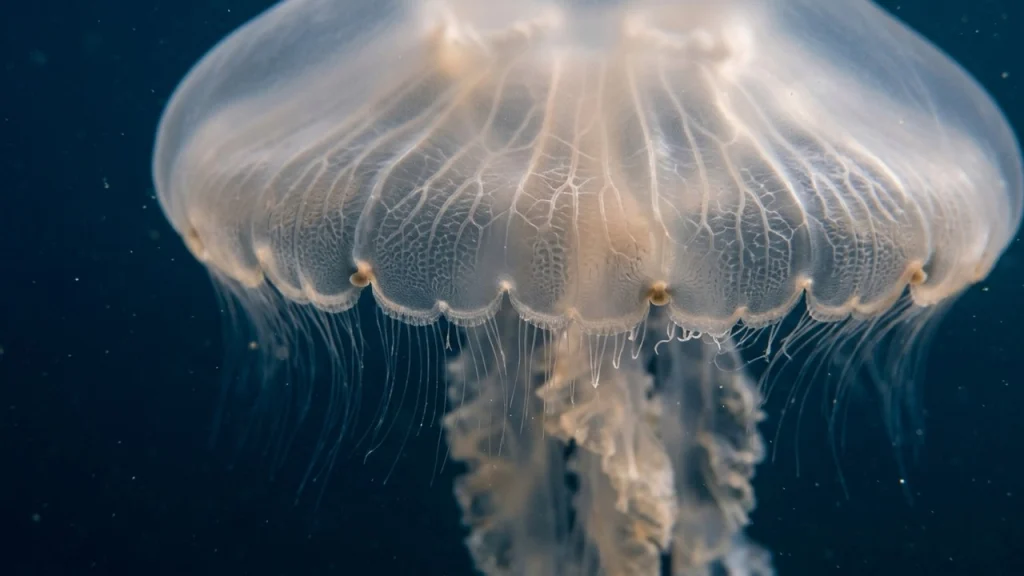
Many rhopalia sit around the rim of the bell, according to the Animal Diversity Web. The same site credits internal statocysts with judging depth, feeling gravity and steadying upright posture. Tilt could shift weight from the lithocyst and bend nearby tissue, a flex that may aid gravity sensing, as outlined in a study of scyphozoan development.
Some jellyfish carry ocelli that register shifts in light and support daily vertical movement to avoid predators and assist foraging, as noted by the same site. In certain species, light sensitive eyespots line the bell margin, according to the same site.
Feeding and folding without a brain
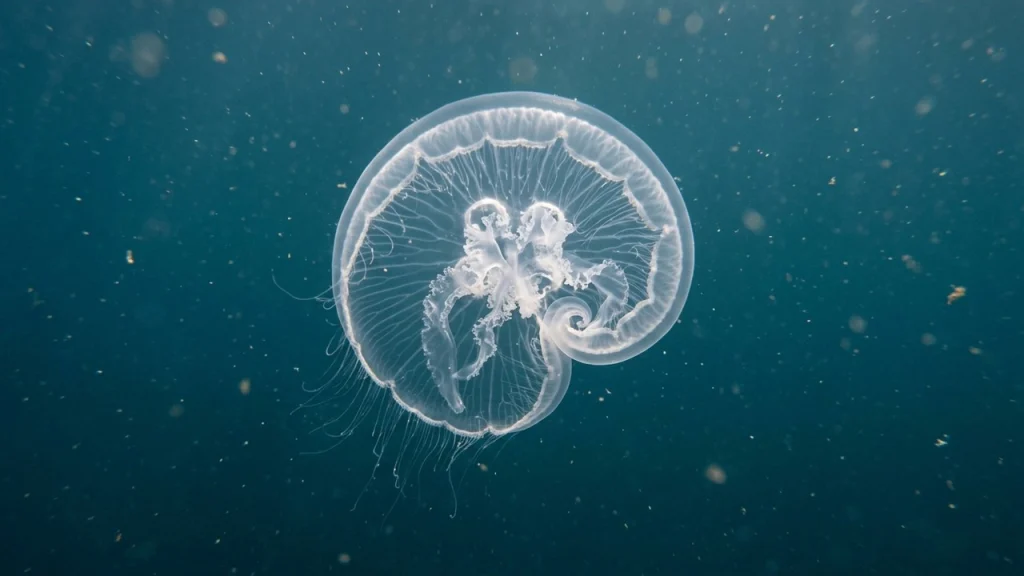
Directional folding of the umbrella margin is steered by distinct subassemblies that tile the surface, revealing order inside a seemingly scattered net, as reported in a systems neuroscience study. The same study traces how cues switch on cells in the marginal ring, which then engage the broader net to drive radial muscles and tuck the edge inward. A peptidergic subnetwork then hands food toward the mouth, with newly active clusters joining across the umbrella during aimed delivery, according to the same study.
Sources
- National Oceanic and Atmospheric Administration: What are jellyfish made of?
- Animal Diversity Web: Scyphozoa: Information
- Animal Diversity Web: Cnidaria: Information
- Animal Diversity Web: Aurelia aurita: Information
- PubMed Central: A genetically tractable jellyfish model for systems and evolutionary neuroscience
- PubMed Central: Development of the rhopalial nervous system in Aurelia sp.1 (Cnidaria, Scyphozoa)