
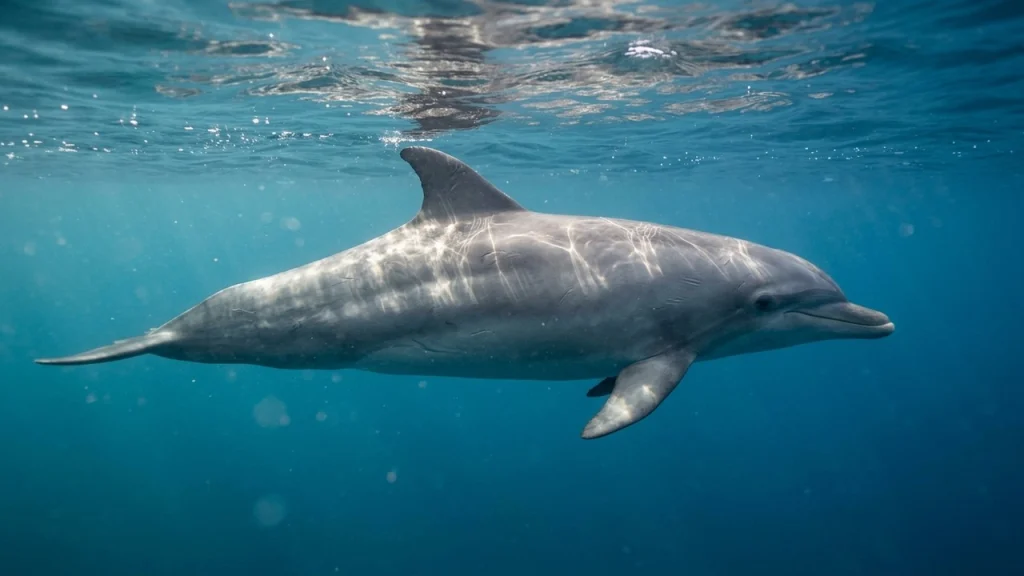
Dolphins sleep with one hemisphere (side) of the brain at a time, and the eye opposite the sleeping hemisphere is usually closed or in an intermediate state, which a chapter in the Handbook of Behavioral Neuroscience counts at 81% to 95% of the time in cetaceans. NOAA Fisheries contrasts this with the sleep of most mammals, in which muscular activity, voluntary behavior and consciousness fall to extremely low levels, and reports instead that whales and dolphins retain the ability to swim and breathe and stay aware in their ocean environment. A review in Nature and Science of Sleep describes a day in which dolphins were awake for almost two thirds of it with a typical bilateral wake EEG pattern, and showed that the USWS pattern filled the remaining daily third.
Among bottlenose dolphins, the Animal Diversity Web describes rest on one side of the brain while the animal stays conscious enough to breathe. According to a chapter in the Handbook of Behavioral Neuroscience, aquatic mammals need to come up for air at regular intervals for breathing, a need that rules out the motionless state which is central to sleep in land mammals.
Why both hemispheres cannot go quiet together
A review in Nature and Science of Sleep notes that swimming and surfacing call for motor activity and reflexes that BSWS and REM sleep, with their reduced or abolished muscular activity, do not allow. According to the same review, BSWS in the delta range never lasted more than a few seconds in dolphins, porpoises and whales. The same handbook chapter reports that cetacean unihemispheric sleep leaves breathing uninterrupted, and that cetaceans resting, swimming or floating in captivity hold their breath rarely longer than 4 min.
A review in Neuroscience & Biobehavioral Reviews names the pressure most likely behind the evolution of cetacean sleep as the need to make up for heat given off to the water, starting at birth and lasting all life. The same review sets out three proposals for what unihemispheric sleep is for: helping movement, making sensory processing more efficient, and helping control breathing.
Reading the eyes during sleep
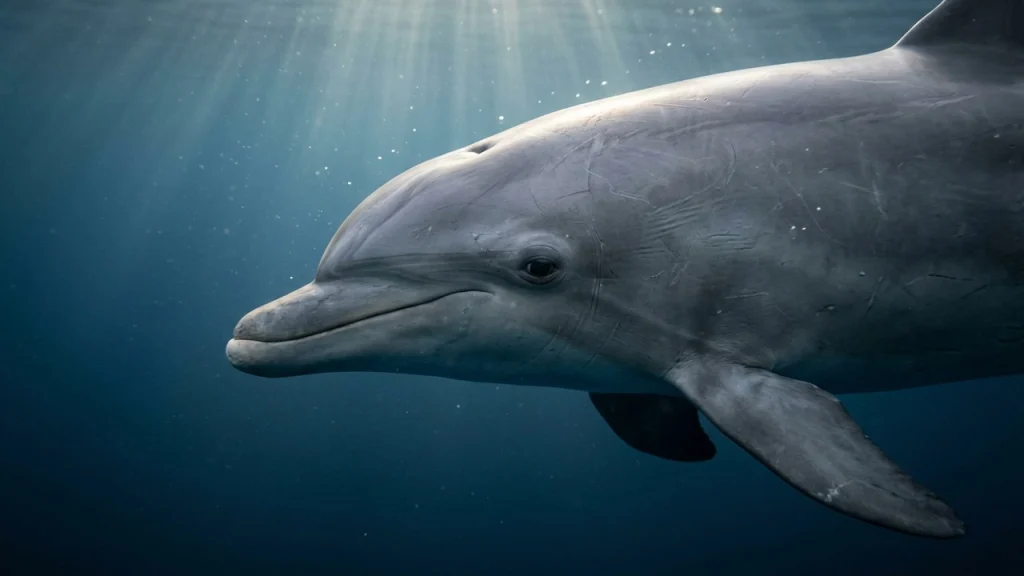
The Handbook of Behavioral Neuroscience reports that the eye opposite the waking hemisphere is predominantly open or in an intermediate state 95% to 98% of the time, and that having both eyes closed at the same time was rare, under 2.0% of the time. In both species scored in that chapter, both eyes opening lined up with waking for an average of 80% of the waking time, while an asymmetrical eye state lined up with sleep in the dolphin 80% of the time and in the beluga 91%.
A review in Nature and Science of Sleep notes that the open eye and the hemisphere that is awake let cetaceans scan for predators when they swim slowly or hover at the surface. Group swimming brought its own pattern: the open eye pointed toward the middle of the group, and the shut one turned away from it. Shifts inside the group flipped which eye stayed open.
Where the sleep happens in pools and in open water
A chapter in the Handbook of Behavioral Neuroscience says cetacean unihemispheric sleep may occur while the animals swim slowly, float at the surface or lie on the bottom of a pool. In captivity, some bottlenose dolphins slept mostly while floating at the surface, up to 85% of total sleep time, while others did it while circling the pools, up to 90%.
Whatever side of the brain was resting, sleeping dolphins and porpoises tended to circle in the same direction, and during that time they were never fully motionless, moving tail flukes and flippers to stabilize their posture. The same chapter warns that sleep cannot be told apart from wakefulness reliably by watching movement. One captive dolphin went through repeated spells of unihemispheric sleep underwater, lying motionless on the pool floor, each running 150 to 212 s before a short waking moment to come up for air. The chapter also counted resting on the bottom at only 4% of total sleep time over the 4 recording days.
In the wild the picture changes: among small cetaceans, surface rests are seldom logged, with the harbor porpoise example under 7.5% of recorded time. Cetaceans in open water have also been seen resting while swimming in close echelon formation.
What the recordings show
A review in Nature and Science of Sleep reports that during unihemispheric sleep in dolphins the brain temperature was effectively lower on the sleeping side, while the awake side stayed constant. The same review adds that steady activity in the locus coeruleus and the raphe nuclei throughout the state would keep enough muscle tone in dolphins for emerging, swimming and breathing. Elsewhere in the same handbook, unihemispheric sleep sits at the most extreme end of the left and right brain asymmetry recorded in mammals and birds.
Deprivation experiments kept dolphins awake for 35 to 119 h. Sleep loss raised the amount of unihemispheric sleep in each of the two cortical hemispheres, or in whichever one had been deprived. After deprivation the two sides swapped more often, 87% of the time following bilateral sleep loss and 80% after one sided sleep loss, against 67% under baseline conditions.
The open REM question
A review in Nature and Science of Sleep notes that cetaceans showing unihemispheric sleep have so far produced no EEG signs of REM sleep. A chapter in the Handbook of Behavioral Neuroscience points to one pilot whale episode of REM lasting 6 min, reported in 1969 by Shurley, Serafetinides, Brooks, Elsner and Kenney, and treats that record as the only report of its kind in cetaceans. The chapter leaves room for doubt, since cetaceans may have no REM sleep at all or a version of it that has escaped detection, and it adds that the muscle jerks and twitches normally tied to REM sleep never lined up clearly with any single EEG or behavioral state in the dolphins studied.
Mothers and calves
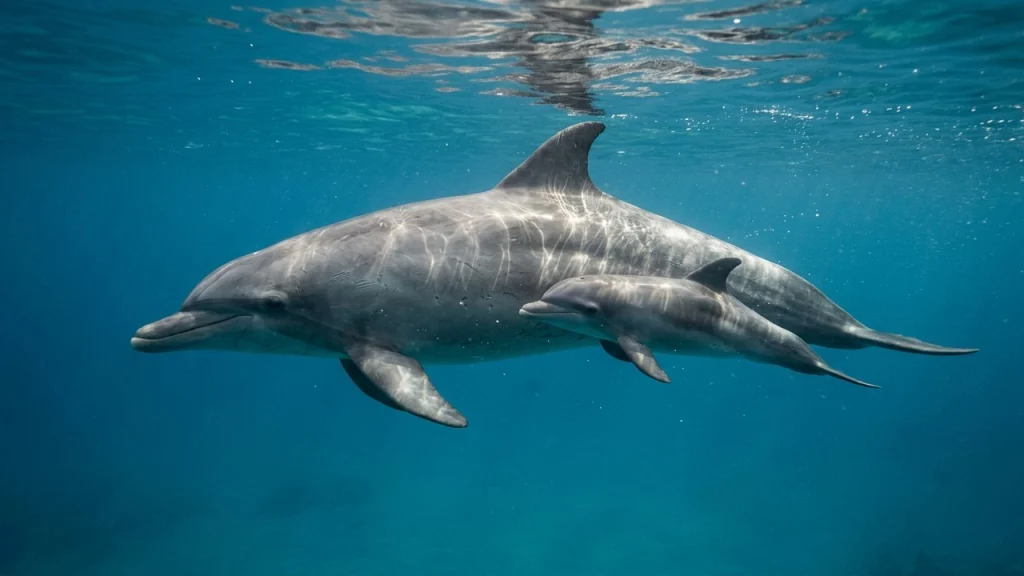
The Handbook of Behavioral Neuroscience reports that pregnant mothers spend much of their rest and apparent sleep floating at the surface, and that surface rest and sleep then disappear for weeks or even months after the birth. During that stretch calves stay with their mothers continuously, resting and sleeping as they move.
A study in Physiology & Behavior on bottlenose dolphin mothers and calves recorded no rest at the surface at all for at least 2 months after the birth, mothers and calves swimming in echelon formation on average 97% to 100% of the observation time. The authors of that study expect the slow wave episodes at this stage to be likely brief, which would cut EEG defined sleep into short stretches. The same study found that a calf’s eye facing the mother was open more often than the eye on the opposite side, on average 95% of all observations in the first calf and 99% in the second, against 82% and 60%.
Sources
- Handbook of Behavioral Neuroscience: Sleep in Aquatic Mammals
- Nature and Science of Sleep: Unihemispheric sleep and asymmetrical sleep: behavioral, neurophysiological, and functional perspectives
- Neuroscience & Biobehavioral Reviews: Cetacean sleep: An unusual form of mammalian sleep
- Physiology & Behavior: Behavioral aspects of sleep in bottlenose dolphin mothers and their calves
- NOAA Fisheries: Question of the Week: Dolphins and Whales on the High Seas
- Animal Diversity Web: Tursiops truncatus (Bottlenosed dolphin)