
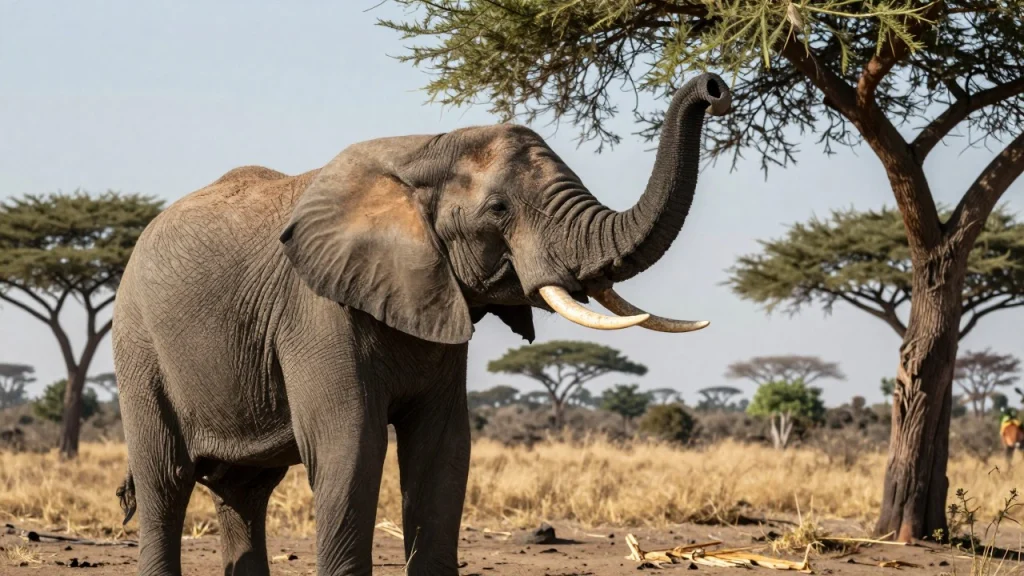
An elephant’s trunk is one of the most remarkable evolutionary adaptations in the animal kingdom. Functioning as a combination of a nose, upper lip, arm, and hand, it allows these massive mammals to interact with their environment with astounding precision and power. What makes this organ so versatile is its structure: a widely cited estimate puts the trunk’s muscle count at about 40,000, while a detailed anatomical reconstruction of an Asian elephant’s trunk found roughly 90,000 muscle fascicles. The trunk also operates without a single bone and is controlled by thousands of motor neurons.
These tens of thousands of muscle units, divided into major muscular groups called fascicles, give the trunk its incredible dexterity. An elephant can use its trunk to uproot entire trees weighing hundreds of pounds, yet it possesses enough delicate control to pick up a single blade of grass, shell a peanut, or comfort a young calf with a gentle touch.
Understanding the Anatomy of an Elephant’s Trunk
Unlike limbs in most mammals, an elephant’s trunk is a boneless muscular hydrostat made of muscle, nerves, skin, and blood vessels, with cartilage only at the base of the nostrils in Asian elephants. This organ evolved from the fusion of the elephant’s upper lip and nose, creating an elongated tool essential for daily survival.
The thousands of muscle fibers in the trunk are arranged in two principal layers:
- Extrinsic muscles: Located near the base of the skull and forehead, these larger muscles anchor the trunk and provide structural support, elevation, and broad movement.
- Intrinsic muscles: Positioned within the body of the trunk itself, these finer muscle groups allow for bending, twisting, coiling, and precise manipulation.
Intrinsic vs. Extrinsic Muscle Breakdown
The intrinsic muscles are further divided into thousands of muscle fascicles running longitudinally, radially or transversely, and obliquely:
- Radial muscles: Extend outward from the central nasal passages like spokes on a wheel, allowing the elephant to compress or flatten its trunk.
- Transverse muscles: Cross horizontally, enabling the trunk to elongate and contract.
- Longitudinal muscles: Run along the outer length, allowing the organ to bend up, down, and side to side.
The trunk is flexible along its whole length and allows a much greater variety of movements than articulated appendages.
How Elephants Use Their Trunk Muscles
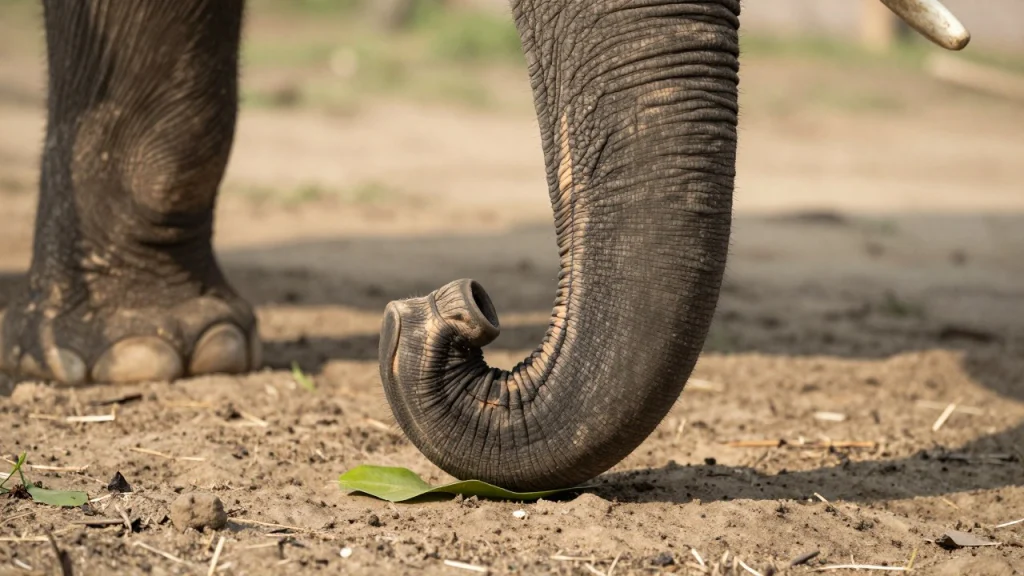
The combination of extreme strength and fine motor skills relies on how an elephant coordinates its 40,000 muscles. Rather than moving the entire organ at once, elephants can selectively contract small groups of muscles to create localized joints or rigid segments as needed.
Power and Strength
When moving heavy objects, the elephant contracts its longitudinal and transverse muscles to turn the trunk into a rigid lever. This allows an adult elephant to pull down large branches, push over trees, or lift objects weighing over 600 pounds (270 kg).
Precision and Touch
At the tip of the trunk, specialized fingers, two on African elephants (Loxodonta africana) and one on Asian elephants (Elephas maximus), provide delicate tactile capability. Controlled by tiny intrinsic muscle fibers, these fingers allow elephants to perform complex tasks:
- Picking up small seeds, fruits, or leaves from the ground.
- Wiping dust or water from their eyes.
- Scratching hard-to-reach parts of their body.
- Interacting socially with herd members through gentle caresses.
Drinking and Feeding
An elephant does not drink directly through its trunk like a straw; doing so would cause it to choke. Instead, it uses its muscle control to suction up to 2 gallons (8 liters) of water into its dual nasal passages, then curls the trunk to blow the water directly into its mouth.
Comparison with Other Muscular Structures
To put the elephant’s 40,000 trunk muscles into perspective, consider the muscle count of other animals and human anatomy:
- Humans: The entire human body contains roughly 600 to 700 muscles, with only a fraction dedicated to the hands and tongue.
- Human Tongue: A muscular hydrostat similar to a trunk, the human tongue contains just 8 muscles.
- Caterpillars: Among the most muscular small creatures, caterpillars have around 4,000 muscles.
With nearly 70 times more muscles than the entire human body, the elephant trunk stands out as one of the most complex muscular systems on Earth.
Nervous System and Brain Control
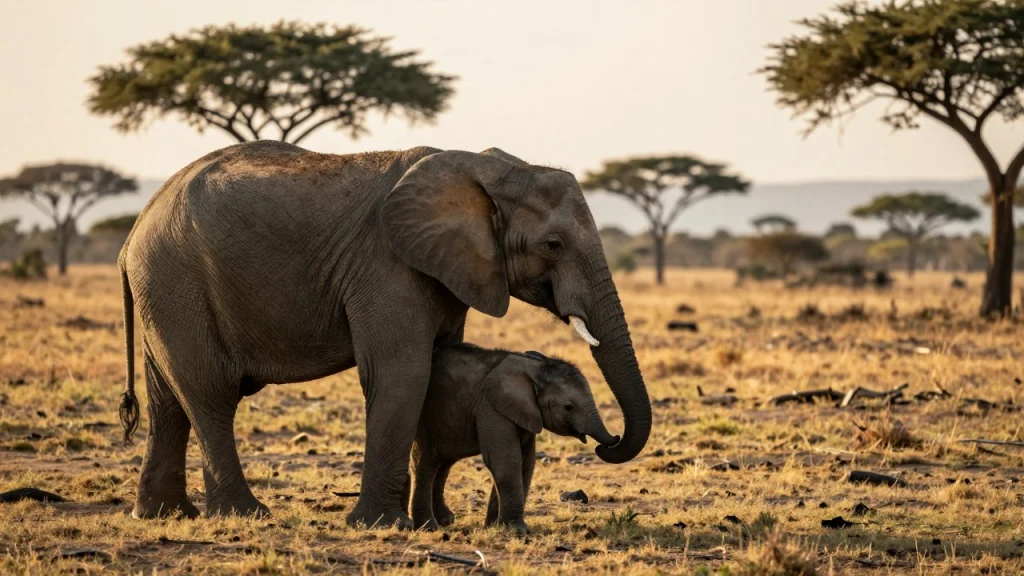
Operating tens of thousands of muscle fascicles requires tremendous neurological processing power. The elephant’s facial nerve is exceptionally large, branching out extensively throughout the length of the trunk to convey motor commands and sensory input.
The dorsal and lateral facial subnuclei are unusually large and are related to trunk representation and motor control. This heavy neurological investment explains why calves take years to learn how to use their trunks, often tripping over them or playing with them like human toddlers discovering their hands, before becoming independent around age eight.
The Evolutionary Advantage of a Bone-Free Trunk
The absence of bones gives the trunk flexibility that rigid limbs cannot match. Without rigid joints, the trunk can bend along its entire length, wrapping around objects and reaching into tree canopies or shallow water with far more versatility than a jointed limb.
Furthermore, this muscular design functions as a versatile multi-tool for survival:
- Olfaction: Smelling scents, including underground water, from up to 7 1/2 miles (12 km) away.
- Respiration: Serving as a snorkel when swimming across rivers.
- Communication: Producing loud trumpeting calls and directing low-frequency infrasound signals.
- Thermoregulation: Sucking up water and mud to spray over the skin, protecting against sunburn and parasites.
Through millions of years of evolution, the development of approximately 40,000 trunk muscles has provided wild elephants with an unparalleled tool for adapting to diverse habitats across Africa and Asia.