
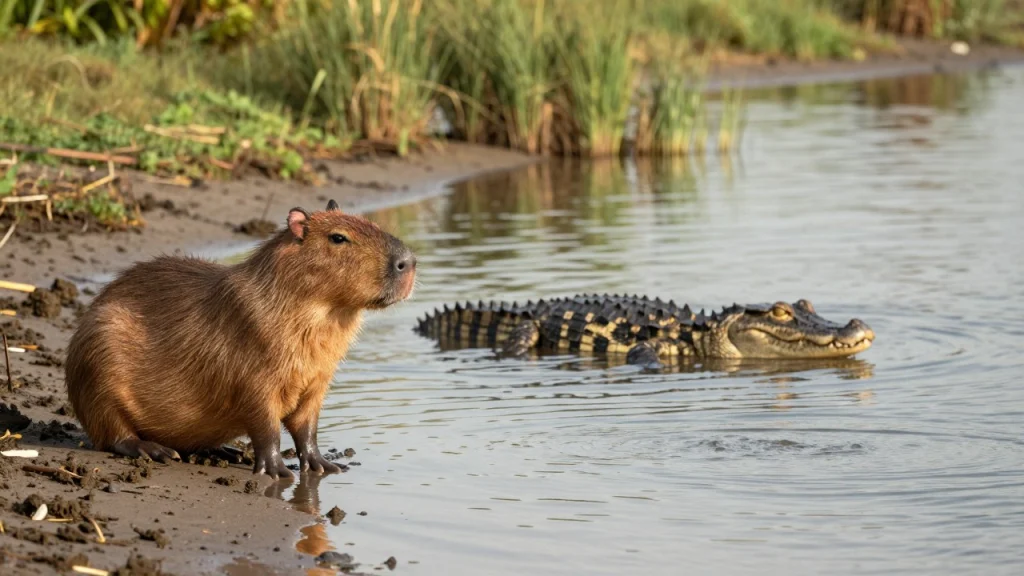
Capybaras and alligators never meet in the wild, so the honest answer to why alligators do not eat capybaras is geography first, then appetite and escape behavior. Capybaras live only in South America, and American alligators live in the southeastern United States. The crocodilian neighbors of capybara country are caimans, and caimans are documented predators of capybaras, above all of the young. This is not a story about a truce between two species sharing a river. It is a story about two animals whose maps do not overlap, plus a set of defenses that make adult capybaras awkward prey even for the crocodilians living beside them.
Two ranges that never meet
The capybara, Hydrochoerus hydrochaeris, is a rodent found only in South America. Published range records stretch across Brazil, Uruguay, Venezuela and Colombia, then south to the pampas of Argentina and west as far as the Andes, and researchers place the species in every country on the continent bar one, Chile. Capybaras also demand particular ground, favoring grassland that floods, the fringes of marshes, and lowland forest where forage is good and water never runs out.
The American alligator, Alligator mississippiensis, is native to North America and holds the record for the most northerly distribution of any crocodilian. It reaches the tidal regions of North Carolina at 35 degrees N, occupies every county in Florida and runs west to central Texas. The Smithsonian’s National Zoo puts that footprint in plain terms: a southeastern United States reptile, spanning the coastal Carolinas down to a single central Texas lake.
The practical result is simple. No wild alligator has ever hunted a wild capybara, and no wild capybara has ever had to watch a gator slide off a bank.
The crocodilians that do share capybara country
In South America the predator role is played by caimans, and the relationship is genuine predation rather than tolerance. Animal Diversity Web lists capybaras as an important food source for several large predators, among them anacondas, caimans, jaguars and people, and it attaches a critical qualifier: the risk is concentrated on the young. The San Diego Zoo Wildlife Alliance fact sheet fills out the picture, and its list of capybara hunters includes:
- jaguars and pumas, the two big cats
- foxes, bush dogs and feral dogs
- ocelots
- caimans, the crocodilians of the capybara range
- birds of prey
- humans
That risk has a clear age structure. Capybara young are slow and easily tired for much of their first year, which is precisely the profile a crocodile can realistically catch. Field accounts list the juveniles’ predators as foxes, ocelots, caiman, raptors, an occasional opossum going after infants, and anaconda. Adults weighing 35 to 66 kg are a very different proposition, and it is adult capybaras that dominate the herds you see at a water hole.
What a hungry gator actually eats
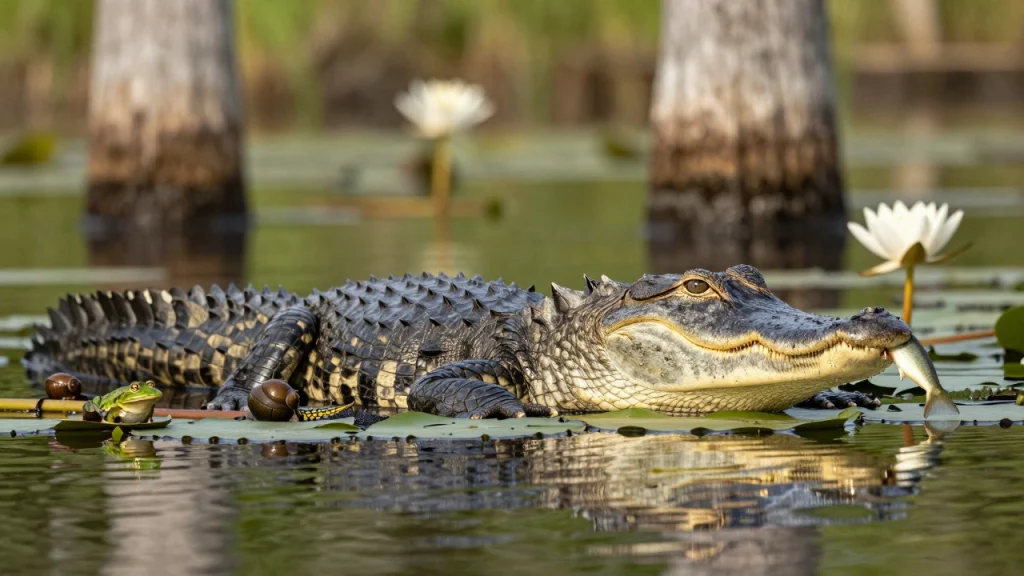
The appetite part of the answer is that an alligator is a generalist feeder, and a capybara is not what fills it. A Texas diet study reported through Animal Diversity Web found invertebrates made up 15.7-34.6% of what alligators ate, amphibians and reptiles 11.9-26%, and mammals only 2-11.4%. Hatchling and juvenile alligators start on small fish, insects and invertebrates, and larger adults add bigger mammals, plus reptiles and birds. The Smithsonian’s short list of what a gator actually takes runs from fish and snails through frogs and birds to any mammal that walks down to drink.
That shoreline focus is the important part. An alligator is a patient feeder stationed on a bank, not a runner chasing a full-grown grazer across open marsh, and a bigger animal can obviously take bigger prey, so a large gator would not find a capybara physically impossible. Capybaras are simply not what fills one. They are the largest rodents alive, and even a big male is an awkward mouthful rather than an easy one. Coarse, thin fur over a reddish brown body leaves very little padding between a gator’s teeth and the animal underneath. For a capybara, the real protection is not size. It is opportunity, and opportunity usually never arrives.
Water sits at the capybara’s feet
The second half of the answer is that a capybara is built to leave. Water is not a detail of its life but infrastructure. Peer-reviewed habitat research describes it as a key resource for thermoregulation, mating and predator avoidance, and some authors report these rodents hardly travel more than 500 m from water. Their daily timing keeps escape close at hand. They rest close together at the water’s edge in the morning, sit in water or mud through the heat of the day, and graze in the late afternoon, in the evening and at night.
Vocal warnings buy the rest. Capybaras bark at an intruder, then jump in the river or run. Most alarm calls come from subordinate males, and the rest of the group answers by freezing alert or diving into whatever water is closest. Under pressure they sink until only their nostrils and eyes break the surface, and they can hold that position for as long as five minutes. Being a strong swimmer and a capable diver is not a side note in this story. It is the difference between a chase and a cold plunge.
Safety in numbers
Capybaras also refuse to live alone. Dry season gatherings at water sources can reach 100 individuals, and the San Diego Zoo fact sheet reads the species’ high sociality as a probable response to predation risk as much as to access to food. Under attack by wild dogs, a group pulls into a defensive huddle with the young in the center and adults facing outward. Groups hold stable ground, with one territory maintained by a single group for over 3 years, and the dominant male often claims the best water holes. Losing that protection costs a great deal, because a capybara without a group is pushed out of most grazing habitat and has little chance of finding a mate.
Reading the photographs correctly
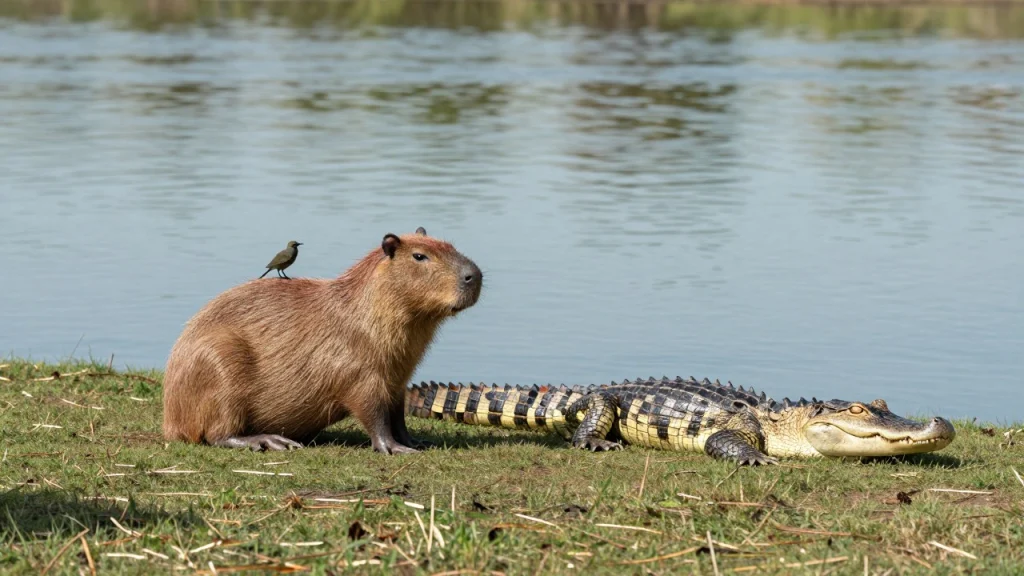
The images that spark the question usually show a capybara and a crocodilian sharing a sunny bank, and the fair reading is tolerance at a distance rather than friendship. The two animals are using the same edge for opposite purposes: the crocodilian as a hunting station, the capybara as a lookout with water at its back. Capybaras do have genuine cleaning partners, but they are birds rather than reptiles. A handful of avian species pull parasites out of capybara coats for a meal, and others simply trail behind grazing herds to catch the insects that get kicked up; at least nine species gain by tagging along. Grooming between capybaras themselves also strips out parasites and eases social tension.
Neither species is the loser here
None of this is a conservation drama. The greater capybara is listed as Least Concern by the IUCN, and so is the American alligator, which was once listed as federally endangered in the United States before being delisted as numbers recovered. Capybaras are not scarce, and alligators are not scarce, so the standoff costs neither of them anything.
What the standoff actually is
So the answer has three parts. Alligators are North American, capybaras are South American, and the pairing lives in photographs rather than in the field. Where crocodilian relatives do overlap with capybaras, they hunt the vulnerable young and leave the awkward adults alone. And an adult capybara that watches, barks, plunges and holds its breath is one of the least profitable meals available in a landscape full of fish, snails and frogs. What reads as peace between two animals is really distance, vigilance and a shared taste for the same shoreline.
Sources
- Animal Diversity Web, University of Michigan: Hydrochoerus hydrochaeris (capybara) | INFORMATION
- Animal Diversity Web, University of Michigan: Alligator mississippiensis | INFORMATION
- San Diego Zoo Wildlife Alliance: Capybaras (Hydrochoerus spp.) Fact Sheet: Summary
- San Diego Zoo Wildlife Alliance: Behavior & Ecology – Capybaras (Hydrochoerus spp.) Fact Sheet
- Smithsonian’s National Zoo and Conservation Biology Institute: American alligator
- Peer-reviewed article via PubMed Central: Habitat selection in natural and human-modified landscapes by capybaras (Hydrochoerus hydrochaeris), an important host for Amblyomma sculptum ticks