
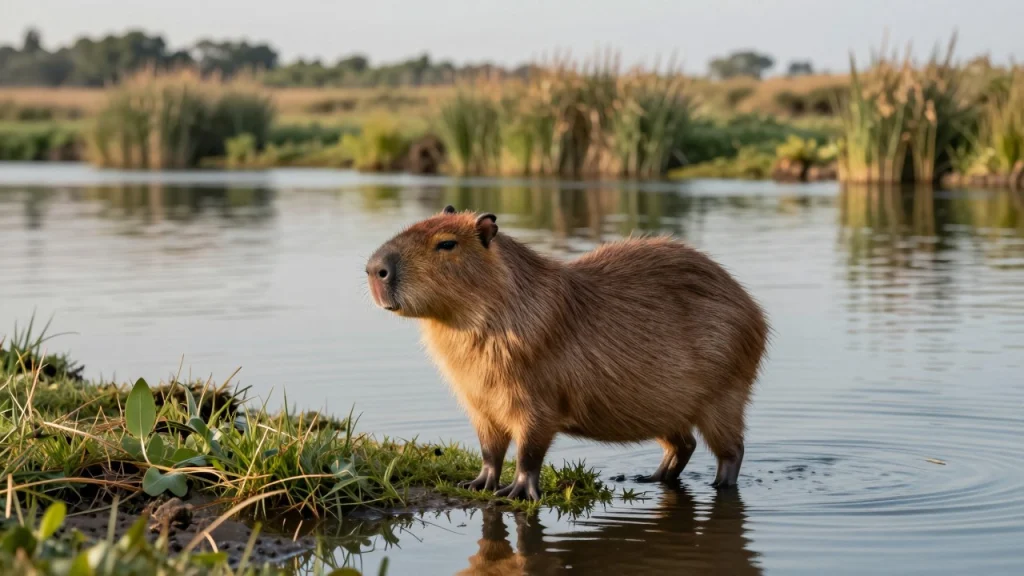
The short answer is no: a capybara is a rodent, but it is not a rat. It sits in the cavy family, next to guinea pigs, rather than among the rats and mice most people picture when they hear the word rodent, and its closest living relatives are rock cavies. An adult carries about 55 kg, which makes it 60 times heavier than a rock cavy and roughly 2,000 times heavier than a house mouse.
Capybaras are the largest living rodents: they weigh 35 to 66 kg, carry the shoulders up to 0.6 meters off the ground and measure about 1.2 meters end to end. A single genus holds the two species alive today, Hydrochoerus hydrochaeris and Hydrochoerus isthmius, which the IUCN counts as separate.
What the giant rat label gets wrong
The useful distinction is taxonomic rather than visual. Recent genetic studies place the capybara in the family Caviidae, alongside cavies, maras and guinea pigs, whereas earlier taxonomies gave capybaras a family of their own, Hydrochoeridae, and both arrangements are still in circulation. Capybaras belong to the South American rodents called caviomorphs, a lineage spanning a broader range of body sizes than any other group inside Rodentia, so being enormous is the exception here.
The scientific name translates Greek words for water hog, which says where the animal lives rather than what it is. Around 190 local common names exist for the species, one of them Kapiyva, which one Amazon tribe renders as master of the grasses.
Rodent teeth on a grazing jaw
Capybaras carry the standard rodent kit, above all the ever-growing front teeth that mice, squirrels and porcupines also have. What they do with those teeth is different: a capybara uses its long, sharp incisors on grass and water plants. The species is a grazer by diet as well as by behavior.
Tough, fibrous grass calls for a different jaw action. Capybaras chew side to side, the way a camel does, rather than up and down, the way we do, and they bring food back up for a second pass. That rumination-like strategy is a genuine independent invention, since rodents sit nowhere near the ruminants in the family tree. Each morning they also re-ingest part of the previous day’s food, restoring the gut bacteria needed to digest the fibre.
Even the menu is narrow. About seventy-five percent of the diet comes from just three to six plant types, and the animals are selective grazers that favour particular native grasses.
A barrel-shaped body built around water
Capybaras are built like a barrel: sturdy, heavy and tailless, with coarse, thin fur that runs reddish brown across the back and yellowish brown underneath. The front limbs come in a little under the rear pair, and the feet show partial webbing. Eyes, ears and nostrils sit high on the skull, so the animal can see, hear and breathe while almost entirely under water.
That water dictates where the animal lives. Capybaras occur only where water is easy to reach, favouring lowland grassland bordering rivers, ponds and lakes that offer both open water and dry ground to graze. Their native range spans most of Brazil plus Uruguay, Venezuela and Colombia, reaching the Argentinian pampas in the south and the Andes in the west.
Swimming costs them almost nothing. The body is only slightly denser than water, and a capybara can sink out of sight and hold its breath for up to five minutes. Water also solves a thermal problem: an animal that heavy is prone to heat stress, so activity is mostly crepuscular, with the hours around noon taken in the water.
Herds, and why company is compulsory
Territory, rank and the cost of solitude
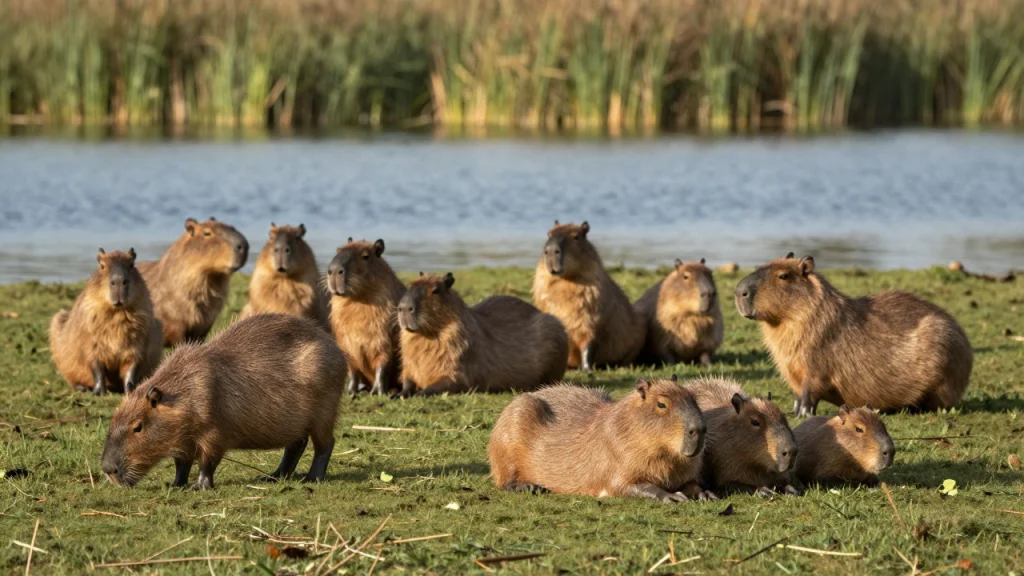
Capybaras are group animals, and social life here is a survival requirement rather than a detail. A typical band numbers some 10 adults of both sexes and can run from 3 to 30, and in the dry season as many as 100 may gather at a water source. Each band defends a territory covering its feeding and wallowing sites, and a strict dominance hierarchy settles disputes among the males, with chasing as the usual form and real fights rare.
A lone animal loses access to most grazing habitat and has little prospect of a mate, which is why almost no capybaras are seen on their own.
Alarm calls and scent marking
Not everything travels by sound. An alarm bark sends everyone scrambling for the water, and males carry a hairless lump on the snout, the morillo gland, whose white secretion works as an individual fingerprint by smell. Capybaras rub that secretion onto trees and shrubs to mark territory, or smear it across their own bodies to advertise status and willingness to mate.
Pups, and a short life for a big animal
Breeding runs all year, with a peak at the start of the rainy season. Young arrive after a 150-day gestation in litters of 2 to 8, and they are precocial, standing and walking shortly after birth and starting to graze inside a week. Newborns average 1,500 grams and are weaned at about 3 months, during which they suckle from their own mother and also from other females in the band, who are usually close relatives.
Longevity is modest for its size. The average wild animal manages about 6 years, though some reach 10, and captivity can stretch that to 12.
The grazer that shapes its landscape
Across much of South America they are the only large grazing species present, and a grazer that size has a dramatic effect on the vegetation where it feeds. Birds pick parasites out of capybara fur and trail the grazers to swallow the insects kicked loose from the grass. In return the capybaras crop vegetation more efficiently than cattle or any other introduced livestock, and they are already an important food source for many local people.
Predators and hunted populations
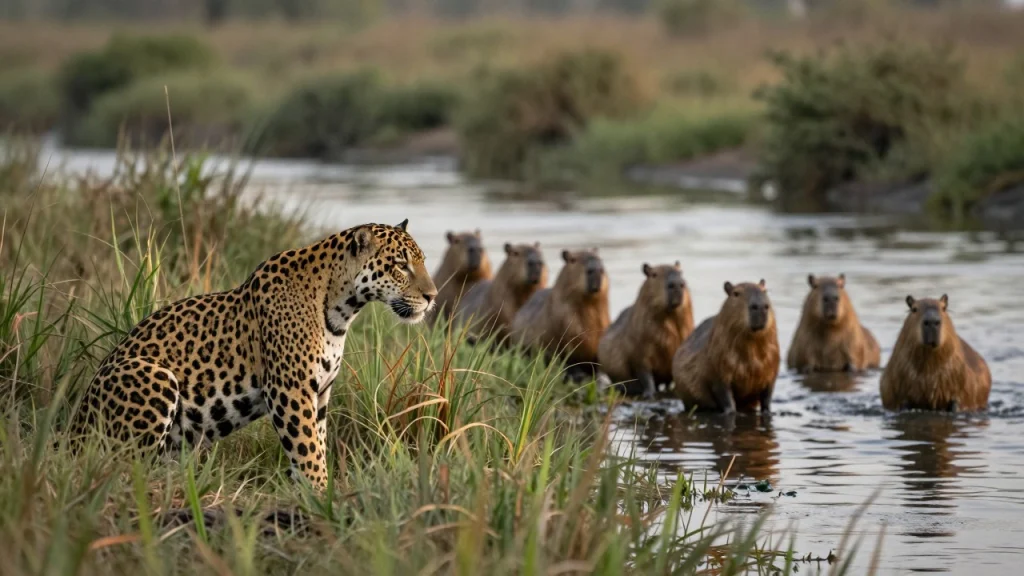
- Jaguars are the one main natural predator recorded for adults, and people hunt capybaras as well
- Anacondas and caimans are among the large predators that take capybaras while they are young
- The wider cast of threats across the range adds caiman, feral dogs, bush dogs, foxes, ocelots, puma and birds of prey
Conservation status: common, not invulnerable
The IUCN lists the greater capybara as Least Concern, assessed in 2016, and records its population trend as stable. The lesser capybara, H. isthmius, is Data Deficient, meaning there is not enough information to judge its risk of extinction. Neither species appears on the CITES appendices, so trade is not controlled at the international level.
Numbers on the ground are reassuring rather than alarming. Densities reach 195 individuals per square kilometre in southeastern Brazilian wetlands and run between 10 and 200 per square kilometre in the Venezuelan Llanos. Legal protection came early, with hunting prohibited in Brazil in 1967 under Federal Law No. 5.197 and in Columbia in 1980.
What still threatens the species is habitat loss along with hunting and farming, plus the encroachment of human development and the perception that capybaras compete with cattle for food. Managers therefore argue that encroachment and competition with agriculture need controls and monitoring rather than treating the Least Concern listing as settled. Hunting has an evolutionary signature: it takes the largest and oldest animals first, including big males and pregnant females, and shrinks band size, leaving a smaller body size in hunted populations over the long term. Where habitat loss removes the predators, capybaras may even gain ground in the short term.
What made a giant rodent
Such size is rare among rodents, and the genetics are instructive. A genome-wide scan of the capybara found several genes under selection tied to postnatal bone growth and musculoskeletal development, which points to growth after birth, rather than size at birth, as the main lever.
Gigantism has a price. A larger body means more cells, and more dividing cells mean more chances of cancer, a mismatch between size and cancer incidence that researchers call Peto’s Paradox. Capybaras seem to pay it in a particular way, since the gene families expanded in this lineage include a putative new anticancer adaptation built on tumor suppression driven by T cells.
Capybaras were not always modest either. Fossil relatives reached twice the length of living animals and probably eight times their mass, and the group crossed into North America some 3.5 million years ago by way of the Panamanian land bridge.
So, giant rat?
Not quite. The label makes sense at the order level, because the animal really is a rodent, with ever-growing incisors, a barrel body and no tail. The useful answer is finer than that: a capybara is a cavy, a member of the family that also holds guinea pigs, and a grazer that eats its way through pasture and spends the hottest hours underwater. It sits alone at the top of the body size range its own order spans.
Sources
- Animal Diversity Web, University of Michigan: Hydrochoerus hydrochaeris (capybara) | INFORMATION | Animal Diversity Web
- San Diego Zoo Wildlife Alliance: Capybara | San Diego Zoo Animals and Plants
- San Diego Zoo Wildlife Alliance Library: Capybaras (Hydrochoerus spp.) Fact Sheet: Summary
- San Diego Zoo Wildlife Alliance Library: Taxonomy and History – Capybaras (Hydrochoerus spp.) Fact Sheet
- San Diego Zoo Wildlife Alliance Library: Population and Conservation Status – Capybaras (Hydrochoerus spp.) Fact Sheet
- Molecular Biology and Evolution (PMC8097284): How to Make a Rodent Giant: Genomic Basis and Tradeoffs of Gigantism in the Capybara, the World’s Largest Rodent