
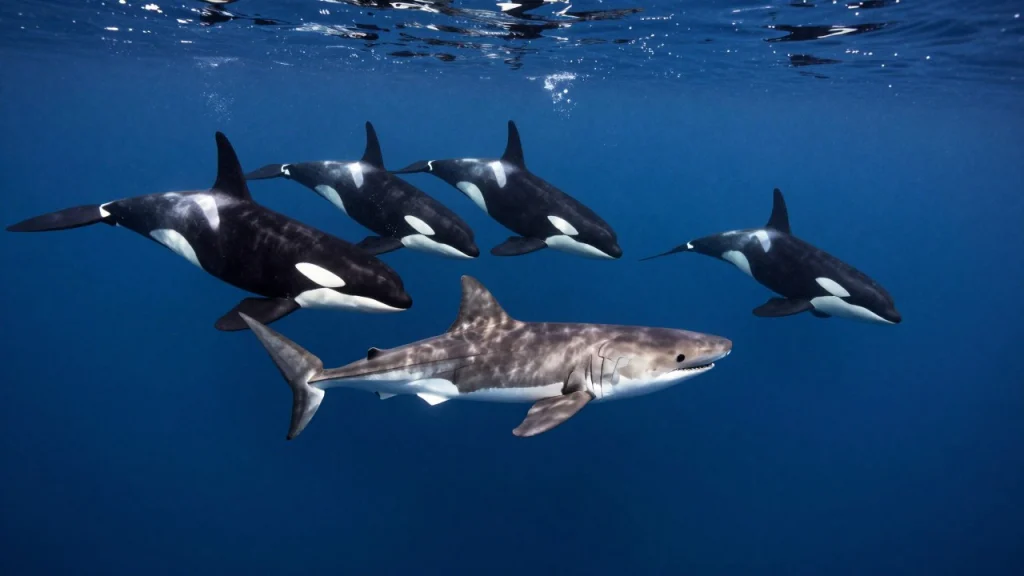
Yes, orcas eat sharks. Field observations, stomach records and video evidence confirm sharks in their diet, including white sharks and whale sharks hunted in coordinated attacks.
That answer surprises many people because orcas already sit near the summit of ocean food webs. Orcas gain an edge through social teamwork, flexible diets and tactics tuned to each type of shark, from quick strikes on midsize predators to long group assaults on giant filter feeders.
A top predator with a flexible menu
The orca holds the highest rank among ocean hunters, which explains why almost no animal is off limits. As the biggest member of the dolphin family, it combines speed, strength, social learning and sharp senses to handle prey much larger than itself.
Across the species, feeding habits rank as the most diverse among whales and dolphins, yet local groups often focus on familiar foods. That mix of broad ability and narrow habit means one population may favor familiar fish while another learns to handle sharks, and those learned habits can persist for years.
Orcas act as opportunists that exploit whatever large sea animals become available. This flexibility lets them switch when fish runs fade, seal numbers shift or sharks move into hunting grounds, so sharks become valuable backup prey rather than a strange choice.
Stomach examinations show an unusually wide menu. Documented foods include:
- seals and sea lions
- smaller whales and dolphins
- fish and sharks
- squid and octopi
- sea turtles and sea birds
- sea otters and river otters
An average animal needs about 45 kg of food a day, although hungry individuals can take far more. That daily demand drives frequent hunting and explains why energy rich organs attract special attention.
Feeding mechanics match prey size. Small catches go down whole, while larger catches get ripped into pieces before swallowing. The approach reduces choking risk and lets several whales share one carcass.
Offshore groups illustrate the shark link especially well. Those wide ranging whales consume fish that include sharks, based on limited but consistent feeding records. In other words, sharks are a normal part of life far from shore, not a coastal accident.
A similar pattern occurs near New Zealand, where some orcas eat stingrays plus sharks.
Orcas face no natural predators as adults, and they occupy the highest step in marine food webs. Only calves face a real threat from other orcas or big sharks, which reinforces why adult orcas can attack dangerous prey with little risk.
How orcas overpower white sharks
White shark hunts remain uncommon in the scientific record. Researchers note that orcas are known to occasionally pursue white sharks, although only three formal studies had described the behavior plus shark flight responses at the time of a key report. Rarity makes each filmed event valuable for understanding tactics.
One well documented case involved at least two and possibly three white sharks killed by one orca group at Mossel Bay on 16 May during about 71 min. The short window shows how fast a coordinated pod can subdue several large predators once it commits to an attack.
Witnesses described close pursuit before the kills. In two clips timed at 14:07 and 14:27, separate orcas trailed large white sharks within less than one body length. The sharks tried to keep the attackers in view, yet proximity gave the whales control.
One whale used its snout to shove an estimated 3 m white shark upward from below and onto its side. Lifting from the ventral side limits the shark’s ability to dive, turn or bite back, so the attacker gains a safer grip.
In another maneuver, an orca tried to roll and flip a white shark into a posture that causes tonic immobility. This trance-like stillness in sharks reduces struggling, which lets the whale position the body precisely before biting.
The bite targets the belly directly behind the pectoral fins. Opening the abdomen just behind the pectoral fins exposes the body cavity quickly, without chewing through thick back muscle or jaws that could injure the whale.
The prize is the liver. The organ roughly matches the size of an orca head, and observers saw it float up before a whale seized it in its mouth. Such a large fatty organ supplies dense energy that helps justify the effort and danger of attacking another apex hunter.
Why white sharks flee after an attack
Shark disappearance after predation can be dramatic. Three kinds of evidence indicated that white sharks left the immediate area and stayed away for at least 7 weeks. Avoidance on that scale shows fear effects can reshape local predator distributions even when few sharks die.
Boat based counts support the pattern. Tour operators averaged 3.3 sharks per trip before the Mossel Bay kills, then recorded zero sharks for 45 days after the event. The sudden drop from regular sightings to none points to active flight rather than normal day to day variation.
Small mammal hunts often involve compact teams of two to eight animals, and shark hunts use similar cooperation. A few coordinated whales can surround, distract and exhaust a shark more effectively than a lone hunter, while still sharing enough food to make teamwork worthwhile.
How one pod learned to kill whale sharks
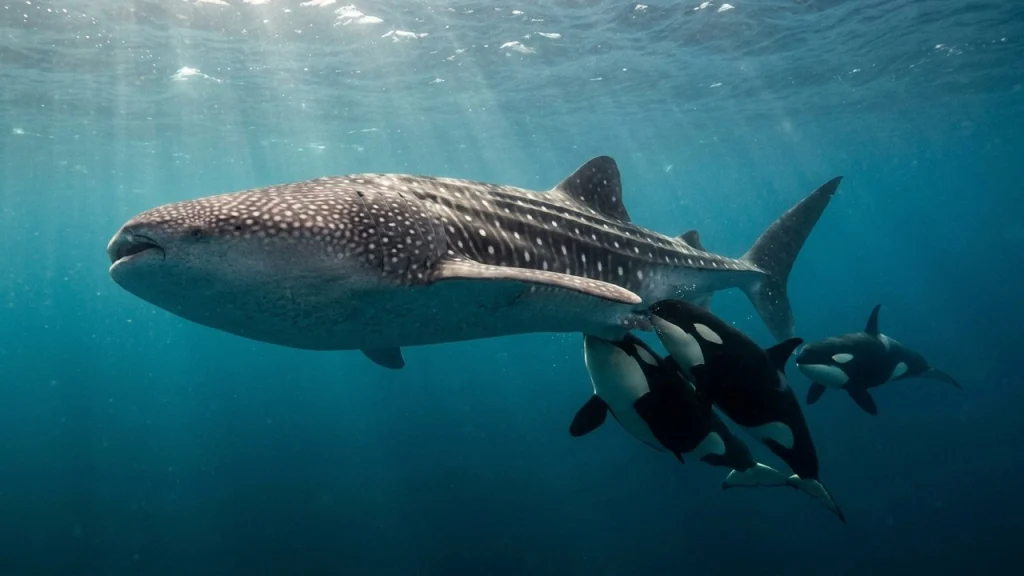
Whale sharks present a very different challenge. Reports describe orcas hunting the largest fish species, the whale shark, using repeated group attacks rather than single ambushes. Size alone does not protect these gentle giants once orcas learn a reliable method.
The Gulf evidence covers four separate kills across six years from 2018 to 2024 in the southern Gulf of California. Repeated events in one region suggest a learned tradition rather than four lucky encounters.
Biologists consider whale sharks the largest member of the Chondrichthyes group, with sizes reaching 18 meters, which makes them the largest fish on the planet. An animal that long can outweigh several orcas combined, so orcas must neutralize its power instead of overpowering it head on.
Their method centers on the rear underside. Attacks focus on the pelvic zone, including claspers and pelvic fins, a strike that drains blood rapidly and opens a path to the lipid-rich liver. Targeting soft rear tissue avoids the thick head and tail while reaching vital organs fast.
The opening blows stun the victim. Orcas ram the whale shark at speed to stun and immobilize it, then maneuver the dazed fish belly up so it cannot dive. Keeping the shark near the surface removes its main escape route.
Photo records point to experienced leaders. Identification showed an adult male called Moctezuma joined three of the four hunts.
Size, range and social life behind the hunts
Adult size helps explain orca confidence. Males average 8 m in length and can reach 9.75 m, while females average 7 m and can reach 8.5 m. That bulk gives even a small pod enough mass to surround midsize sharks and harass far larger fish.
Their range is global. Orcinus orca lives in every ocean, so encounters with many shark species are inevitable. Wide distribution also exposes different pods to different prey, which encourages local hunting cultures.
Teamwork ties these facts together. Orcas commonly hunt as a coordinated unit, acting together like a wolf pack to herd, tire and dispatch prey. Shared tactics, shared food and long family bonds turn difficult prey such as sharks into a teachable skill rather than a desperate gamble.
Shark eating therefore reflects opportunity, learning and energy payoff. Orcas do not eat every shark they meet, but offshore fish eaters, New Zealand groups, white shark hunters at Mossel Bay and whale shark specialists in the Gulf of California all show the same lesson. When sharks offer rich livers and predictable encounters, these social dolphins learn how to catch them and return for more.
Sources
- Animal Diversity Web: Orcinus orca (killer whale) | INFORMATION | Animal Diversity Web
- NOAA Fisheries: Killer Whale – NOAA Fisheries
- Ecology: Direct observation of killer whales preying on white sharks and evidence of a flight response
- Frontiers in Marine Science: Killer whales (Orcinus orca) hunt, kill and consume the largest fish on Earth, the whale shark (Rhincodon typus)
- Alaska Department of Fish and Game: Killer Whale Species Profile, Alaska Department of Fish and Game