
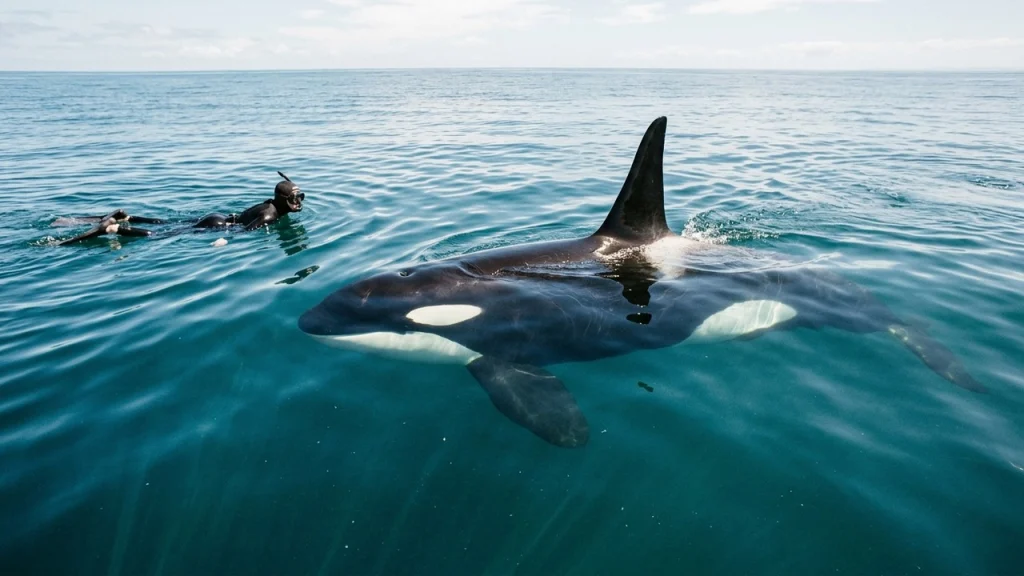
No unconfined killer whale has ever been recorded killing a human in nature, and encounters with people in the wild are usually peaceful. Swimmers, divers, and coastal kayakers frequently describe peaceful, inquisitive approaches rather than predatory aggression. There are no known adverse effects of orcas on humans.
Humans and orcas can develop friendships. Free-ranging pods routinely ignore swimmers or display playful curiosity, proving that these apex predators do not view people as food. Centuries ago, communities without intimate sea experience viewed these imposing apex marine mammals with dread as bloodthirsty killers. Modern marine biology replaces that ancient dread with an appreciation for a disciplined, socially sophisticated cetacean.
Historical Myths and the True Identity of Oceanic Dolphins
Centuries of seafaring lore distorted human understanding of this formidable ocean carnivore. Observing the predators pursue gigantic whales, eighteenth century Basque whalers designated the hunter ballena assasina, translating to whale killer. English translators subsequently inverted the Spanish wording into the familiar moniker killer whale, reinforcing misconceptions that the creature hunted everything in the sea.
Despite popular naming, taxonomists categorize the animal as the largest living member of the oceanic dolphin group within the family Delphinidae. Adult specimens reach total measurements from 23 to 26 feet while maintaining body masses between four to eight tons. Their hydrodynamic bodies permit rapid aquatic cruising across varied maritime terrains.
Physical differentiation between sexes becomes visible once animals attain sexual maturity. On fully grown bulls, a triangular dorsal fin can rise up to six feet above the water line. This erect dorsal structure stabilizes rapid turns and serves as an identification badge across open water.
Beyond their massive external anatomy, their internal cognitive physiology sets them apart from most marine predators. The orca brain is exceptionally large and complex.
Wide Distribution and Daily Movements Across Global Oceans
Killer whales thrive across diverse water temperatures, colonizing subpolar seas and warm equatorial currents alike. Roaming across every ocean on Earth, these marine mammals enjoy the most extensive ecological distribution documented among all cetaceans. Their adaptability allows them to forage near shallow coastline shallows and deep oceanic trenches.
Sustaining their large physical bulk requires tremendous locomotion and endurance. Even though their precise boundary limits remain undefined, travelling groups have been recorded journeying up to 160 km a day. Such broad geographical patrols allow communities to track migratory food sources efficiently.
Social Structure, Maternal Pods, and Cultural Dialects
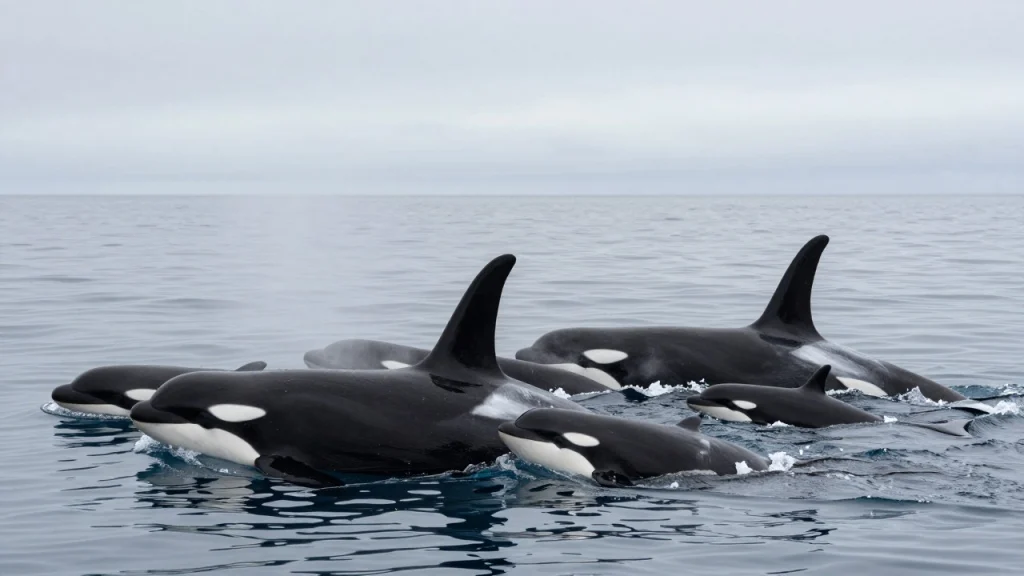
The core foundation of killer whale daily life is built around lifelong family unity. Daily communal life revolves around maternal pods composed of closely connected relatives that remain together across most of their lives. Offspring generally remain alongside their mothers, establishing multi-generational clans led by senior matriarchs.
The structure of these social units balances familial intimacy with broader communal interaction:
- Typical family groups incorporate two to 15 animals, although larger temporary congregations coalesce during rich feeding seasons, social events, or breeding periods.
- Inbreeding is strictly avoided across lineages, as pod members do not reproduce within their own familial group.
- Submerged companions coordinate their hunting and travelling maneuvers by producing audio cues including pulsed calls, whistles, and echolocation clicks.
- Every resident clan across the Pacific Northwest displays an acoustic dialect that calves master and culturally transmit across generations.
Cultural Prey Specialization: Why Humans Are Not on the Menu
A central question regarding human safety is why these massive carnivores never hunt people swimming in the sea. While local marine ecosystems supply regional options, foraging choices reflect the culturally acquired techniques perfected by each ecotype. Killer whales do not hunt indiscriminately; instead, calves strictly inherit dietary preferences from their elders.
This generational tradition divides populations into specialized dietary ecotypes around the globe:
- Resident groups in the Pacific Northwest dine purely on fish like salmon, whereas neighboring Bigg’s or Transient pods pursue marine mammals and squid.
- Off the coastal perimeter of Norway, local pods forage overwhelmingly on herring and dense schools of swimming fish.
- Pods patrolling coastal New Zealand waters specialize in hunting elasmobranchs, consuming sharks and stingrays.
Because humans have never belonged to any lineage’s learned hunting repertoire, wild orcas do not treat people as viable prey.
Shared Longevity Realities and Post-Reproductive Grandmothers
The social complexity of killer whale society mirrors human communal life through unique evolutionary parallels. Post-reproductive survival patterns align with our own biology, since menopause occurs in humans, beluga whales, narwhals, killer whales, false killer whales, and short-finned pilot whales.
Female killer whales achieve remarkable lifespans that permit the accumulation of decades of environmental knowledge. Wild female killer whales achieve an average longevity of around 63 years, with healthy grandmothers attaining 80 to 90 years.
Male members of the species experience distinct life history trajectories and higher mortality rates. Adult bulls survive for shorter periods, averaging roughly 36 years while occasionally reaching maximum ages of 50 to 60 years. Even as adults, sons depend heavily on the hunting experience and protective guidance of their mothers.
Solitary Calves and Gregarious Human Connections
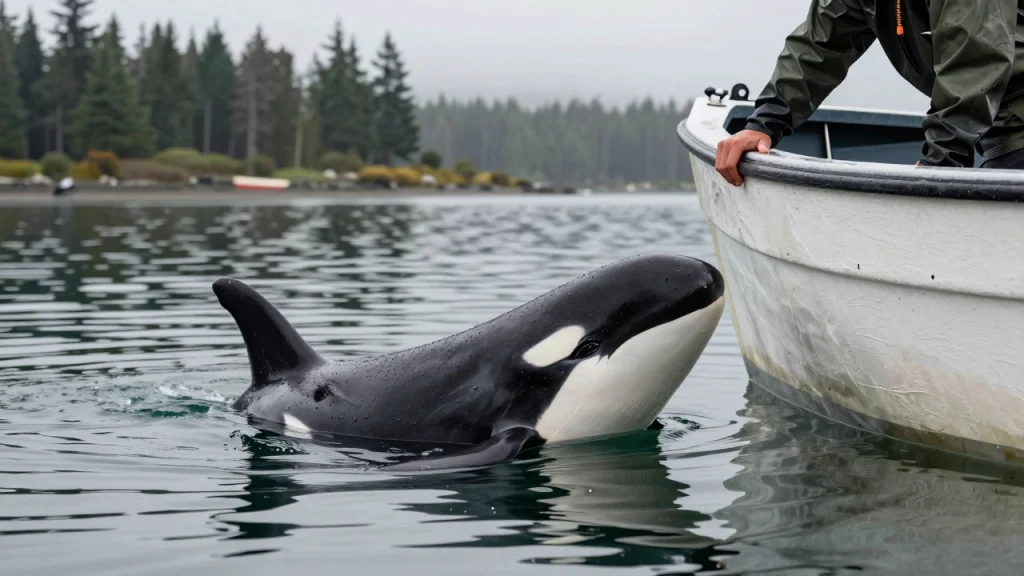
While family groups normally keep a respectful distance from watercraft, isolated calves occasionally seek out alternative companions. In the summer of 2001, researchers identified a separated young whale cataloged as L-98 inhabiting Nootka Sound off Vancouver Island in British Columbia, Canada. Deprived of his natural pod, the lonely young animal turned toward coastal communities for social stimulation.
Nicknamed Luna, this gregarious youngster actively initiated contact with people, presenting legal dilemmas because Canadian environmental regulations banned such fraternization. Luna attempted to socialize with people. This historical episode highlighted the intense intrinsic need for social connection that characterizes the species.
Captivity Pressures Versus Natural Wild Temperament
The rare incidents where killer whales injured human trainers occurred almost entirely inside artificial oceanarium enclosures. Open marine existence has shaped these apex predators to cover distances up to 40 miles each day while exercising and foraging. Natural hunting routines include recurring deep dives spanning from 100 to 500 feet below the surface multiple times daily.
Confinement in chlorinated concrete tanks imposes profound behavioral stress that is foreign to wild populations:
- Confined marine mammals often manifest abnormal repetitive conditions termed zoochosis, which include swaying, rocking, and episodes of self-mutilation.
- Institutional routines fracture family structures, since captive-born orcas are frequently relocated between commercial facilities, dissolving established social bonds.
- Welfare controversies expanded after the 2013 documentary film Blackfish chronicled how a captive whale named Tilikum killed two trainers at SeaWorld Orlando.
- Former facility trainers and cetacean scientists emphasized that persistent environmental stress provoked the captive male’s hostility toward humans.
- Even under artificial pool conditions, approximately 55% of all SeaWorld captive killer whales have never recorded any published aggressive incidents.
Demystifying Iberian Boat Interactions: Aggression or Social Play?
Recent headlines regarding vessel encounters along the coast of southwestern Europe have led some sailors to question whether wild orcas have become aggressive. Beginning in 2020, an isolated subpopulation of Iberian killer whales started persistently nudging sailing vessels, frequently damaging rudders and occasionally disabling boats. These events spurred widespread media speculation about deliberate whale revolts against human boaters.
Marine biologists explain these maritime encounters primarily as exploratory play, social transmission, or behavioral fads rather than coordinated anti-human attacks. Scientific logs reveal that whales consistently approach vessels from the stern, focusing on steering rudders while responding to changes in boat motion, resistance, and vibration. Once the moving rudder ceases to rotate or breaks, the animals routinely swim away without attempting to harm the crew aboard.
Peaceful Giants of the Open Sea
Centuries of maritime myth once cast killer whales as terrifying sea beasts, yet no wild orca has ever been documented killing a person. In natural oceans, free-ranging orcas show curiosity and disciplined forbearance when encountering people.
Sources
- NOAA Fisheries: Killer Whale
- National Park Service: Orca (Killer Whale) – Kenai Fjords National Park (U.S. National Park Service)
- Animal Diversity Web: Orcinus orca (killer whale)
- National Geographic: Orcas (Killer Whales)
- Animal Cognition: When orcas hit the rudder: what Iberian orca–boat interactions reveal about action explanations in animal cognition
- Animals: Orca Behavior and Subsequent Aggression Associated with Oceanarium Confinement