
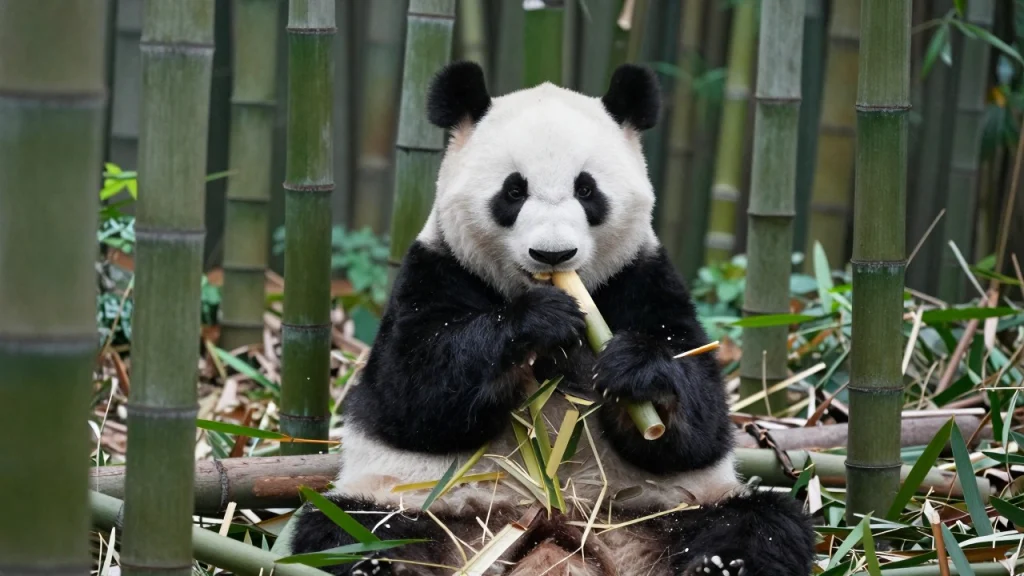
Giant pandas eat almost entirely bamboo in the wild, though they occasionally take grass, fruit, insects, or carrion. A peer-reviewed study in mBio reports that 99% of the animal’s diet consists of bamboo, and Smithsonian’s National Zoo reports that its pandas eat bamboo, alongside highly nutritious biscuits, carrots, and apples.
Giant pandas eat bamboo, and almost nothing else. In the wild the species feeds almost exclusively on bamboo, and peer-reviewed work on the animal puts that plant at about 99% of the whole diet.
It is also an unrewarding meal. Cellulose, hemicellulose and lignin account for 70–80% of bamboo, leaving protein, soluble carbohydrate and fat to make up 20–30%. Squeezing enough nutrition out of material that tough is difficult, and it explains almost everything about how a panda lives: the sheer volume it must eat, the hours lost to foraging, and the unusual body it carries to deal with the plant.
How much a panda has to eat
Eating is a full-time occupation for a giant panda, and the quantities are hard to believe:
- Up to 12.5 kg of bamboo in a day for a wild animal
- 10 to 16 hours of the day spent on foraging and eating
- 70 to 100 pounds daily, a much higher estimate from the Smithsonian’s National Zoo of what a panda must eat to get all its nutrients
Outside those hours the animal is mostly sleeping and resting. The sheer volume is a response to waste. A giant panda’s digestive system resembles a carnivore’s far more than an herbivore’s, so a large share of what goes in is passed straight through. Anatomically the panda keeps a simple stomach, a degenerate cecum and a short, straight colon, a layout that gives food a rapid transit time, and it never evolved dedicated enzymes for breaking bamboo down.
What comes back is modest. The panda manages to use 75–90% of the protein but only 27% of the hemicellulose and just 8% of the cellulose. The animal has to lean on symbiotic microbes to cope with such a fibrous diet, though its microbial community is low in diversity and swings sharply with the seasons. Zoos keep serving bamboo for a simple reason: the digestive tract that makes captivity difficult is the very one a wild panda runs on.
Leaves, shoots and the parts in between
Fibrous leaves and stems dominate the wild menu, with tender new shoots added in spring and summer. Leaves are stripped from the stalk, wadded into a ball and swallowed. Stems take more work: the teeth peel off the tough outer layer to expose the soft inner tissue, and heavy chewing does the rest.
Choice is limited. A panda can work through 25 types of bamboo, but it usually concentrates on the 4 or 5 kinds growing in its home range, and any one subpopulation reaches just a handful of species. Posture helps with the handling. Sitting upright like a person on the floor frees the front paws for work on the food.
The gripping and grinding gear
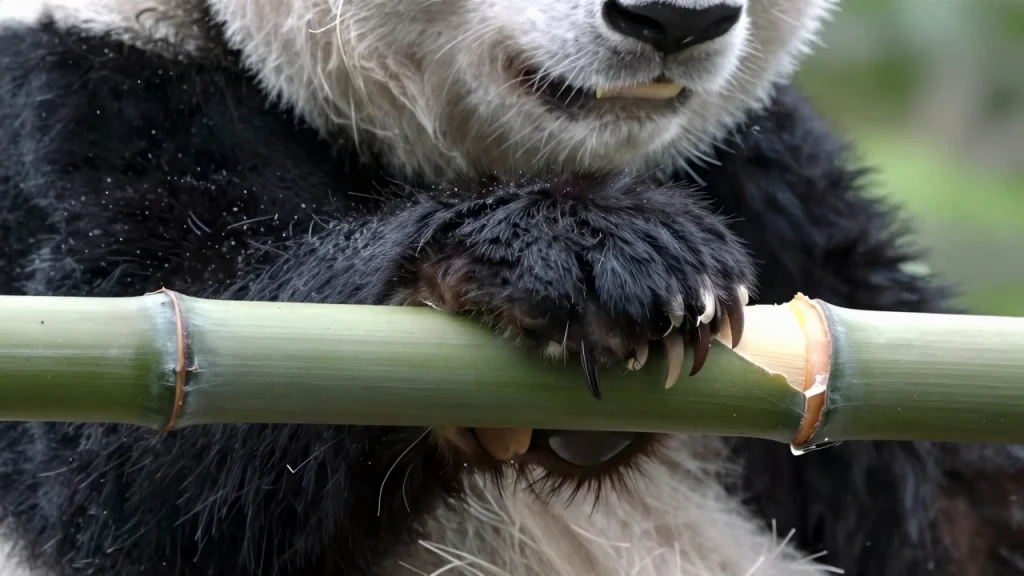
Five digits grasp the stalk, and an enlarged wrist bone, formally the radial sesamoid, does the rest of the holding. That bone is long and swollen, and it is capped with a fleshy pad of skin. Together they let the pseudo-thumb hold and manipulate bamboo almost as well as a human thumb does.
The grinding happens in the head. A powerful mandible meets a set of flattened teeth to bite and chew the stalk, and heavy jawbones and cheek muscles supply the crushing force that breaks it down.
The occasional non-bamboo meal
Grass, bulbs, fruit and insects all turn up in the record, and so do rodents and carrion. Meat is not excluded either: researchers have confirmed that pandas retain the ability to eat it, both in the wild and in captivity.
Part of that sits in the genome. Umami is the savory taste of protein-rich food such as meat, and the panda’s gene for detecting it, TAS1R1, has been reduced to a pseudogene. The mutation behind it was small, an insertion of 2 bp in one exon paired with a deletion of 6 bp in another.
How a carnivore turned into a bamboo specialist
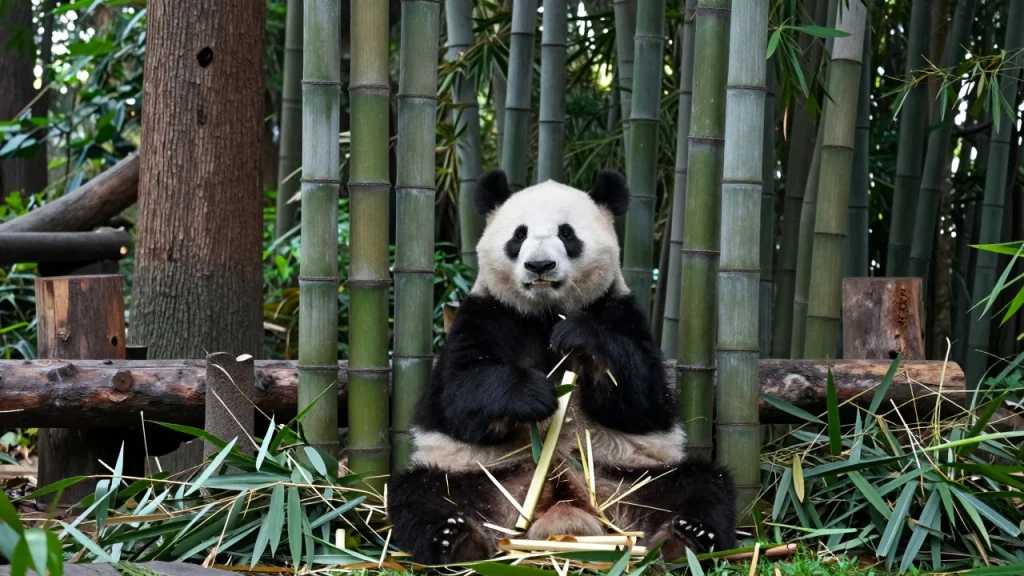
The switch happened deep in evolutionary time. Estimates put the first bamboo feeding at least 7 million years ago, and the point at which the animal became an exclusively bamboo-eating species at roughly 2 to 2.4 million years back. Living on such a monotonous diet has driven morphological, ecological and genetic adaptation in the species.
What managed pandas are fed
A zoo diet keeps the bamboo and rounds it out. At the Smithsonian’s National Zoo, the pandas receive bamboo along with highly nutritious biscuits, carrots and apples. The San Diego Zoo works at a far bigger scale, offering several hundred pounds of homegrown bamboo daily, with horticulture crews harvesting nearly a dozen bamboo species on six acres of dedicated land.
When the bamboo supply fails
Bamboo has an awkward life cycle. All the plants of a single type in one area bloom and die together, and a die-off forces the pandas to look elsewhere. Good panda habitat therefore needs several different varieties of bamboo, and a panda range needs old-growth conifer with a minimum of two bamboo types plus dependable water access. Old-growth stands earn their place for another reason: the empty logs and stumps they hold are big enough to serve as dens for raising cubs, and they shelter the bamboo as well.
A climate problem sits on top of the biological one. Bamboo colonizes new ground slowly, and it may not reach higher ground or new latitudes as fast as the pandas that rely on it. Land use adds its own pressure, because the range has shrunk and become highly fragmented, and a panda cannot always walk to a fresh stand. Chinese scientists put the remaining wild population at about 1,864 animals. Protection runs through 67 giant panda reserves in China, set up to keep panda habitats from further development, and natural corridors link some of them together. The species is currently listed as Vulnerable, a category it moved into in 2016, when it had previously been categorized as Endangered.
Strip the forest away and the species has nothing else to fall back on, because giant pandas specialize in eating bamboo above all.
So the answer to what a giant panda eats is simple and strange: bamboo, and a great deal of it. The remarkable part is the mismatch between the food and the animal. A digestive tract built for meat, enzymes and microbes that recover only a fraction of what bamboo holds, and a food plant that flowers and dies all at once all push the same way, towards an animal that spends its life eating and walking to the next stand.
What types of bamboo do giant pandas eat?
A study in Scientific Reports indicates that in the Qinling Mountains, where nine bamboo species across five genera are documented, the animals prefer Bashania fargesii and Fargesia spathacea. Smithsonian’s National Zoo reports that for pandas Qing Bao and Bao Li, arrow bamboo (Pseudosasa japonica), a thin-stalked type with abundant leaves, seems to be their strongest preference, while pandas Mei Xiang and Tian Tian are partial to yellow groove bamboo during winter and spring.
What do baby giant pandas eat?
Animal Diversity Web notes that nursing occurs up to 14 times a day and can last for up to 30 minutes. According to the San Diego Zoo Wildlife Alliance, a young cub tries tasting bamboo at five to six months but continues nursing until roughly 18 months old. For nursery-raised twins, combining mother’s milk with supplemental formula dramatically improves survival.
Sources
- San Diego Zoo Wildlife Alliance: Giant Panda | San Diego Zoo Animals & Plants
- Smithsonian’s National Zoo: Giant panda
- Smithsonian’s National Zoo: Giant Panda FAQs
- mBio, American Society for Microbiology: The Bamboo-Eating Giant Panda Harbors a Carnivore-Like Gut Microbiota, with Excessive Seasonal Variations
- Peer-reviewed article hosted on PubMed Central: Comparative genomics reveals bamboo feeding adaptability in the giant panda (Ailuropoda melanoleuca)
- WWF: Giant Panda climate change vulnerability assessment
- Scientific Reports: A Diet Diverse in Bamboo Parts is Important for Giant Panda (Ailuropoda melanoleuca) Metabolism and Health
- Smithsonian’s National Zoo: To Keep the National Zoo Pandas Satisfied, Staff Prepare an Endless Supply of Bamboo
- Smithsonian’s National Zoo: Melodious Munches: Pandas and Bamboo Shoots
- Animal Diversity Web: Ailuropoda melanoleuca giant panda Information