
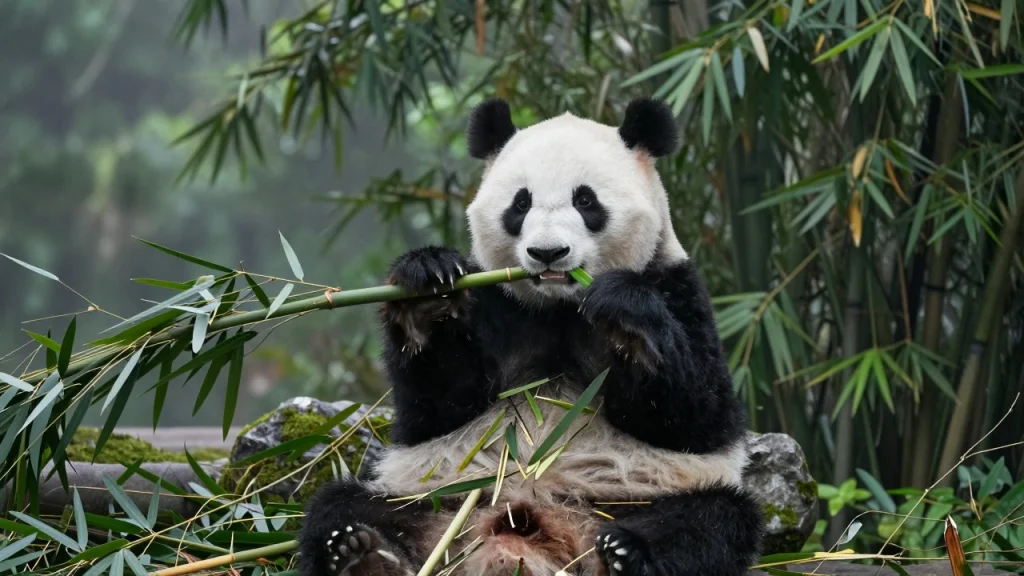
The animal that comes to mind when someone says panda is the black-and-white bear, and its formal name is Ailuropoda melanoleuca. Panda on its own is not a species name. It is a common word that ended up attached to two mammals belonging to different families, so the question has more than one honest answer.
The other animal is the red panda, Ailurus fulgens, a far smaller treetop creature with cinnamon red fur and a fluffy ringed tail. Both are called pandas today, yet the two trace their connection to a common ancestor that lived millions of years ago. The label was also attached to the small animal first, so the naming history runs opposite to the fame.
The red panda held the name first
Cuvier, a French zoologist, formally described the western red panda in 1825, and that happened 48 years before the black-and-white bear was catalogued. Anyone tracing the word panda backwards therefore meets the small animal before the famous one.
That is not just a quirk of dates. The two species sit in separate families, with the red panda alone in Ailuridae and the giant panda in the bear family Ursidae. Because the giant panda is much larger, biologists spent years describing the smaller species as the lesser panda, and they also filed it with the raccoons and their relatives in Procyonidae. DNA work later showed that the red panda represents a family which diverged from the rest of the carnivoran order, so taxonomists gave it Ailuridae to itself.
Where the word itself came from is genuinely unclear. One widely repeated theory derives it from the second part of an old Nepalese name, nigalya ponya, which may have meant something like bamboo footed. Another account traces the English word to French, which may in turn come from a Nepalese or Nepalese-Tibetan term describing how pandas eat bamboo. Either way the name points at a feeding habit rather than a family.
What the giant panda’s Latin name encodes
Scientific names come in two parts, genus first and species second, and both halves of this one point at things you can see in a live animal.
- Ailuropoda, the genus, refers to the way the panda’s feet help it feed on bamboo.
- melanoleuca, the species, refers to the black-and-white colour of its coat.
- The original combination was Ursus melanoleucus, published by Armand David in 1869.
- The genus itself dates to 1870, the same year a French zoological article printed the name giant panda for the first time.
The credit lines up with how the animal entered science. Père Armand David, a French missionary and naturalist, met the giant panda on an expedition to China in 1869 and sent descriptions and specimens to a museum in Paris, making the species known in Europe for the first time. Before the 1800s the animal was unknown outside China, and it reached European eyes only after trade opened the country.
Other languages avoid the bare word panda
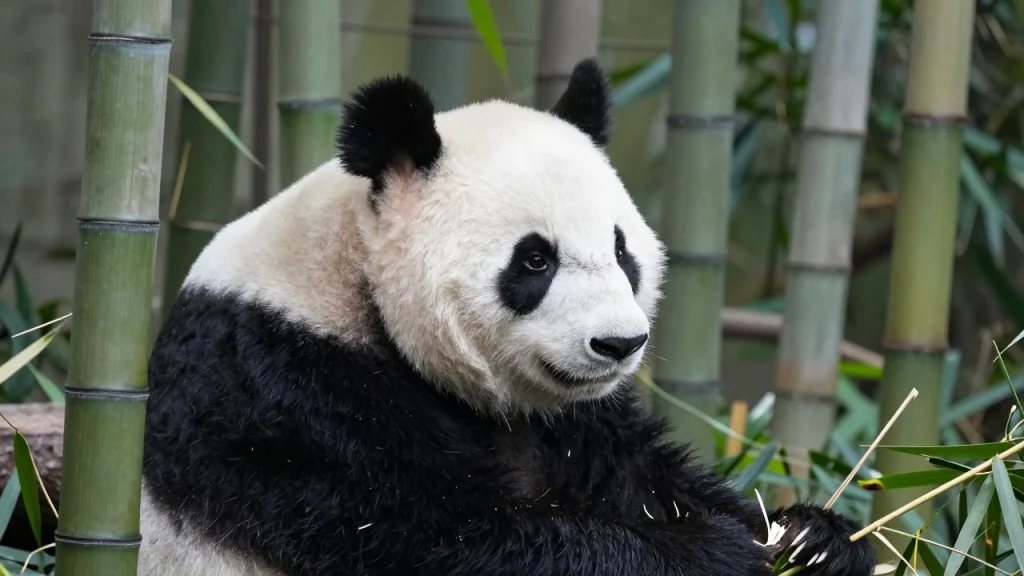
Neither the Chinese nor the German name contains the word panda at all. In Chinese the characters translate as large bear cat, and the German Bambusbär literally means bamboo bear. English has a whole shelf of names instead, among them panda bear, great panda, parti-coloured bear, bamboo bear and white bear.
Those modifiers do real work. The giant panda is firmly a bear, though it was for a time placed in Procyonidae alongside raccoons before the evidence settled the question. Getting the family right matters, because an animal filed under the wrong group inherits the wrong biology.
Why the two look more alike than they are
Both animals solve the same problem, holding bamboo, in the same way. Each has an enlarged wrist bone working as a false thumb, and in the giant panda that structure is not a real digit at all but a pad of skin overlying a wrist bone. Two unrelated mammals arriving at the same solution is textbook convergent evolution, and it is exactly the kind of shared trait that makes distant cousins look like close relatives.
Their menus overlap without matching. Giant pandas take the stalk or culm along with the leaves, whereas red pandas eat leaves only, and both feed on bamboo for a large part of the day. Where they live is different too: today the red panda survives only in small, isolated mountain territories above 4,000 feet, spread across China, Nepal, India, Bhutan and Burma.
The animal behind the name
Once the label is settled, the biology is more interesting than the naming.
Range. Pandas are native to central China and now live in a few mountain ranges in Sichuan, Shaanxi and Gansu provinces, with the biggest groups in the Minshan, Qinling and Qionglai ranges. They typically occupy temperate montane forest at altitudes of 1,500 to 3,000 m, and pandas have been living in bamboo forest for several million years.
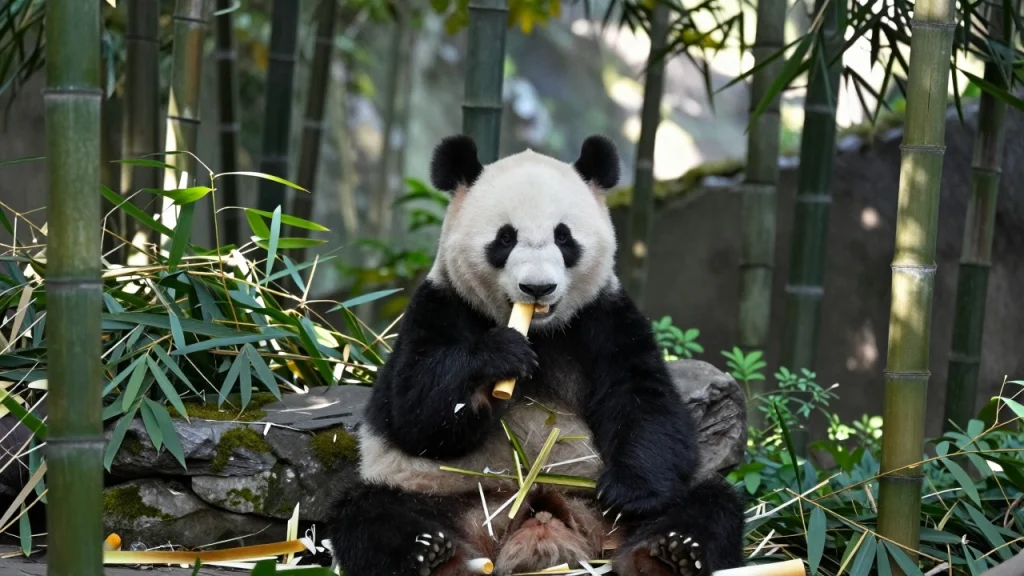
Diet. Bamboo is effectively the whole menu, making up over 99% of what they eat. The plant is nutritionally poor, with little protein and much lignin and cellulose, and wild pandas digest an average of only 17% of the dry matter they swallow. That inefficiency is why they must eat up to 12.5 kg of bamboo per day, and their gut still works more like a carnivore’s than an herbivore’s. Classified in the order Carnivora, the animal has specialised on bamboo alone.
Feeding anatomy. The panda sits upright while eating, which leaves the front paws free to grasp stems. Its grinding molars and premolars are broader and flatter than those found in other bears, with heavy ridges and cusps, and powerful jaw muscles help crush the tough stalks.
Size. About as large as an American black bear: 2 to 3 feet (60 to 90 centimeters) at the shoulder, and a body length of 4 to 6 feet, or 1.2 to 1.8 meters.
Weight. Males are the larger sex, and wild males weigh up to 250 pounds (113 kilograms).
Lifespan. Scientists estimate 15 to 20 years in the wild, against roughly 30 years in human care.
Behaviour. Pandas are solitary and seasonal breeders, coming together only from March to May. Females give birth 90 to 180 days after mating, and cubs stay with the mother from about a year and a half to three years.
The current conservation status
Giant pandas are classed as Vulnerable on the IUCN Red List, and that status comes from the most recent assessment, made in 2016 under criteria C2a(i) and D1. Coming down from Endangered is real progress, but it is recent progress.
The wild figure everyone quotes comes from China’s Fourth National Survey, conducted from 2011 to 2014, which produced an estimated range-wide total of 1,864 giant pandas, not counting dependent young under 1.5 years of age. Around 600 more pandas live in zoos and breeding centres worldwide.
The reason a rising head count does not equal a secure species is fragmentation. The panda’s range is highly fragmented after centuries of human encroachment and the loss of forested habitat at lower elevations, and without more migration and connectivity many of those smaller populations face rapidly eroding evolutionary potential. The Qinling Mountains group is a distinctive genetic cluster, significantly different from the other mountain populations, having diverged about 0.3 million years ago.
Quick answers
- The famous black-and-white bear is Ailuropoda melanoleuca, the giant panda, a member of the bear family Ursidae.
- The small reddish one is Ailurus fulgens, the red panda, placed in a family of its own called Ailuridae.
- Which was named first: the red panda, described in 1825, decades before the giant panda reached European science.
- Where the word comes from: uncertain, possibly the tail end of a Nepalese term translated as bamboo footed.
- Current status: Vulnerable, with about 1,864 pandas counted in the wild during the latest national survey.
Sources
- IUCN Red List of Threatened Species: Ailuropoda melanoleuca (Giant Panda)
- Smithsonian’s National Zoo and Conservation Biology Institute: Giant panda
- San Diego Zoo Wildlife Alliance: Red Panda
- San Diego Zoo Wildlife Alliance: Giant Panda (Ailuropoda melanoleuca) Fact Sheet: Taxonomy & History
- San Diego Zoo Wildlife Alliance: The Panda in Red
- Animal Diversity Web: Ailuropoda melanoleuca (giant panda)