
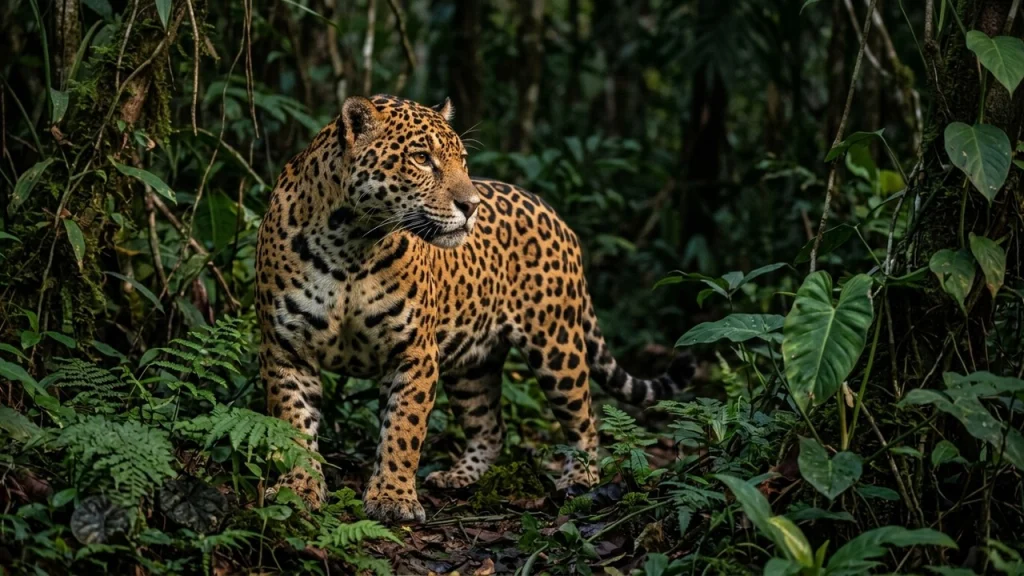
No, jaguars are not friendly to humans. These wild cats live alone, keep distance from neighbors and rely on camouflage to stay unseen.
That distant nature keeps most meetings uneventful, yet it does not make them harmless. Documented strikes are uncommon in natural habitat, but wounds are often life threatening, and wild individuals almost never strike unless provoked.
Why jaguars prefer to stay away from people
Solitary cats with private territories
Jaguars spend almost all of their lives on their own. Males join females only during mating periods, then separate again to patrol alone.
Each animal maintains a personal range. Female ranges cover around 25 to 38 square km, while male ranges can reach about twice that size.
Loud calls help owners warn rivals, guard ground and invite mates.
Jaguars rest in sheltered spots during bright hours and become most lively around dusk and dawn, though movement can happen at any hour. Dens are tucked into caves, narrow gorges and even crumbling structures.
Their coats blend into forest light, and quiet habits reduce notice by both prey and people.
How expert hunters view humans in the forest
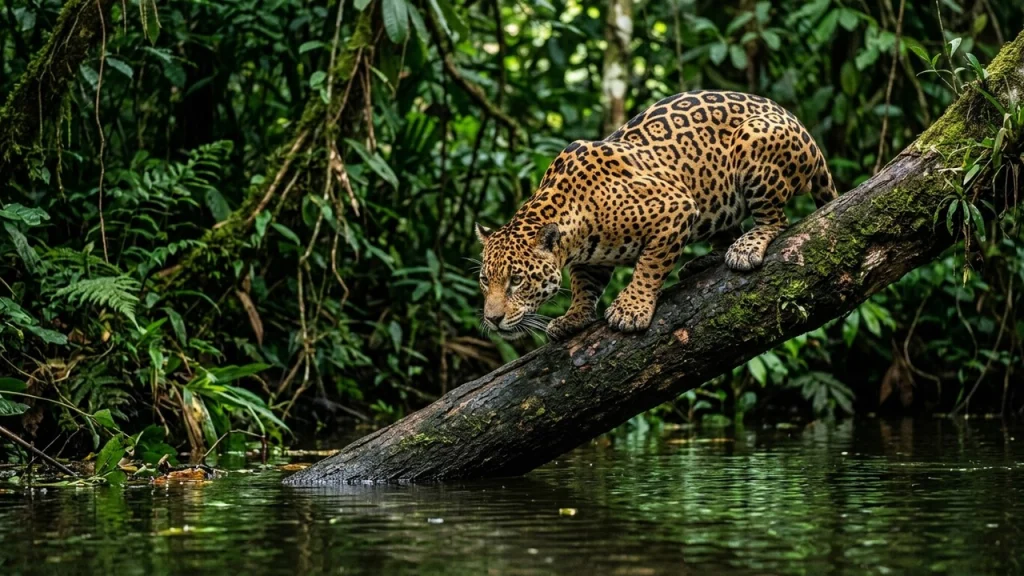
Ambush skills built for power, not chase
As the largest felines on the American continents and the sole regional member of the genus Panthera, jaguars carry heavy bodies designed for strength. Adults commonly fall between 68 and 136 kilograms in mass.
Among cats worldwide, only tigers and lions surpass them in size.
Instead of long pursuits, they crouch in thick cover and spring onto victims from hiding. Victims may be throttled with a throat grip or killed instantly when fangs punch through the rear of the cranium, a method that works even against thick skin and bone.
The head and teeth are exceptionally robust. That build can crack armored reptiles and drive straight through the shell of a turtle or the skull of a tapir or cow to reach the brain.
Water does not deter them. They enter rivers readily and swim well, so turtles, fish and even caimans become regular catches, secured when mighty jaws smash through bone and shell.
On land the menu is broad:
- capybaras, tapirs and deer taken by stealth after dark
- peccaries seized during night maneuvers in thick cover
- cattle attacked when wild food is scarce near ranches
- reptiles and fish adding variety through the year
In total the diet spans over 85 kinds of animals, among them capybaras, tapirs, deer, peccaries and cattle.
Night work favors them because they creep and leap under darkness rather than run down targets across open ground.
Their core stronghold lies in the Western Hemisphere, with dense numbers in Amazonian South America, especially Brazil. There they sit near the top of the food web, and mature animals face little danger except from humans.
People remain the main killers of jaguars.
When calm observation shifts to danger
Rare strikes with serious consequences
Sometimes a jaguar trails walkers for a short distance. Researchers interpret that behavior as escorting intruders beyond a boundary, not as curiosity or affection.
Risk rises where cats lose wariness. In places with regular boat visits and deliberate feeding, dread of people fades and bold approaches grow more likely.
How to share landscapes safely and support survival
Livestock, fear and habitat pressure
Hungry cats sometimes seize cows and other farm stock, and ranchers may respond by persecuting them. That cycle harms both livelihoods and cat numbers.
Survival is threatened mainly when people kill cats directly or shrink feeding opportunities by clearing and entering habitat.
Global listings rank the species as near threatened.
Conservation teams hope to lower human-jaguar conflict.
What to do during a sighting
- Stay calm and do nothing to provoke the cat, since wild jaguars do not attack people without provocation.
- Never feed or lure a jaguar, since feeding has made some lose their fear of people.
Free ranging jaguars survive 12 to 15 years, while zoo residents can reach 20 years. Females deliver 2 cubs on average, within a span of 1 to 4, after carrying them for 91 to 111 days.