
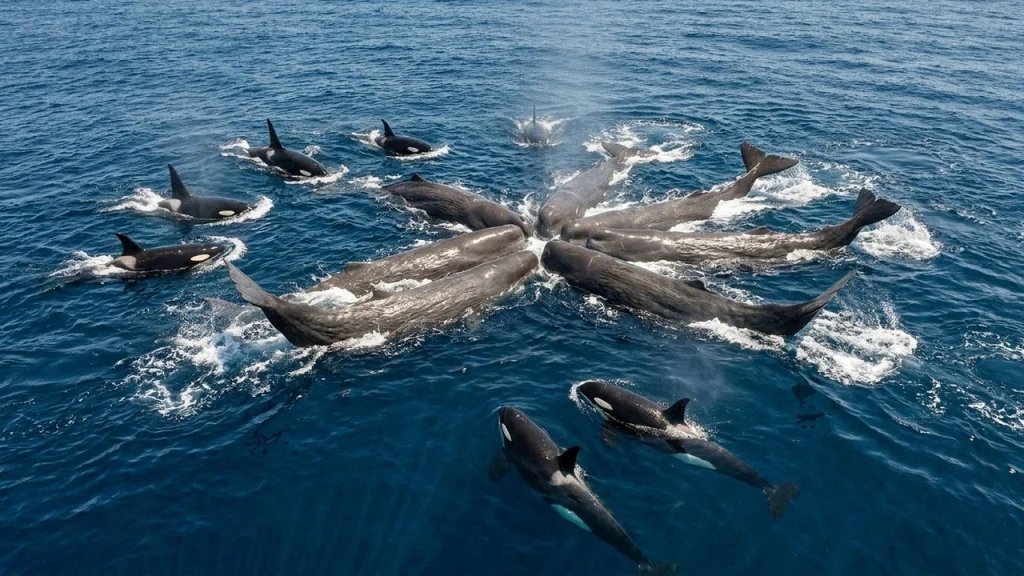
Sperm whales have almost no natural enemies. The only animal confirmed to kill a healthy adult sperm whale is the killer whale, and even that is not a species-wide campaign: the individuals attacked are calves, juveniles and the females travelling in family groups. The pressure that has really decided how many sperm whales there are came from a species with ships, harpoons and fishing gear.
That shortage of enemies is no myth: no toothed whale is bigger, and the species ranges through every deep ocean on the planet. Among ocean animals only two groups are serious generalist predators of cetaceans: killer whales and sharks. Killer whales, in other words, hunt big cetaceans, and among the toothed whales they take are adult females and juveniles, while sharks leave big whales alone.
Killer whales are the only dependable whale killer
For most of the twentieth century the evidence looked thinner than the reputation. When researchers pooled the published reports of killer whales attacking marine mammals, they could not document a single successful kill of a sperm whale, although calves and injured adults had been known to be attacked. Size, deep diving, group behaviour and heavy jaws were assumed to add up to immunity.
Field observations closed that gap. The best documented case, 21 October 1997, played out about 130 km west-southwest of Morro Bay, California, where the water was 4,400 m deep. For four hours the attackers worked in relays: grown females, some of them accompanied by calves, came in on the pod four to five at a time and broke off again, waiting about 10 minutes between attempts. Only adult female and immature killer whales joined in, while the three or more fully grown bulls present hung back at 100 to 2,000 m. Those bulls waited for the finish, and the last of them charged in to kill a badly hurt whale that had been dragged out of the ring. By the end one animal had been killed and eaten, and the survivors were hurt badly enough that some may not have survived.
A review drew on nine encounters with 49 unidentified killer whales offshore from California and Oregon between 1997 and 2021. Those animals were seen attacking a group of nine adult female sperm whales and left with a single victim, the earliest record of such an attack on the west coast. None of the 49 could be matched to a known group, and the authors propose either an offshoot of the transient population or an ocean population of its own, living off California and Oregon.
Who inside a group carries the risk
The pattern is consistent. Killer whales do not try to drag off a full-grown bull; they look for a way into the group. A mature male is also poor value as prey, since male anti-predator behaviour may be formidable enough to discourage attacks on something that offers so little. What is at risk is concentrated in family groups that average 12 adult females with their young, and calves arrive singly after 14 to 16 months of pregnancy, measure about 13 feet and keep nursing for several years.
Movement adds to the exposure. Growing males head poleward on long migrations through temperate water, while females and calves hold station in the tropics all year, so the groups sharing water with oceanic killer whales are the ones carrying calves. The biggest bulls go the other way and end up alone, since bachelor groups shrink as they age. Such encounters read as tests: the attackers work a group until something weak shows.
Sharks and other toothed whales rarely finish the job
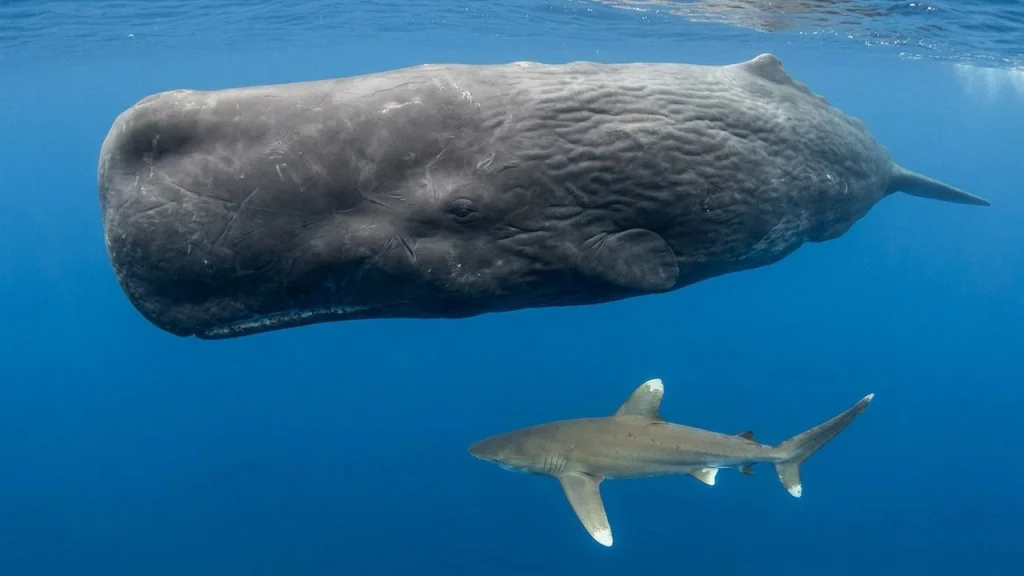
Sharks, the obvious second name on any list of whale predators, are not a serious threat here. They are no real danger to grown whales, although the tiniest calves can occasionally be at risk. The relationship more often runs the other way, since sperm whales eat sharks, and squid dominate a diet that also lists skates and deep-sea fish. Between 20 and 26 heavy teeth on each side of a narrow lower jaw, on a body whose head is a third of its length, is not easy prey for anything with cartilage.
Next come the smaller toothed whales. Short-finned pilot whales and false killer whales have been seen attacking sperm whale groups, and the animals that bit them took only minor wounds; in all of those cases the herd’s own behaviour was enough to send the attackers away. Those encounters look like harassment and testing rather than hunting, which is why sperm whales survive them far more often than killer whale attacks succeed.
How a pod defends itself
The famous answer is a rosette. Under attack the herd draws into a ring with noses pointing inward and flukes pointing out at the threat, so the only part of any body facing a killer whale is a tail. Heads are shielded in the middle, calves are covered by the adults around them, and a whale that has been bitten may be shuffled towards the centre out of reach. They rebuild the ring every time the attackers back away.
The formation suits small groups: 10 to 15 animals is about the limit at which the rosette is the best answer, and above that sperm whales pack into a tight flotilla instead. The other option is depth, since sperm whales and other deep divers can drop below the range killer whales can follow, and ordinary feeding dives already take them to about 2,000 feet for as long as 45 minutes. Neither defence is free, which is why the 1997 attackers spent four hours on a herd that never stopped rescuing its weakest members.
Sperm whales listen for danger first
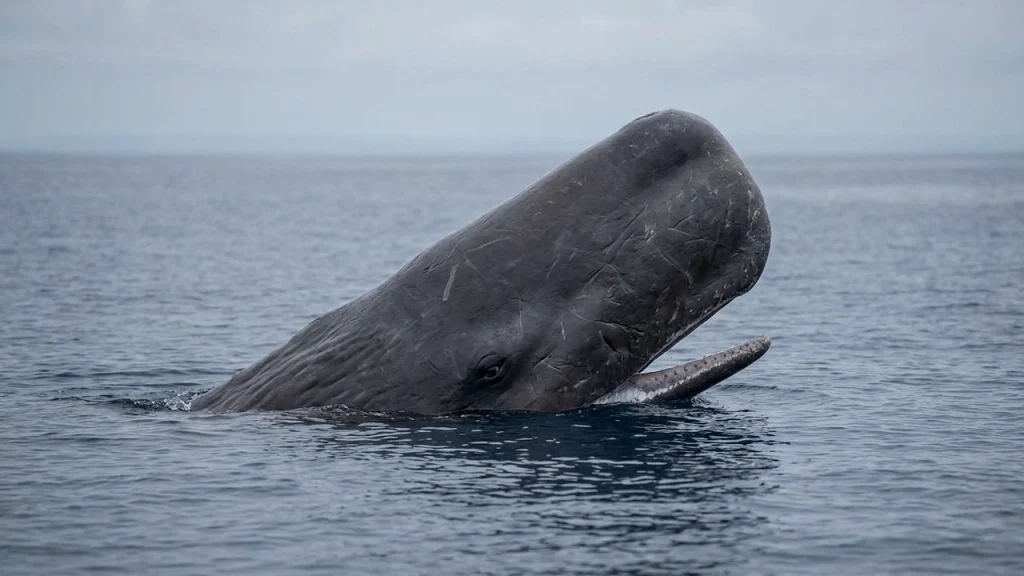
Killer whales hunt in groups and call constantly, and sperm whales can act on those calls before anything is seen. Researchers tagged five typically solitary males with multi-sensor tags and played recordings of mammal-feeding killer whales at them. Once a recording started, their dives came up shorter and shallower than their own pre-playback baseline, so the whales returned to the surface rather than going deeper. The four animals that had been hunting all but stopped clicking, one lifted its head clear of the water, a display known as a spyhop, as soon as it surfaced, and three of the five drew company, bunching at the surface and giving alerting sounds.
That is a costly choice: abandoning a deep, productive dive only makes sense if the sound signals real danger. At population scale, killer whale predation probably plays a small part in setting sperm whale numbers, but for one whale the effect is large. These males are not often attacked, yet they still stop hunting, surface and call others in.
The threat that actually decided the numbers
Predation is a rare cause of death for sperm whales. Whaling was not. Industrial whaling ran from 1800 to 1987 and left the species close to wiped out across its range, and an international moratorium on commercial whaling in 1986 did not undo that instantly. Numbers are thought to be rising again, but the recovery has been slow.
Today’s danger is diffuse rather than dramatic. A whale can get snagged in trap lines, pots or gillnets, and an animal towing gear risks exhaustion, lost feeding time and death. Vessel strikes are documented and underwater noise disrupts the sound communication these whales depend on.
Conservation status reflects that history rather than predator pressure. The IUCN Red List still rates the species Vulnerable, and United States law has treated it as endangered since 2 June 1970. Population modelling puts the world total at about 844,761 animals in 2022, against roughly 1,949,698 in 1711 before the whaling era, a fall of 48% across the three generations that conservation assessors measure.
What the record shows
So who eats sperm whales? Killer whales, almost always the same animals that hunt seals, dolphins and other whales, and only when a group offers an easier target than a lone giant. Sharks belong on the list only as an occasional risk to very small calves, while pilot whales and false killer whales are harassers that have never taken one. A healthy adult male has no known animal enemy, and the calves and the females that guard them carry almost all of the predation risk.
That imbalance explains why a whale this size is still hard to kill. The rosette, the silence, the deep dives, the listening for alarm calls and four hours of defending a neighbour all raise the cost of an attack above what most predators will pay. It is also why the number of recorded fatal attacks is so small, and why the history of sperm whales is overwhelmingly a history of what people did to them.
Sources
- UCLA / Marine Mammal Science: Killer Whale Predation on Sperm Whales: Observations and Implications (Marine Mammal Science, 2001)
- Scientific Reports: Responses of male sperm whales (Physeter macrocephalus) to killer whale sounds: implications for anti-predator strategies
- University of British Columbia: Shark-bitten orcas in the Northeastern Pacific could be a new population of killer whale
- NOAA Fisheries: Sperm Whale
- IUCN SSC Cetacean Specialist Group: Red List Updates Published for Sperm Whales and Lahille’s Bottlenose Dolphins
- Scientific Reports: Current global population size, post-whaling trend and historical trajectory of sperm whales