
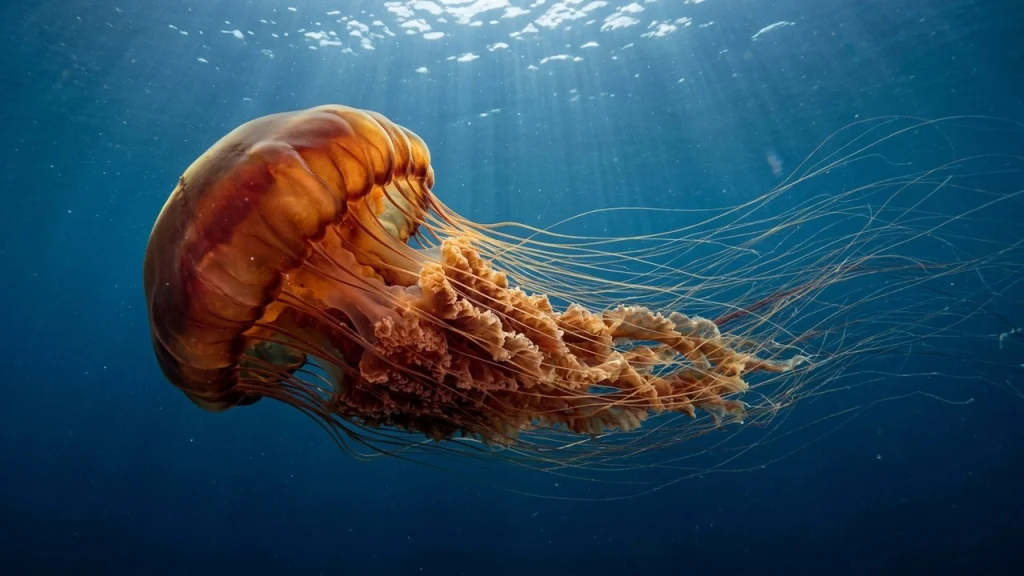
According to the Aquarium of the Pacific, the lion’s mane jelly ranks as the biggest representative among more than 200 species belonging to Scyphozoa, the true jellies. The institution notes that specimens inhabiting freezing Arctic and Antarctic waters attain bell widths of 3 m (7 ft) alongside trailing tentacles measuring 30 m (100 ft). In a separate finding, Plankton and Benthos Research highlights Nemopilema nomurai for its massive frame, recording an approximate maximum bell diameter of 2 m and a wet weight of 200 kg.
Typical dimensions across the wider lion’s mane population remain far below polar extremes. The Aquarium of the Pacific records that most individuals display bells spanning 30 to 61 cm (1 to 2 ft), accompanied by tentacles extending 1.8 to 2.4 m (6 to 8 ft).
Dimensions of the lion’s mane jelly across regions
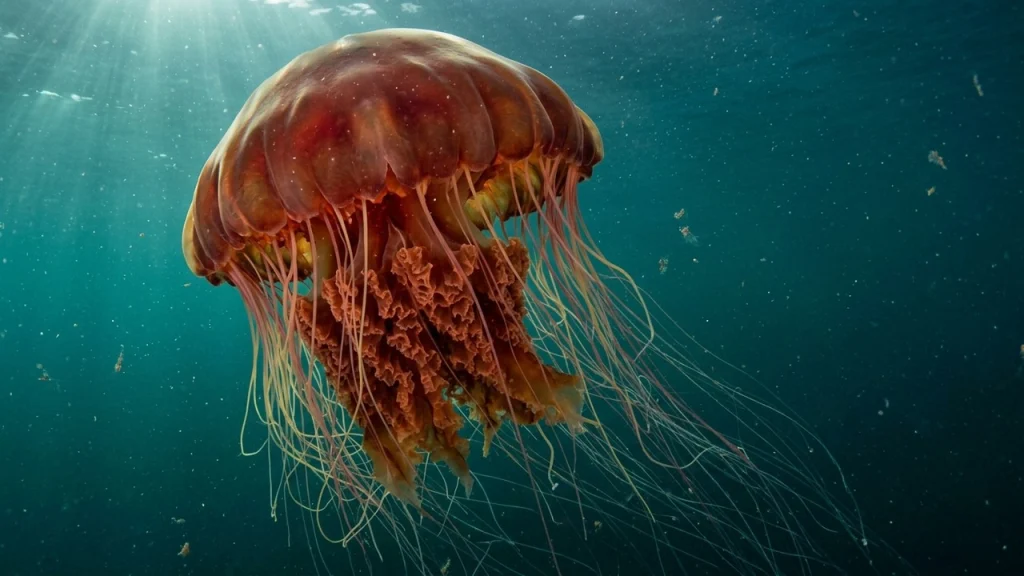
Size listings from wildlife organizations show considerable variation among individuals. National Geographic records that this animal can develop a diameter of 6.6 feet (2 meters), accompanied by strands exceeding 49 feet (15 meters). Monterey Bay Aquarium gives a typical bell span ranging from 19 inches (50 cm) to 3 feet (1 m), while its strands can extend past 100 feet (30.5 m). In records from Animal Diversity Web, the bell of Cyanea capillata generally spans 30 to 80 cm, though particular specimens reach an upper limit of 180 cm.
Regional temperatures align with differences in body scale. The Aquarium of the Pacific notes that jellies in northwestern and northeastern portions of the United States and Canada present bells reaching 51 cm (20 in) and tentacles measuring 9 m (30 ft). The same facility observes that representatives in warmer southeastern United States waters are the smallest, possessing bells of 13 to 15 cm (5 to 6 in) and tentacles spanning 2 to 7 m (7 to 9 ft).
Tentacle structure and size comparisons
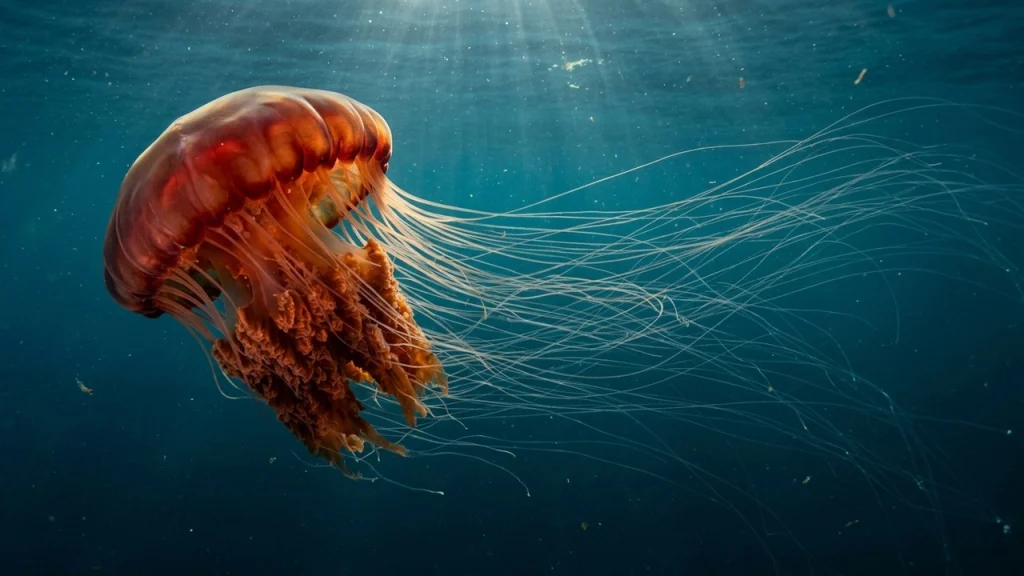
Extensive clusters of appendages emerge beneath the body. Animal Diversity Web documents eight groupings containing 150 tentacles apiece situated underneath the umbrella of Cyanea capillata. The Aquarium of the Pacific observes seventy to 150 clusters shaped like horseshoes distributed across four distinct rows suspended below the subumbrella.
Monterey Bay Aquarium compares this tentacle span to other ocean life, indicating it exceeds a 90 foot (27.4 m) blue whale yet falls short of the 130 feet (39.6 m) reached by a giant siphonophore.
Geographic distribution and heavy rhizostome species
The lion’s mane jelly occupies diverse cool-water environments across the globe. The Aquarium of the Pacific indicates that it occurs almost worldwide, avoiding only tropical zones, while inhabiting coastal waters described as cold, temperate, and subtropical. Monterey Bay Aquarium documents an Arctic and North Pacific range stretching from Alaska down to Washington, with uncommon sightings in California. Animal Diversity Web records the presence of Cyanea capillata throughout cooler waters of the Baltic, North Sea, Atlantic, and Pacific, pointing out strong prevalence along the eastern coast of Britain.
Substantial mass also appears within other jellyfish lineages. Plankton and Benthos Research observes that the rhizostome species Nemopilema nomurai is restricted entirely to East Asian Marginal Seas, encompassing the Yellow, Bohai, Japan, and East China Seas.
Sources
- Aquarium of the Pacific: Lion’s Mane Jelly (Cyanea capillata)
- Monterey Bay Aquarium: Lion’s mane jelly
- Animal Diversity Web: Cyanea capillata (Lions mane)
- National Geographic: Colossal Sea Creatures
- Plankton and Benthos Research: Blooms of the giant jellyfish Nemopilema nomurai: a threat to the fisheries sustainability of the East Asian Marginal Seas
- Point Defiance Zoo & Aquarium: Jellyfish