
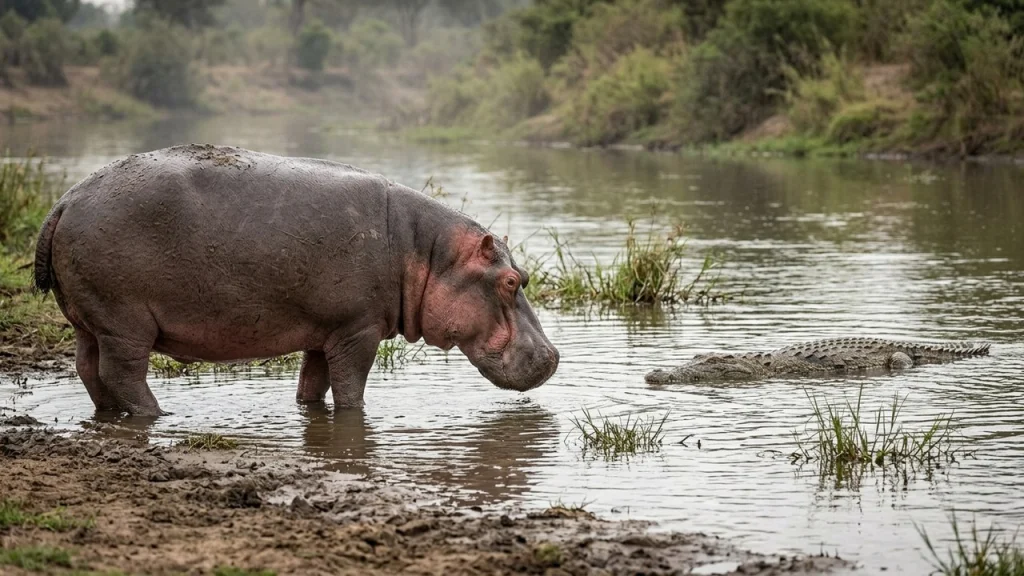
According to National Geographic, fish constitute the primary diet of the Nile crocodile, yet the reptile attacks nearly anything crossing its trail, including zebras, small hippos, porcupines, birds, and other crocodiles. None of the zoo, wildlife agency or research sources behind this article records a combat outcome between an adult hippopotamus and a Nile crocodile.
Shared waters and daily routines
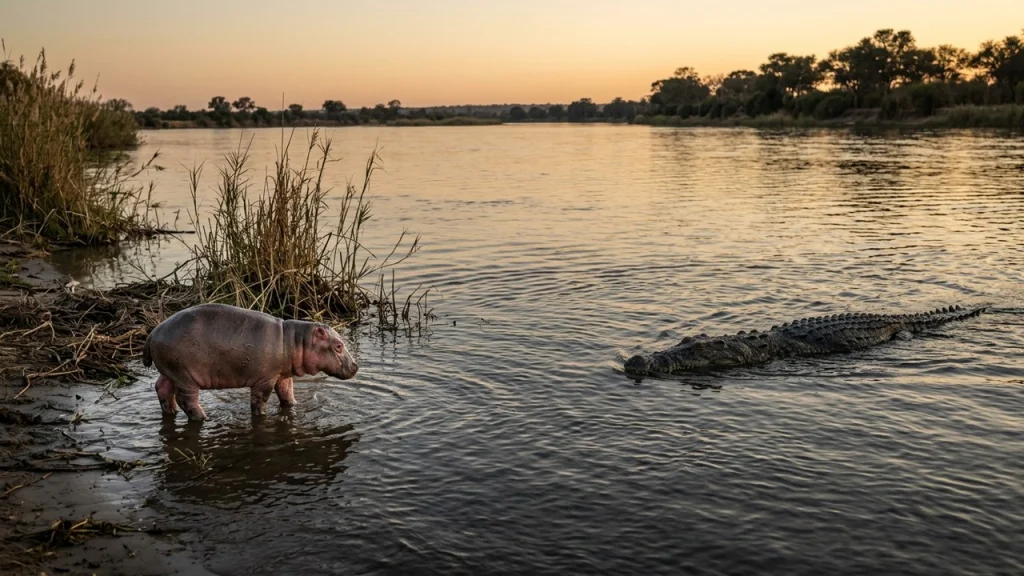
Animal Diversity Web states that hippos are semi-aquatic mammals, usually living in shallow lakes, rivers, and swamps. In the daytime, herds prefer sleeping closely grouped together in shallow water or sometimes on mud banks. When dusk arrives, hippos depart these resting waters along familiar trails.
National Geographic reports that Nile crocodiles live in rivers, freshwater marshes, and mangrove swamps throughout sub-Saharan Africa, the Nile Basin, and Madagascar. The San Diego Zoo Wildlife Alliance explains that crocodilians venture ashore only to lay eggs or bask on sandbars and river banks.
Body mass and physical dimensions
Animal Diversity Web reports that hippopotamuses weigh between 1,300 and 3,200 kg, measure from 209 to 505 cm long with a tail of about 35 cm, and stand 150 to 165 cm tall. The San Diego Zoo Wildlife Alliance lists “Weight: Females, 3,000 pounds (1,400 kilograms) average; males, 3,500 to 9,920 pounds (1,600 to 4,500 kilograms)”. The database adds that the heaviest recorded hippo was a captive Munich male at 4,500 kg.
For the reptile, National Geographic notes that the Nile crocodile reaches a maximum size of about 20 feet and up to 1,650 pounds. Average sizes for the species center near 16 feet and 500 pounds.
Jaws, teeth, and defensive behavior
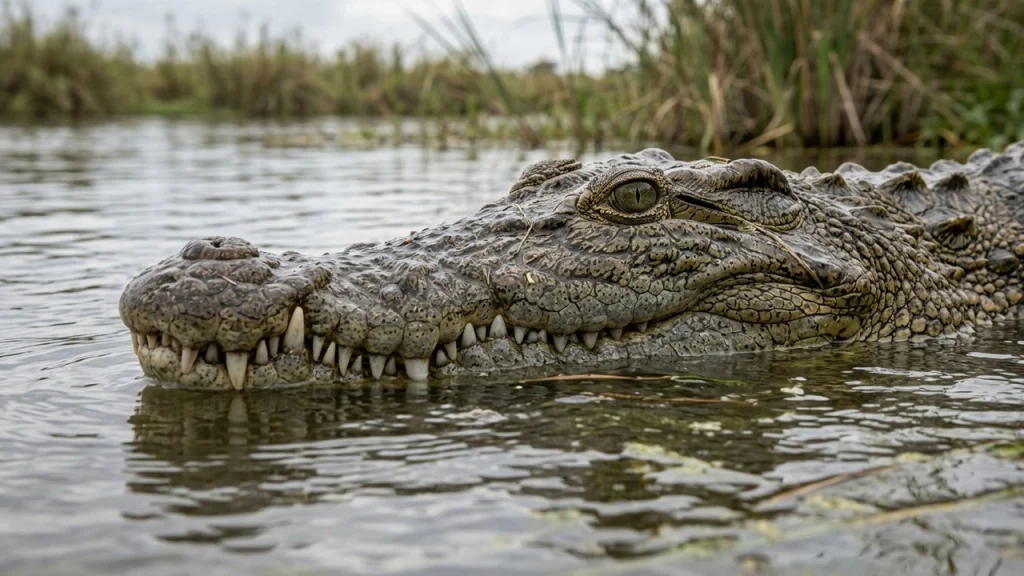
The San Diego Zoo Wildlife Alliance states that in crocodilians the greatest power is exerted when snapping the jaws shut, while large-jawed species can produce bite force of up to 5,000 pounds per square inch of pressure. Tooth counts present at one time range from 60 in the slender-snouted crocodile to 110 in the gharial, and the San Diego Zoo Wildlife Alliance states that crocodilians may cycle through 8,000 teeth over their lifetime.
The San Diego Zoo Wildlife Alliance reports that hippo canine and incisor teeth grow continuously. Canines reach 20 inches (51 centimeters), according to the zoo. Animal Diversity Web notes that incisors grow to 40 cm, and male tusks measure twice as long as female tusks. Hippos do not chew meals with these teeth, instead tearing and softening grass to avoid losing nutrients. The San Diego Zoo Wildlife Alliance reports that when rival male hippos confront one another, they stand snout to snout while opening their jaws as widely as possible, up to a 150-degree angle.
Locomotion and diving stamina
Animal Diversity Web states that “On land, they are able to move at speeds up to 30 km per hour and can maintain these speeds for several hundred meters.” The San Diego Zoo Wildlife Alliance states that “crocs can swim up to 20 miles per hour (32 kilometers per hour) and can run on land as fast as 11 miles per hour (17.6 kilometers per hour) for short distances if they need to”.
For submerged breath-holding, crocodilians can stay underwater for more than an hour, according to the zoo. The San Diego Zoo Wildlife Alliance states that an adult hippo can hold its breath for five minutes or longer while submerged underwater.
The zoo ranks hippos among the most dangerous and aggressive of all mammals. The wildlife database records that female hippos carry out most attacks on humans and other animals when protecting calves or prior to birthing, while males protect herd members and frequently attack anything posing a threat.
Sources
- Animal Diversity Web, University of Michigan: Hippopotamus amphibius (hippopotamus) | INFORMATION | Animal Diversity Web
- San Diego Zoo Wildlife Alliance: Hippo | San Diego Zoo Animals & Plants
- San Diego Zoo Wildlife Alliance: Crocodilian | San Diego Zoo Animals & Plants
- National Geographic: Nile Crocodile | National Geographic
- PLOS ONE (via PubMed Central): Human-common hippo (Hippopotamus amphibius)-conflict in the Dhidhessa Wildlife Sanctuary and its surrounding, Southwestern Ethiopia
- Animals (MDPI), via PubMed Central: Attitudes and Perceptions of Local Communities towards Nile Crocodiles (Crocodylus niloticus) in the Sudd Wetlands, South Sudan