
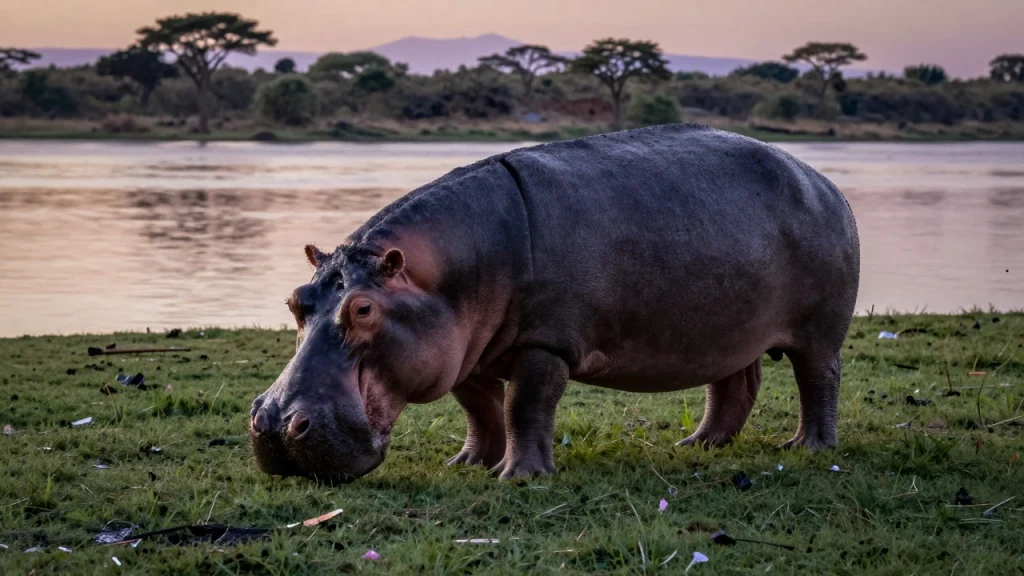
Hippopotamuses are primarily nocturnal herbivores whose diet consists almost entirely of short terrestrial grasses. Despite spending most of their daylight hours submerged in rivers, lakes, and swamps to keep cool, hippos rarely consume aquatic plants in significant quantities. Instead, when twilight falls, these massive mammals leave the safety of the water to graze on dry land, often traveling several miles to find suitable pastures.
While their immense physical size might suggest an enormous appetite, hippos consume a surprisingly modest amount of food relative to their total body mass. On average, a hippopotamus eats about 40 kilograms (88 pounds) of grass each night, which represents about 1 to 1.5 percent of its body weight. This efficiency is made possible by their low-energy daytime lifestyle and a specialized digestive system that extracts maximum nutrition from fibrous plant matter.
The primary diet of hippopotamuses in the wild
The vast majority of a wild hippopotamus’s diet is made up of short turf grasses that grow on grasslands near rivers, lakes, and seasonal floodplains. Hippos prefer short, sweet grass species over taller, tougher vegetation because these plants are easier to crop and digest.
Although hippos spend almost all of their daylight hours wallowing in the water, water plants form a negligible portion of their daily nutritional intake. Their jaws and digestive systems are optimized for terrestrial grazing rather than filtering floating or submerged flora.
- Short grasses: The primary component of their diet, providing carbohydrates and fiber.
- Fallen fruits: Consumed opportunistically when hippos encounter fruiting trees near riverbanks.
- Reeds and sedges: Eaten occasionally when grass is scarce along river margins.
- Aquatic vegetation: Consumed only in minimal amounts or during severe food shortages.
Hippos return to the same grazing areas night after night, creating tightly cropped expanses of pasture often referred to as hippo lawns. These areas play a crucial role in savanna ecosystems by maintaining short-grass habitats that benefit other herbivorous species.
Nocturnal foraging and grazing behaviors
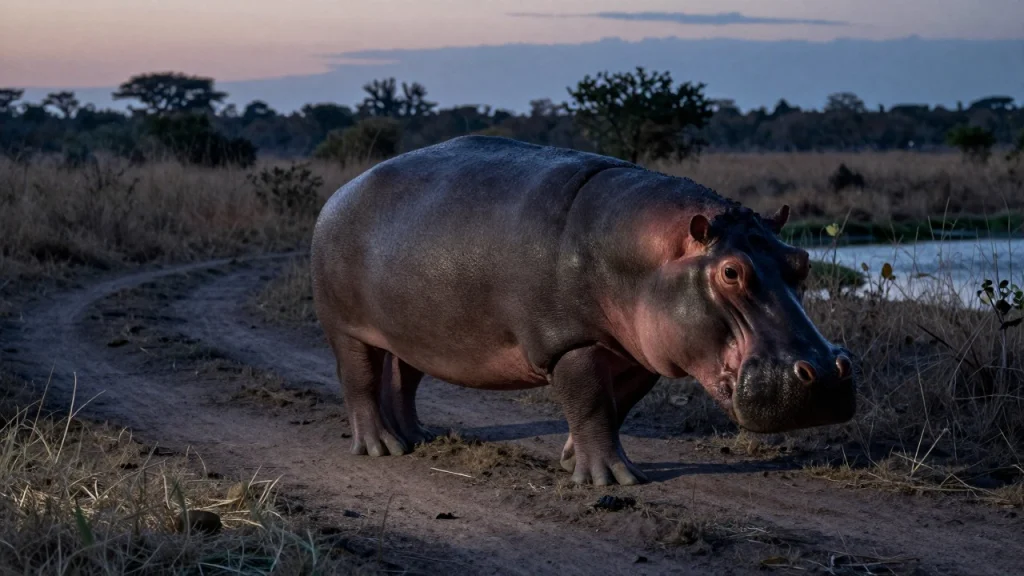
Hippopotamuses graze after leaving the water around dusk, when temperatures cool down. Remaining in the water during the hot African day protects their sensitive skin from sunburn and dehydration, allowing them to conserve vital energy for nighttime foraging.
To reach their feeding grounds, hippos follow well-worn paths known as hippo trails. These paths are sculpted over years of repeated use, carving deep channels into the landscape that connect water bodies directly to inland pastures. Hippos typically graze in circular patterns covering 3 to 4 kilometers each night, though they will travel several kilometers when food is scarce.
Unique grazing mechanics
Unlike many other mammalian grazers, hippos do not rely on their large, sharp canine teeth to gather food. Their formidable tusks are used almost exclusively for defense, combat, and establishing dominance within their pods.
Instead, hippos use their wide, tough lips to crop grass cleanly close to the ground. Their muscular lips act like a lawnmower, pulling grass into their mouths where flat molars grind the fibrous material before swallowing.
How the hippo digestive system processes food
The digestive anatomy of the hippopotamus is uniquely suited for processing large volumes of coarse plant material. Hippos are classified as non-ruminant foregut fermenters or pseudo-ruminants, meaning they possess a complex, multi-chambered stomach designed to break down tough plant cellulose.
In the closely related pygmy hippopotamus, the stomach has four chambers: the first three form the proventriculus and the fourth is the glandular stomach. This microbial fermentation breaks down structural carbohydrates into absorbable nutrients, allowing hippos to extract high levels of energy from nutrient-poor grasses.
Key features of hippo digestion
- Multi-chambered stomach: Uses microbial fermentation to break down fibrous plant cell walls.
- No cud-chewing: Unlike cows or giraffes, hippos do not regurgitate and re-chew their food.
- Slow transit time: Food stays in the digestive tract for an extended period, maximizing nutrient absorption.
- Low metabolic rate: Resting in water during the day drastically reduces caloric needs.
Because hippos spend their days floating weightlessly in water, they expend very little metabolic energy compared to other large terrestrial mammals. Consequently, hippos are characterized by a generally low food intake for their size.
Do hippopotamuses ever eat meat?
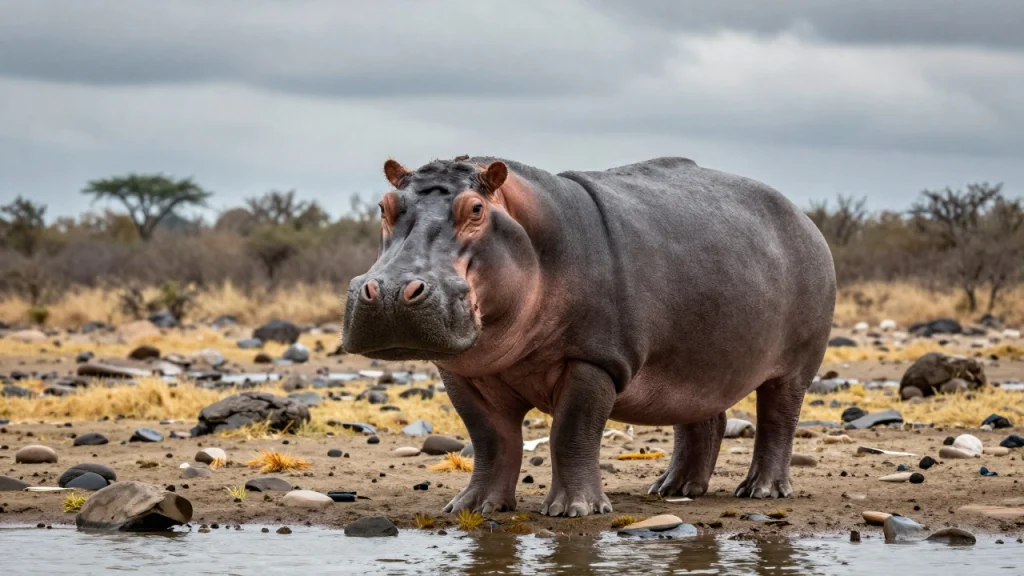
Hippopotamuses are anatomically and behaviorally specialized herbivores, but researchers have documented rare instances of hippos consuming meat or scavenging animal carcasses. These unusual events have sparked interest among wildlife biologists studying megaherbivore behavior.
Observational studies indicate that carnivory in hippos is extremely uncommon and typically occurs under abnormal environmental conditions. These behaviors are usually driven by severe drought, extreme food scarcity, or severe nutritional deficiencies in local populations.
Understanding opportunistic carnivory
When meat consumption does occur, it almost always involves scavenging on existing carcasses rather than active hunting. Hippos lack the predatory instincts, agility, and specialized dentition required to hunt live prey effectively.
- Nutritional stress: Scavenging usually coincides with intense droughts when grass supplies are depleted.
- Mineral deficiencies: Meat or bone chewing may provide missing dietary minerals like phosphorus.
- Aberrant behavior: Meat eating remains an anomaly rather than a standard component of hippo ecology.
While these incidents demonstrate behavioral flexibility under extreme stress, hippos remain classified as obligate herbivores whose survival depends almost entirely on healthy grassland ecosystems.
Dietary differences between common hippos and pygmy hippos
The hippopotamus family contains two living species: the common hippopotamus (Hippopotamus amphibius) and the smaller pygmy hippopotamus (Choeropsis liberiensis). While both are herbivores, their habitats and dietary preferences differ significantly.
Common hippos inhabit open savannas and river networks where grass is abundant. In contrast, pygmy hippos are native to the dense rainforests and swamps of West Africa, where open grasslands are virtually non-existent.
The pygmy hippo forest diet
Because pygmy hippos live beneath dense forest canopies, their diet consists primarily of forest vegetation rather than savanna grasses. They roam the forest floor individually at night, searching for a variety of plant matter.
- Fallen fruits: A major source of energy and moisture for pygmy hippos.
- Forest leaves and shoots: Browsed from low-hanging bushes and young saplings.
- Ferns and roots: Dug up using their snouts in damp forest soil.
- Semi-aquatic herbs: Foraged along the banks of forest streams.
This dietary divergence highlights how both species have adapted their feeding strategies to thrive in distinctly different ecosystems across the African continent.
Ecological impact of hippo feeding habits
The feeding habits of hippopotamuses extend far beyond their own survival, shaping the structure and health of ecosystems across sub-Saharan Africa. By consuming vast quantities of terrestrial grass and depositing waste in rivers, hippos act as vital ecological engineers.
At night, their selective grazing maintains short-grass habitats, preventing invasive scrub brush from overwhelming riverbanks. During the day, while resting in water, hippos excrete large amounts of nutrient-rich dung directly into river systems.
This transfer of organic matter and nutrients from land to water feeds aquatic microorganisms, insects, and fish populations. Through their daily cycle of terrestrial feeding and aquatic resting, hippopotamuses link land and water environments in sub-Saharan Africa, where their nutrient-rich dung sustains other species throughout the waterways.
Sources
- San Diego Zoo Wildlife Alliance: Hippo | San Diego Zoo Animals & Plants
- San Diego Zoo Wildlife Alliance: Pygmy Hippopotamus | San Diego Zoo Animals & Plants
- National Geographic: Hippopotamus, facts and photos | National Geographic
- Comparative Biochemistry and Physiology Part A: Intake, ingesta retention, particle size distribution and digestibility in the hippopotamidae
- Journal of Morphology: Comparative and functional morphology of the stomach in the adult and newborn pigmy hippopotamus (Choeropsis liberiensis)